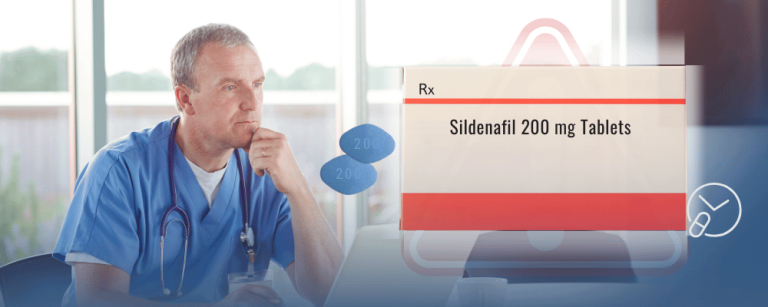
Sildenafil, one of the most commonly prescribed medications for erectile dysfunction, is well-known for its effectiveness. However, sometimes, men with treatment-resistant erectile dysfunction (ED) go beyond the standard 25-100-mg range and consider doses as high as 200mg.
Sildenafil: Standard Dosage
Regulatory authorities such as the FDA and international urological associations agree that for erectile dysfunction, the standard, safe, and scientifically backed dosage range for Sildenafil is 25 mg to 100 mg once per day. The best starting dose for most adults is 50 mg, with adjustments based on effectiveness and tolerability. If needed, physicians may raise the prescription to a maximum single dose of 100 mg, which is widely accepted as the Sildenafil max dose.
Effects of Sildenafil Higher Doses
Clinical trials on taking 200 mg of Viagra consistently show limited added benefits and a striking rise in unwanted symptoms. In clinical salvage trials designed for men who failed to respond to maximum standard therapy, a small group (about 22%) showed modest improvement in erectile function with 200mg compared to 100mg. However, even this improvement didn’t translate to a higher rate of successful intercourse, especially when compared with 150mg doses.
Short-Term Risks of Exceeding 100 mg
- Severe hypotension: Dizziness, fainting, and potential falls.
- Palpitations and reflex tachycardia: Increased heart rate as the body tries to compensate for falling blood pressure.
- Transient visual effects: Users often experience “blue vision,” light sensitivity, or blurred vision, with higher doses worsening these side effects.
- Sudden hearing loss: The FDA reports rare cases of sudden sensorineural hearing loss, sometimes permanent, at high doses.
- Priapism: The risk of a prolonged, potentially destructive erection (requiring emergency intervention) rises above 0.5% at doses beyond 100mg.
- These issues mean that taking 200mg of Viagra is not just a dosing question—it demands urgent caution and medical guidance.
Long-Term Effects & Cumulative Toxicity
- Photoreceptor apoptosis: Permanent damage and loss of cells crucial for vision, potentially irreversible.
- Retinal pigment epithelium changes: Associated with progressive visual impairment.
- Optic nerve ischemia: Clusters of cases suggest that excess Sildenafil can reduce blood supply to the optic nerve, causing sudden, sometimes irreversible vision loss.
- Vascular injury: While short-term, properly dosed use may have some beneficial effects on blood vessels, chronic misuse may worsen endothelial (vessel-lining) dysfunction.
Contraindications & High-Risk Cohorts
- Concurrent nitrate or riociguat use: The risk of catastrophic, untreatable hypotension is well-documented.
- Severe liver or kidney impairment: Such patients have a threefold or higher increase in drug levels, multiplying all side effects.
- Recent heart attack, class III-IV heart failure, or uncontrolled hypertension: The cardiac risks of profound blood pressure reductions are significant.
- Elderly patients (age > 65): Slower drug clearance and increased sensitivity to hypotensive effects magnify the risks.
- If you fall into any of these categories, high-dose Sildenafil is not just inadvisable—it could be lethal.
When Specialists Might Explore Higher Doses
- Refractory diabetic or post-prostatectomy ED: Only explored in highly controlled, specialist environments.
- SSRI-induced sexual dysfunction: In rare, open-label trials, Sildenafil between 80–200mg has been used for sexual side effects caused by antidepressants, but this is strictly off-label and closely monitored.
- To minimize risks in such scenarios, patients undergo hospital-based cardiovascular stress testing, regular follow-up, and comprehensive lab work.
Clinical Monitoring Checklist for ≥150 mg
- Baseline and periodic labs: Lipid panel, HbA1c (for diabetes risk), creatinine (for kidney function).
- Blood pressure and heart rate logs: Pre- and post-dose checks to monitor for hypotension.
- Fundoscopy: Baseline and follow-up eye exams to detect early retinal changes.
- ECG: Essential if there is any personal or family history of cardiac disease.
This comprehensive approach underscores that higher dosing is not intended solely for home experimentation but for highly specialized medical environments where safety can be closely monitored. Without such careful management, the answer to how much Sildenafil is too much is clear: anything above the standard ceiling puts your health at unnecessary risk.
Alternatives to Dose Escalation
Consider these evidence-based alternatives:
- Combination therapy: Using daily low-dose tadalafil (such as 5mg) plus “on demand” Sildenafil 50mg often produces better outcomes than simply taking more of a single drug.
- Mechanical and non-pharmacological therapies: Vacuum erection devices (VEDs) or intracavernosal injections (like alprostadil) offer effective alternatives for those not responding to pills.
- Lifestyle optimization: Achieving and maintaining a healthy weight, regular exercise, treating comorbid conditions like sleep apnea (with CPAP), and moderating alcohol can each substantially improve erectile function. Sometimes, optimizing these factors will make lower doses of Sildenafil work reliably.
- Medical review: Always consult your specialist if your medication is underperforming; secondary causes or drug interactions may be the real issue.
FAQs
Q1. Can two 100 mg tablets be taken together?
Q2. Does 200 mg last longer than 100 mg?
Q3. Is splitting one 100 mg pill safer than swallowing two 50 mg pills?
Q4. How soon after nitrates can Sildenafil be restarted?
Key Takeaways and Actionable Advice
- Raising the dosage to 200mg rarely improves outcomes but dramatically compounds risks to vision, cardiovascular health, and even longevity.
- If Sildenafil 100mg is not working, look for reversible factors or combination approaches; never self-escalate.
- When considering dose increases, specialist input is essential. New symptoms or side effects always warrant a professional review.
- For best effect, take Sildenafil 30–60 minutes before activity and avoid heavy/fatty meals that delay its onset.