Medical and regulatory note: This article is for general education to support safer, more compliant use of and purchasing of medicines. It is not medical or legal advice. Rules vary by EU country and by medicine type (prescription, controlled, cold-chain biologics, etc.). If you’re unsure, confirm with the destination country’s medicines authority and customs before ordering.
Deal in 5 minutes
What was announced (January 2026)
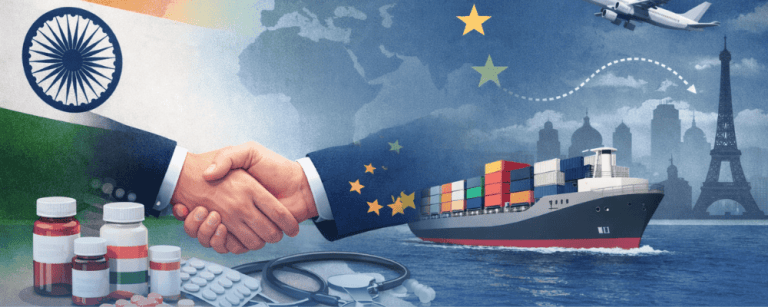
The India-EU Free Trade Agreement was officially signed on January 27, 2026, in New Delhi, following negotiations that restarted in 2022 after a nine-year pause.
Public summaries indicate a significant reduction in tariffs and trade barriers across many goods and services. Headline figures include India reducing tariffs on 93% of imports from the EU (by value) and the EU eliminating duties on 99% of Indian exports to the EU.
When does this take effect?
While the deal was signed in January 2026, full implementation requires ratification by the European Parliament and approval by individual EU member states. India's Commerce Minister expects the deal to come into force in 2026, but tariff reductions may be phased over several years.
Why this matters for healthcare
Trade rules influence the “behind the scenes” parts of healthcare: API sourcing, manufacturing inputs, lab supplies, packaging, and logistics. Reduced friction can improve supply resilience, but it does not override medical safety laws or prescribing standards.
What “tariff cuts” and “trade facilitation” mean in plain language
- Tariff cuts: lower import duties on certain categories (often phased over years).
- Trade facilitation: smoother procedures (documentation, customs coordination, predictability).
The deal eliminates EU tariffs of up to 11% on pharmaceuticals and reduces duties on nearly 90% of medical devices, lowering rates as high as 27.5% to zero.
What to watch next (important for patients)
Even after political agreement, there are typically steps like legal finalisation and ratification before full implementation. Reuters reporting notes the deal still requires legal vetting and is expected to be implemented within about a year.
What changes for pharma/APIs and cross-border supply
Potential impact on APIs and raw materials
The deal specifically addresses India's removal of tariffs on many EU industrial imports, including pharmaceuticals (currently around 11%), chemicals, and machinery, which can affect pharma input costs and capacity.
What this may mean over time:
- Some inputs and equipment could become less expensive to import (depending on the final tariff schedule and product category).
- Manufacturers may gain flexibility in supplier diversification, improving resilience.
Possible effects on finished medicines and health products
It's tempting to assume that lower tariffs automatically mean lower medicine prices. In reality, patient pricing depends on country pricing policies and reimbursement, distributor margins and procurement contracts, taxes and VAT rules, and regulatory requirements and quality controls.
Industry experts anticipate mild price reductions of 10-20% in the short term, with prices potentially dropping 40-70% over 2-3 years once local manufacturing scales up, biosimilars enter the market, and patent expiries align.
However, any price impact for individual patients is possible but not guaranteed.
Logistics and customs: where friction may reduce
Trade agreements often aim to reduce paperwork friction and delays. That can improve supply availability—but it won’t eliminate the need for lawful import documentation or product legitimacy checks.
What won’t automatically happen
- It won’t “legalise” importing prescription medicines for personal use across all EU countries.
- It won’t remove EU requirements for authorisation, verified supply chains, or anti-counterfeit measures.
- It won't eliminate the need for prescriptions, medical oversight, or clinical appropriateness checks, even for medicines that become cheaper.
What doesn’t change: EU medicine safety rules still apply
EU medicine authorization (why approval still matters)
In the EU, medicines generally must be authorised before marketing, including via the EMA’s centralised pathway for eligible products.
If a medicine isn’t authorised/available in a given country, access may be restricted even within the EU.
Anti-counterfeit protections (pack integrity + traceability)
EU anti-falsified measures include:
- Obligatory safety features on packs: a unique identifier and an anti-tampering device.
- A common EU logo for legally operating online pharmacies and retailers.
Online medicine sales: why national rules differ
Your Europe (EU) guidance is clear: there are no EU-wide rules on buying prescription medicine online; some countries allow it, some do not, so you must check the destination country’s national register.
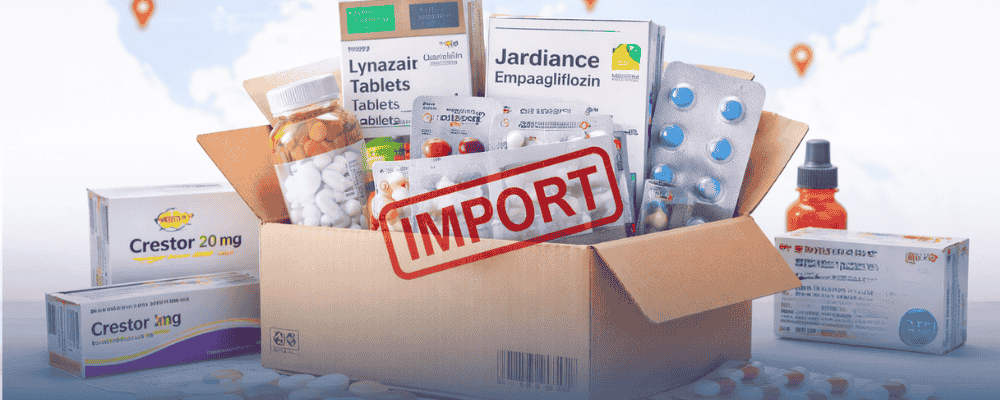
Why “ships to Europe” doesn’t mean “legal to import.”
A website offering shipping is not proof of:
- legality under the destination country’s rules,
- product authorisation status,
- safe supply chain controls.
From a patient safety perspective, that gap is where the risk of counterfeit and substandard products increases.
Personal medicine import guidelines (EU): what to check before you order
Step 1 — Confirm the destination country’s rules (especially for prescription medicines)
Start here: Does the destination EU country permit online purchases or imports of prescription medicines?
Check the country's national register of online medicine retailers.
Step 2 — Identify the medicine type (risk level matters)
Extra caution (and often stricter rules) apply to:
- controlled or narcotic medicines,
- injectables or biologics,
- cold-chain medicines (temperature-sensitive),
- medicines with high misuse potential.
Example of why this matters: the Netherlands notes that you can bring most medicines for personal use, but medicines with narcotic effects may require an official certificate.
Step 3 — Ensure clinical appropriateness (a medical safety checkpoint)
Before ordering, confirm with a qualified clinician:
- correct diagnosis and dose,
- interactions with existing medicines,
- allergy risks,
- suitability if pregnant, breastfeeding, elderly, or immunocompromised.
This step protects you even when the purchase is legal, because medication harm often comes from wrong drug / wrong dose / wrong patient.
Step 4 — Documentation checklist (reduce customs and safety risks)
Have these ready (digitally and printed where possible):
- a valid prescription (and preferably a clinician's letter summarising the indication and dose),
- product invoice/order confirmation,
- ID matching the recipient name,
- original label details (active ingredient, strength, dosing form).
Even within the EU, cross-border prescriptions can run into availability/authorisation differences.
Step 5 — Quantity: keep it clearly “personal use”
Order only what reasonably matches the duration of personal therapy. Very large quantities can be interpreted as commercial distribution and may be stopped. (Limits vary by country—verify locally.)
Step 6 — Packaging rules: insist on original, intact packs
From a patient-safety perspective, avoid:
- opened blisters,
- loose tablets,
- missing batch/expiry.
EU safety expectations emphasise pack integrity and verification features.
Step 7 — Shipping safety: temperature control and transit time
If a medicine needs refrigeration or is temperature-sensitive:
- Confirm validated cold-chain packaging and monitoring,
- Avoid long transit windows,
- Don’t use products that arrived warm/hot or with compromised packaging.
Step 8 — If customs holds/refuses a shipment
Common outcomes include:
- Request for documentation,
- return to sender,
- refusal/seizure (especially if rules are not met).
Do not attempt to “work around” a hold. Instead:
- provide requested documentation,
- Contact the destination country’s customs/medicines authority for guidance.
Check the country's national register of online medicine retailers.
Be cautious of websites that show these warning signs:
- No physical address or pharmacist contact information
- No prescription required for prescription medicines
- Prices significantly below market rates (too good to be true)
- Spelling or grammar errors, or unprofessional website design
- Pressure tactics or limited-time offers
- Payment only through untraceable methods (cryptocurrency, wire transfer)
- Claims of miracle cures or guaranteed results
Do/Don’t checklist (compliance-forward and patient-safe)
DO
- Do check the destination EU country’s rules and national register for online medicine retailers.
- Do use licensed pharmacies/retailers and verify the EU common logo where applicable.
- Do keep medicines in their original packaging, with visible batch/expiry dates and intact seals.
- Do keep a valid prescription and supporting clinician documentation.
- Seek medical advice before changing doses or brands, or starting a new prescription medication.
DON’T
- Don’t buy from sites that hide their address, skip prescription checks, or make “miracle cure” claims.
- Don’t import controlled/narcotic medicines without understanding the destination’s certification requirements.
- Don’t accept loose pills, broken seals, or missing batch/expiry information.
- Don’t assume a trade deal makes personal imports universally legal—EU countries can differ.
- Don’t use medicines that may have been heat-exposed or improperly stored in transit.
FAQs
Does the India–EU trade deal facilitate the import of personal medicines?
Not directly. The deal may reduce trade friction and tariffs across sectors over time, but personal import rules and medicine safety controls remain governed by EU/national regulations.
How can I verify a medicine is legitimate in the EU context?
Use licensed sellers, verify national registers where applicable, and rely on EU anti-falsification measures, such as pack safety features and the common logo framework.
Can I import prescription medicines into the EU for personal use?
It depends on the destination country. EU guidance clarifies that rules for buying prescription medicines online vary by member state, with no harmonized EU-wide framework.
Where can I check whether a medicine is authorised in the EU?
For centrally authorised products, EMA publishes public information, including EPARs and a medicines finder.
What if my medicine brand name differs from the EU version?
Even within the EU, the same active ingredient can have different names and may not be available everywhere. Confirm active ingredient, strength, and formulation with a pharmacist or doctor.
conclusion
The India–EU trade deal is a major economic step that may improve pharma supply dynamics over time—but patient safety and legality for personal imports still depend on EU/national rules, authorised supply chains, and verified quality controls. When in doubt, choose regulated pathways and confirm with local authorities before ordering.
Resources
- EU: Buying prescription medicines online (rules differ by country) [Click here]
- EU: Falsified medicines (safety features + online logo framework) [Click here]
- EMA: Authorisation of medicines (EU marketing authorisation overview) [Click here]
- WHO: Good Manufacturing Practice (GMP) standards (quality systems basics) [Click here]
- FDA: Drug approvals & databases (Drugs@FDA hub) [Click here]
- ISO: ISO 9001 quality management standard (overview) [Click here]