Description
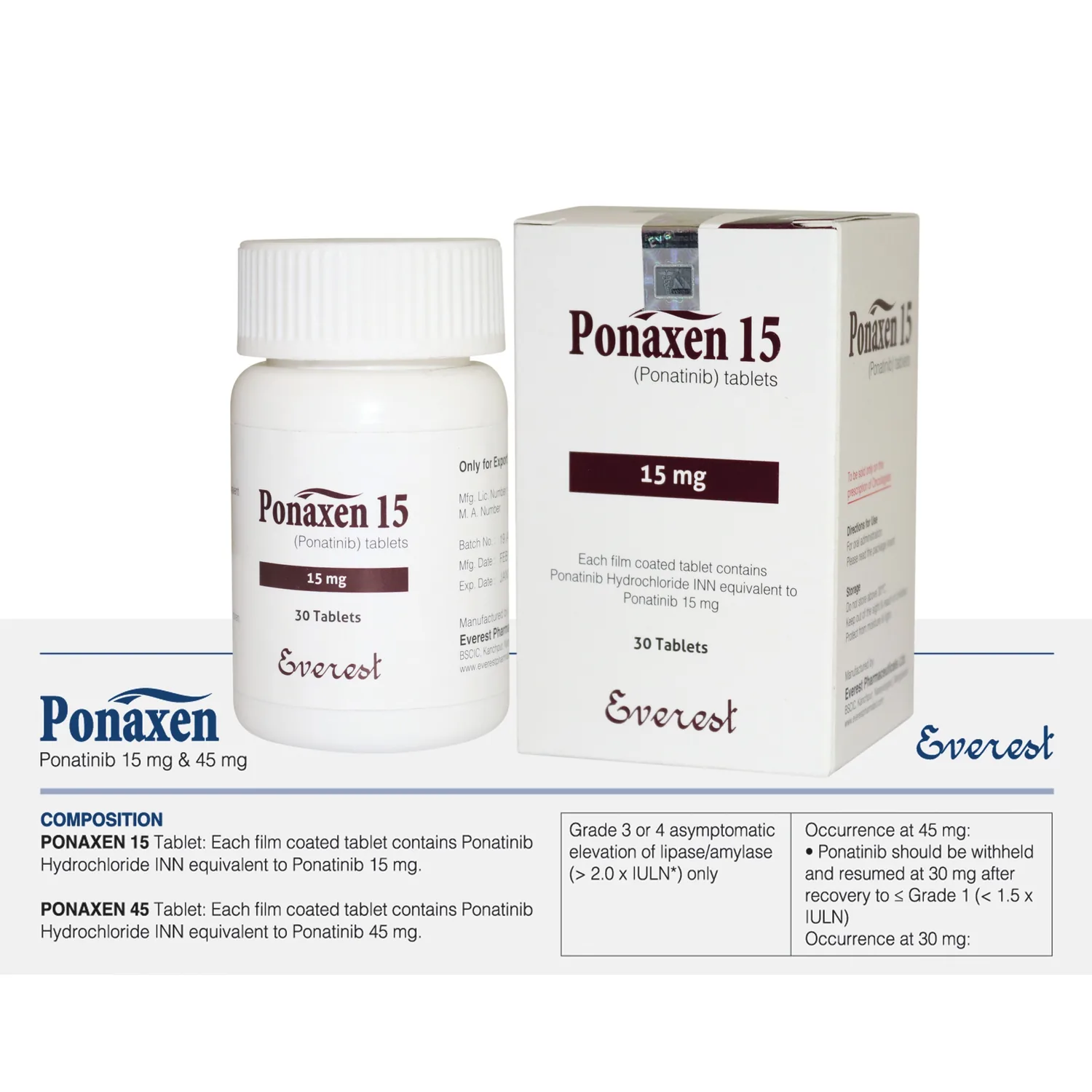
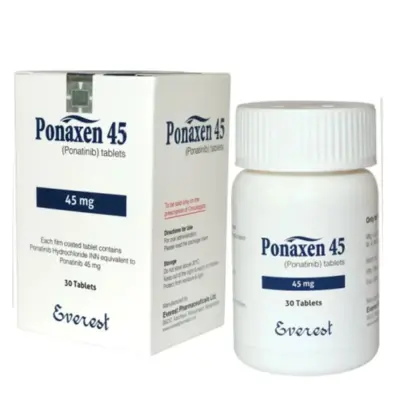
Ponaxen 15mg Tablet is a specialized, oral targeted anti-cancer medicine manufactured by Everest Pharmaceuticals Ltd. Each film-coated tablet contains:
-
Ponatinib Hydrochloride: Equivalent to 15 mg of ponatinib base
Ponaxen belongs to the pharmacological class of third-generation BCR-ABL tyrosine kinase inhibitors (TKIs) and multikinase inhibitors. It is prescribed under the supervision of hematologist-oncologists for adult patients diagnosed with specific resistant forms of leukemia, including Chronic Myeloid Leukemia (CML) and Philadelphia chromosome-positive Acute Lymphoblastic Leukemia (Ph+ ALL).
Ponaxen was developed to overcome severe resistance mutations that cause earlier targeted cancer therapies (such as imatinib, dasatinib, and nilotinib) to fail—specifically the T315I “gatekeeper” mutation. The 15 mg strength is a central clinical tool used as a reduced maintenance dose once a deep molecular response is achieved, or as an adjusted dose to manage vascular and hematologic toxicities.
Quick Product Fact Sheet
| Feature | Details |
| Brand Name | Ponaxen 15mg Tablet |
| Active Ingredient | Ponatinib Hydrochloride (equivalent to 15 mg ponatinib) |
| Manufacturer | Everest Pharmaceuticals Ltd. |
| Therapeutic Class | Antineoplastic agent / Targeted cancer therapy |
| Pharmacological Class | Third-generation BCR-ABL Tyrosine Kinase Inhibitor (TKI) |
| Dosage Form | Film-coated oral tablet |
| Standard Administration | Taken orally once daily, with or without food |
| Key Hallmark | Overcomes the BCR-ABL1 T315I resistance mutation |
| Packaging | Bottle or pack of 30 tablets |
How Ponaxen 15mg Works
Chronic Myeloid Leukemia and Ph+ ALL are driven by an abnormal chromosome rearrangement known as the Philadelphia chromosome. This genetic fusion creates an abnormal hybrid protein: BCR-ABL1 tyrosine kinase.
In healthy cells, cellular growth signals turn on and off in an orderly fashion. In CML, the BCR-ABL1 enzyme remains permanently switched “on,” sending continuous signals through intracellular pathways (including STAT5, AKT, and MAPK) that force bone marrow stem cells to produce excessive, uncontrolled, and dysfunctional white blood cells.
[Philadelphia Chromosome Genetic Fusion (BCR-ABL1)]
                          │
                          ▼
    [BCR-ABL1 Tyrosine Kinase Permanently Activated]
                          │
       [PONAXEN 15mg (Ponatinib) STEPS IN]
    • Inserts its carbon-carbon triple bond (ethynyl linker)
    • Binds deep inside the ATP-binding pocket
    • Circumvents the bulky Isoleucine 315 side chain
                          │
                          ▼
    [Enzyme Autophosphorylation Blocked Completely]
                          │
                          ▼
[Leukemic Cell Proliferation Halted + Apoptosis (Cell Death) Triggered]
Overcoming the T315I “Gatekeeper” Mutation
-
The Resistance Problem: First- and second-generation TKIs (like imatinib, dasatinib, and nilotinib) rely on fitting into the ATP-binding pocket of the BCR-ABL kinase. A common point mutation changes an amino acid at position 315 from threonine to isoleucine (T315I). Isoleucine has a bulky hydrocarbon side chain that blocks older drugs from entering the pocket.
-
The Ponatinib Solution: Ponatinib was designed using structure-based drug design. It features a rigid carbon-carbon triple bond (ethynyl link) that navigates around the bulky isoleucine side chain, allowing the drug to bind deep within the pocket despite the mutation.
-
Multikinase Reach: In addition to BCR-ABL, ponatinib inhibits related kinases that promote tumor survival and angiogenesis, including VEGFR, PDGFR, FGFR, KIT, and RET.
Approved Medical Uses
Ponaxen 15mg is indicated for adult patients in the following specific oncology settings:
-
Chronic Phase CML (CP-CML) with Prior TKI Resistance: Treatment of adult patients with chronic phase CML who have developed resistance or unacceptable intolerance to at least two prior tyrosine kinase inhibitors.
-
Accelerated Phase (AP-CML) or Blast Phase (BP-CML): Treatment of advanced-stage CML for whom no other kinase inhibitor is clinically indicated.
-
T315I-Positive CML or Ph+ ALL: Indicated for CML (in any disease phase) or Philadelphia chromosome-positive Acute Lymphoblastic Leukemia harboring the T315I mutation.
-
Ph+ ALL Monotherapy: Treatment of adult patients with Ph+ ALL for whom no other kinase inhibitor therapy is suitable.
-
Dose-Reduced Maintenance Therapy: Used at the 15 mg dose level for patients who started at higher doses (45 mg or 30 mg) and successfully achieved a major molecular response (such as 1 percent or less BCR-ABL1 on the International Scale).
Important Limitation: Ponaxen is not recommended for newly diagnosed chronic-phase CML because of the risk of serious vascular adverse events compared to first-line options.
Standard Dosage and How to Take
Ponaxen dosing is individualized based on disease stage, baseline molecular testing, response milestones, and tolerability under the direct care of an oncologist.
Standard Clinical Dosing Framework
| Disease Stage / Indication | Typical Starting Dose | Role of the 15mg Tablet |
| Chronic Phase CML (CP-CML) | 45 mg once daily | Step-down maintenance dose: Once a patient reaches 1 percent or less BCR-ABL1 (IS), the dose is typically reduced to 15 mg once daily to lower long-term vascular risks while sustaining remission. |
| Accelerated / Blast Phase CML | 45 mg once daily | Used as a downward dose adjustment (to 30 mg or 15 mg daily) if severe hematologic or non-hematologic toxicity occurs. |
| T315I-Positive CML (All Phases) | 45 mg once daily | Dose reduction to 15 mg daily is evaluated after achieving deep molecular response. |
| Ph+ ALL (Monotherapy) | 45 mg once daily | Continued under close monitoring; reduced to 15 mg daily if adverse events arise. |
Administration Instructions
-
Swallow Whole: Swallow the tablet whole with a full glass of water. Do not chew, crush, split, or dissolve the tablet.
-
With or Without Food: Ponaxen can be taken with or without meals.
-
Daily Consistency: Take your tablet at the exact same time every day to maintain consistent medicine levels.
-
Missed Dose Protocol: If you miss a dose, skip that dose and take your next tablet at your regularly scheduled time the following day. Never take two tablets at once to make up for a missed dose.
Serious Warnings and Critical Safety Precautions
Ponatinib carries class-leading safety warnings that require strict oncology monitoring throughout therapy.
1. Arterial Occlusive Events (Blood Clots in Arteries)
Ponatinib can cause serious arterial blood clots, including heart attacks, strokes, severe narrowing of leg or arm arteries (peripheral artery disease), and the need for emergency revascularization procedures.
-
Risk factors include older age (65 years and older), history of high blood pressure, diabetes, high cholesterol, or prior vascular disease.
-
Patients must be evaluated for cardiovascular risk factors prior to starting treatment.
-
Action: Contact your oncology team immediately for chest pain, pain spreading to the jaw or arm, sudden numbness or weakness on one side of the body, sudden difficulty speaking, or severe leg pain and coldness.
2. Venous Thromboembolism (VTE)
Blood clots can develop in the veins, leading to deep vein thrombosis (DVT) in the legs or pulmonary embolism (PE) in the lungs. Report sudden shortness of breath, unexplained sharp chest pain while breathing, or swelling in one leg.
3. Heart Failure and Arrhythmias
Can cause left ventricular dysfunction, heart failure, and QT prolongation. Cardiac function (ejection fraction) and baseline ECGs are evaluated prior to therapy.
4. Liver Toxicity (Hepatotoxicity)
Ponatinib can cause elevations in liver transaminases (ALT, AST), bilirubin, or severe drug-induced liver injury. Report dark brown urine, yellowing of the skin or eyes (jaundice), or pain in the upper right side of your abdomen.
5. Pancreatitis and Amylase/Lipase Elevations
Inflammation of the pancreas (pancreatitis) is a known adverse effect. Serum lipase and amylase must be tracked regularly. Severe upper abdominal pain radiating to the back with nausea requires urgent medical evaluation.
Potential Side Effects & Management
While the 15 mg dose has a lower incidence of severe toxicities compared to higher starting doses (such as 45 mg), patients can experience side effects.
Common Adverse Reactions
-
Constitutional: Fatigue, headache, weakness, or mild fever.
-
Dermatological: Dry skin, maculopapular rash, pruritus (itching).
-
Gastrointestinal: Nausea, mild abdominal pain, constipation, or diarrhea.
-
Musculoskeletal: Joint pain (arthralgia), muscle aches (myalgia), or pain in the arms, hands, legs, or feet.
-
Cardiovascular: High blood pressure (hypertension), which frequently requires starting or adjusting anti-hypertensive medication.
Hematologic Toxicities (Myelosuppression)
-
Thrombocytopenia (Low Platelets): Increases bleeding or bruising tendencies.
-
Neutropenia (Low White Blood Cells): Increases susceptibility to infections.
-
Anemia (Low Red Blood Cells): Causes fatigue, shortness of breath, and pale skin.
Precautions & Clinical Safety Monitoring
Patients taking Ponaxen require regular lab tests and clinical exams to manage potential risks:
| Monitoring Parameter | Recommended Frequency | Purpose |
| Complete Blood Count (CBC) | Every week for the first 3 months, then monthly | Detects neutropenia, anemia, and thrombocytopenia early. |
| Liver Function Tests (ALT, AST, Bilirubin) | Baseline, then at least monthly | Screens for drug-induced liver toxicity. |
| Serum Lipase and Amylase | Every 2 weeks for the first 2 months, then monthly | Catches asymptomatic pancreatic inflammation before acute pancreatitis develops. |
| Blood Pressure Monitoring | Baseline, then weekly during initial therapy | Manages new-onset or worsening secondary hypertension. |
| Cardiovascular & Vascular Assessment | Regular clinical checks | Screens for early signs of peripheral artery disease, angina, or carotid narrowing. |
| BCR-ABL1 Transcript Level (RT-qPCR) | Every 3 months | Assesses molecular response to decide whether to maintain the 15 mg dose. |
Drug Interactions & Dietary Precautions
Ponatinib is metabolized primarily by the liver enzyme CYP3A4 and cleared in part through P-glycoprotein (P-gp).
-
Grapefruit and Grapefruit Juice: Strictly avoid grapefruit products. Grapefruit blocks CYP3A4, causing ponatinib blood levels to surge, which increases the risk of vascular occlusions and pancreatitis.
-
Strong CYP3A4 Inhibitors (e.g., Ketoconazole, Clarithromycin, Itraconazole, Voriconazole): These slow the breakdown of ponatinib. If concurrent use cannot be avoided, your oncologist will typically reduce the ponatinib dose.
-
Strong CYP3A4 Inducers (e.g., Rifampin, Carbamazepine, Phenytoin, St. John’s Wort): These accelerate ponatinib breakdown, lowering drug levels in the blood and leading to treatment failure. Co-administration should be avoided.
-
Anticoagulants & Antiplatelet Drugs (e.g., Warfarin, Clopidogrel, High-Dose Aspirin): Use with care under medical supervision, as concurrent use can alter bleeding and clotting balances.
-
Drugs that Prolong the QT Interval: Avoid combining with medications known to prolong cardiac repolarization without regular ECG tracking.
Special Population Guidance
| Subpopulation | Clinical Advice |
| Pregnancy (Strictly Unsafe) | Ponatinib can cause fetal harm and embryo-fetal death based on its mechanism and animal data. Females of reproductive potential must verify a negative pregnancy test before starting therapy and use effective contraception during treatment and for at least 3 weeks after the final dose. |
| Breastfeeding (Contraindicated) | It is unknown whether ponatinib passes into human milk. Breastfeeding must be discontinued during treatment and for at least 1 week after the final dose. |
| Cardiovascular Disease History | Use with extreme caution. The decision to use Ponaxen in patients with prior myocardial infarction, stroke, or revascularization requires a careful risk-benefit evaluation. |
| Liver Impairment | Patients with pre-existing hepatic impairment can receive standard starting doses, but require careful clinical monitoring for liver enzyme elevations. |
| Kidney Impairment | Use caution in patients with estimated creatinine clearance below 50 mL/min or end-stage renal disease. |
| Pediatric Use | Safety and effectiveness have not been established in patients under 18 years of age. |
Storage and Handling Protocols
-
Store tablets at room temperature below 30°C (86°F).
-
Do not expose the medicine to temperatures exceeding 40°C (104°F).
-
Keep in the original container, tightly closed, in a dry place protected from direct heat, moisture, and sunlight.
-
Keep strictly out of reach of children and pets.
Frequently Asked Questions (FAQs)
Q1: Why was I prescribed Ponaxen 15mg instead of a 45mg tablet?
The 15 mg strength is commonly prescribed for two reasons: (1) As a maintenance dose for patients who have already achieved a deep molecular response (such as 1 percent or less BCR-ABL1) on a higher starting dose, to minimize ongoing vascular side effects; or (2) As an adjusted lower dose to manage specific side effects like high blood pressure, low blood counts, or elevated lipase.
Q2: What is the T315I mutation, and why does Ponaxen work against it?
The T315I mutation is a change in the BCR-ABL cancer protein where a bulky isoleucine amino acid replaces threonine at position 315. This bulky shape acts like a gatekeeper that blocks older medicines (such as imatinib or dasatinib) from entering the protein’s active pocket. Ponaxen was built with a specialized linear triple-bond link that bypasses this blockage, allowing it to fit into the pocket and stop the cancer signal.
Q3: Can I cut or dissolve the 15mg tablet if I have trouble swallowing?
No. Ponaxen tablets are film-coated and must be swallowed whole with water. Do not crush, chew, split, or dissolve the tablet, as this can affect how the medicine is absorbed and increase toxicity risks.
Q4: How will my doctor know if Ponaxen 15mg is working?
Your hematologist-oncologist will order regular quantitative blood tests (RT-qPCR for BCR-ABL1 transcript levels) every 3 months. A decreasing percentage of BCR-ABL1 confirms that the leukemia cells are being suppressed and the treatment is working.
Medical Disclaimer
This clinical guide is strictly for educational, informational, and professional onboarding purposes and must not replace individualized medical advice, clinical diagnosis, or professional treatment. Always consult a qualified hematologist, oncologist, or healthcare provider before initiating, modifying, or discontinuing any targeted cancer therapy.
References
-
U.S. Food and Drug Administration (FDA):Iclusig (ponatinib) Tablets Full Prescribing Information & Boxed Warnings.
-
National Center for Biotechnology Information (NCBI):StatPearls Review: Ponatinib Pharmacology, Indications, and Clinical Management.
-
National Comprehensive Cancer Network (NCCN):NCCN Clinical Practice Guidelines in Oncology: Chronic Myeloid Leukemia.
-
European Medicines Agency (EMA):Iclusig (ponatinib) Summary of Product Characteristics (SmPC).

Reviews
There are no reviews yet.