Description
What Is Duvadilan Retards 40 mg Tablets?
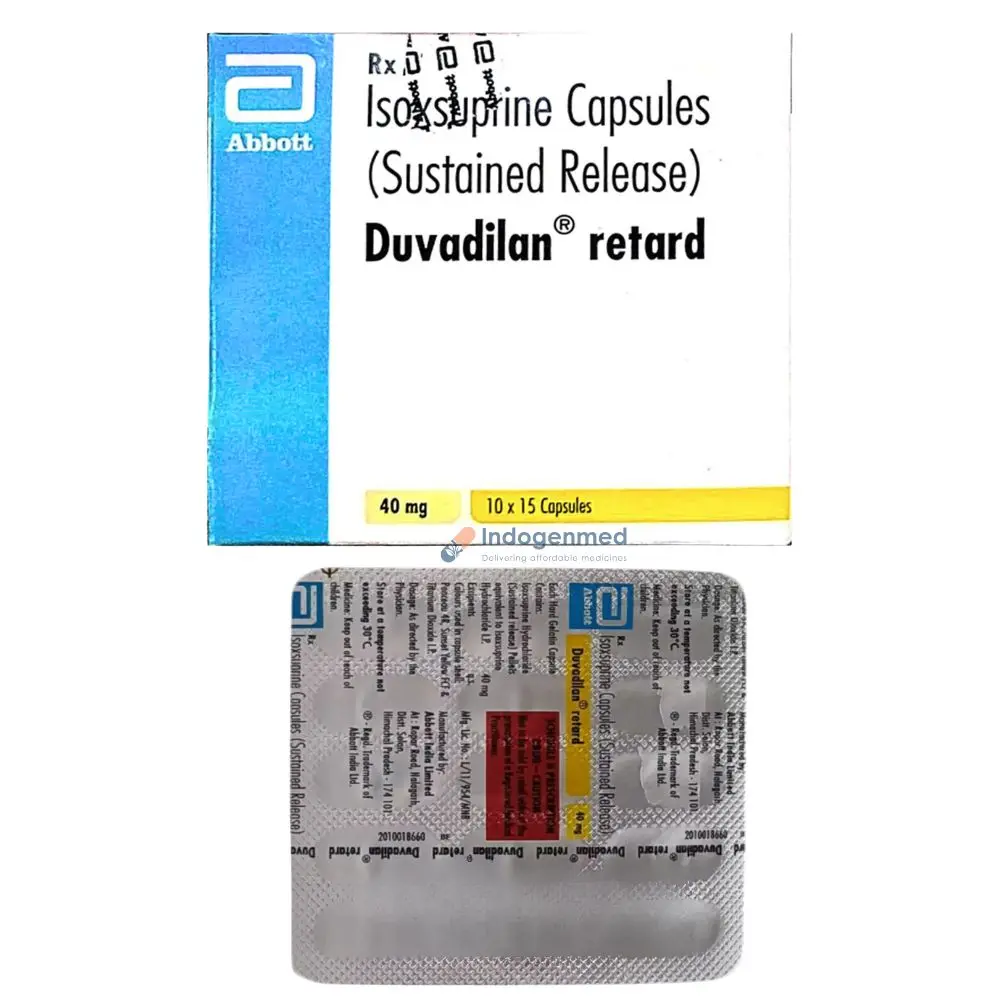
Duvadilan Retards 40 mg Tablets contain isoxsuprine hydrochloride 40 mg per sustained-release tablet. Isoxsuprine is a beta-adrenoceptor agonist and peripheral vasodilator with both beta-2 adrenergic agonist and direct vascular smooth muscle relaxant properties. The “Retards” formulation indicates a slow-release, modified-release preparation designed to deliver isoxsuprine over a prolonged period, reducing dosing frequency and providing more stable plasma concentrations compared to standard immediate-release tablets.
Isoxsuprine has been used clinically for several decades for peripheral vascular disease, particularly conditions involving impaired blood flow to the extremities, as well as in obstetric practice as a uterine relaxant (tocolytic) for the management of premature labour. Its beta-2 agonist properties cause vasodilation and uterine relaxation, while its use in cardiovascular conditions is based on the concept of improving perfusion to ischaemic tissues. However, prescribers should be aware that isoxsuprine’s evidence base is older and more limited than many modern cardiovascular agents, and current guidelines generally favour other agents for peripheral arterial disease. Duvadilan is a well-known brand name for isoxsuprine in several Asian and other markets.
Mechanism of Action
Isoxsuprine acts through two complementary mechanisms to produce vasodilation and smooth muscle relaxation:
Beta-2 Adrenoceptor Agonism
Isoxsuprine stimulates beta-2 adrenoceptors in vascular smooth muscle and uterine smooth muscle. Beta-2 receptor activation increases intracellular cyclic AMP (cAMP) via adenylyl cyclase stimulation. Elevated cAMP activates protein kinase A (PKA), which phosphorylates myosin light chain kinase (MLCK) and reduces its activity — resulting in reduced smooth muscle tone and relaxation. In vascular smooth muscle, this produces vasodilation; in uterine smooth muscle, it produces tocolysis (relaxation of the uterus).
Direct Smooth Muscle Relaxation
In addition to its receptor-mediated effects, isoxsuprine has direct relaxant effects on vascular smooth muscle that are partly independent of adrenoceptor activation. This contributes to its vasodilatory action in peripheral vessels, including arterioles supplying the limbs and potentially cerebral vessels.
Haemodynamic Effects
The net effect of these mechanisms is:
- Peripheral vasodilation, particularly of arterioles in skeletal muscle and skin
- Reduced peripheral vascular resistance
- Increased peripheral blood flow in affected limbs
- Mild decrease in systolic blood pressure
- Reflex tachycardia (from the vasodilation and direct beta-1 stimulation at higher doses)
- Uterine smooth muscle relaxation (tocolytic effect in pregnancy)
Indications
- Peripheral vascular disease — including arteriosclerosis obliterans, Raynaud’s phenomenon, Buerger’s disease (thromboangiitis obliterans), and other conditions causing reduced blood flow to the extremities; aimed at improving peripheral circulation and reducing symptoms of claudication or rest pain
- Cerebrovascular insufficiency — historically used for symptoms attributed to reduced cerebral blood flow; evidence for this use is limited and this indication has largely been superseded
- Premature labour (tocolysis) — isoxsuprine has been used to suppress uterine contractions and delay preterm delivery; in many countries, beta-2 agonists with better evidence (ritodrine, terbutaline) or non-adrenergic tocolytics (atosiban, nifedipine) have replaced isoxsuprine for this indication, but it remains used in some markets
- Dysmenorrhoea — relief of painful menstruation via uterine smooth muscle relaxation
Dosage and Administration
Peripheral vascular disease (sustained-release/Retards formulation): One tablet (40 mg) once or twice daily, taken orally with food. The modified-release formulation is designed for once or twice daily dosing. For immediate-release tablets, the typical dose is 10–20 mg three to four times daily; the Retards 40 mg formulation covers equivalent daily exposure with less frequent dosing.
Tocolysis (premature labour): Dosing in this context is typically guided by specialist obstetric care; immediate-release preparations are more commonly used for acute tocolysis, with oral maintenance therapy thereafter. The sustained-release formulation may be used for maintenance. Standard oral tocolytic doses of isoxsuprine are 10–20 mg every 4–6 hours for immediate-release forms.
Renal impairment: No well-established dose adjustment guidelines are available. Use with caution; start at the lower end of the dose range and monitor for hypotension and tachycardia.
Hepatic impairment: Isoxsuprine is partly metabolised hepatically. Use with caution in hepatic impairment; clinical monitoring is recommended.
Elderly patients: More susceptible to hypotension and tachycardia. Start at the lowest effective dose and monitor blood pressure and heart rate.
Administration: Swallow tablets whole with water; do not crush or chew the sustained-release formulation as this will alter the release profile.
Contraindications
- Hypersensitivity to isoxsuprine or any excipient
- Immediately post-partum and in the presence of active arterial bleeding (risk of haemorrhage with vasodilation and uterine relaxation)
- Severe hypotension or cardiovascular shock
- Recent arterial haemorrhage
- Tachyarrhythmias (including atrial fibrillation with rapid ventricular rate) — isoxsuprine can increase heart rate further
- Thyrotoxicosis — beta-2 agonism can worsen tachycardia and metabolic effects
Warnings and Precautions
Hypotension and Tachycardia
Isoxsuprine causes vasodilation and may cause a reduction in blood pressure, particularly in patients who are volume-depleted, on other antihypertensives, or starting therapy. Reflex tachycardia is a common accompaniment. Monitor blood pressure and pulse, especially at initiation. Patients should be warned about dizziness on standing (postural hypotension).
Cardiac Disease
Use with caution in patients with ischaemic heart disease (tachycardia increases myocardial oxygen demand and may worsen angina), significant arrhythmias, or recent myocardial infarction. The tachycardia induced by isoxsuprine may be harmful in these contexts.
Obstetric Use (Tocolysis)
When used for tocolysis, isoxsuprine can cause maternal and foetal tachycardia, hypoglycaemia in the neonate (from beta-2–mediated insulin secretion), and other neonatal complications. Pulmonary oedema has been reported in pregnant women receiving IV beta-2 agonists for tocolysis, particularly with concurrent corticosteroids and fluid overload. Obstetric use should be under specialist supervision with appropriate foetal and maternal monitoring.
Diabetes
Beta-2 agonism can cause hyperglycaemia and may impair glycaemic control. Monitor blood glucose in patients with diabetes mellitus.
Adverse Effects
- Common (1–10%): Palpitations, tachycardia, flushing, dizziness, headache, nausea, vomiting, skin rash (especially in pregnancy)
- Less common (0.1–1%): Hypotension (including postural hypotension), tremor, restlessness, abdominal discomfort
- Rare: Severe hypotension, significant tachycardia requiring dose reduction or discontinuation; in obstetric use — pulmonary oedema (rare but serious), neonatal hypoglycaemia, neonatal tachycardia
Drug Interactions
Antihypertensive Agents
Additive blood pressure–lowering effects. Monitor blood pressure when isoxsuprine is combined with antihypertensive drugs; dose adjustment may be required.
Other Beta-2 Agonists
Additive cardiovascular effects (tachycardia, vasodilation, hypotension) with other sympathomimetics including beta-2 agonists used for asthma (salbutamol/albuterol, terbutaline). Monitor heart rate and blood pressure.
Beta-Blockers
Beta-blockers antagonise the vasodilatory and tocolytic effects of isoxsuprine. This combination is generally best avoided unless there is a specific clinical rationale (e.g., using a selective beta-1 blocker for rate control in a patient requiring isoxsuprine for peripheral vascular disease — specialist supervision required).
Corticosteroids (in tocolysis)
Concurrent use of corticosteroids (for foetal lung maturity) and beta-2 agonist tocolytics has been associated with an increased risk of pulmonary oedema in pregnant women. Close monitoring is required in this context.
Storage
Store Duvadilan Retards 40 mg Tablets below 25°C in a dry place, protected from light and moisture. Keep in original packaging. Store out of the reach of children. Do not use after the expiry date printed on the pack.
Related Products
- Venpres 40 mg Tablets (Verapamil — calcium channel blocker for hypertension, angina, and arrhythmias)
- Ismo 20 mg Tablets (Isosorbide mononitrate — antianginal and vasodilator for ischaemic heart disease)
- Rami-Race 5 mg Tablets (Ramipril 5 mg — ACE inhibitor for hypertension and cardiovascular risk reduction)
- Lipicard Tricor 200 mg Tablets (Fenofibrate — lipid-lowering therapy for cardiovascular risk)
References
- DailyMed. Isoxsuprine hydrochloride tablets — prescribing information. U.S. National Library of Medicine. Available at: https://dailymed.nlm.nih.gov/dailymed/
- MedlinePlus. Isoxsuprine. U.S. National Library of Medicine. Available at: https://medlineplus.gov/druginfo/meds/a682558.html
- Mayo Clinic. Isoxsuprine (Oral Route). Available at: https://www.mayoclinic.org/
- Creasy RK, Iams JD. Prevention of preterm birth. In: Creasy and Resnik’s Maternal-Fetal Medicine. PMID reference for beta-2 tocolytic use: Gyetvai K, et al. Tocolytics for preterm labor. Obstet Gynecol. 1999;94(5 Pt 2):869–77. PMID: 10546742
- Electronic Medicines Compendium (EMC). Isoxsuprine — Summary of Product Characteristics. Available at: https://www.medicines.org.uk/emc/




Reviews
There are no reviews yet.