




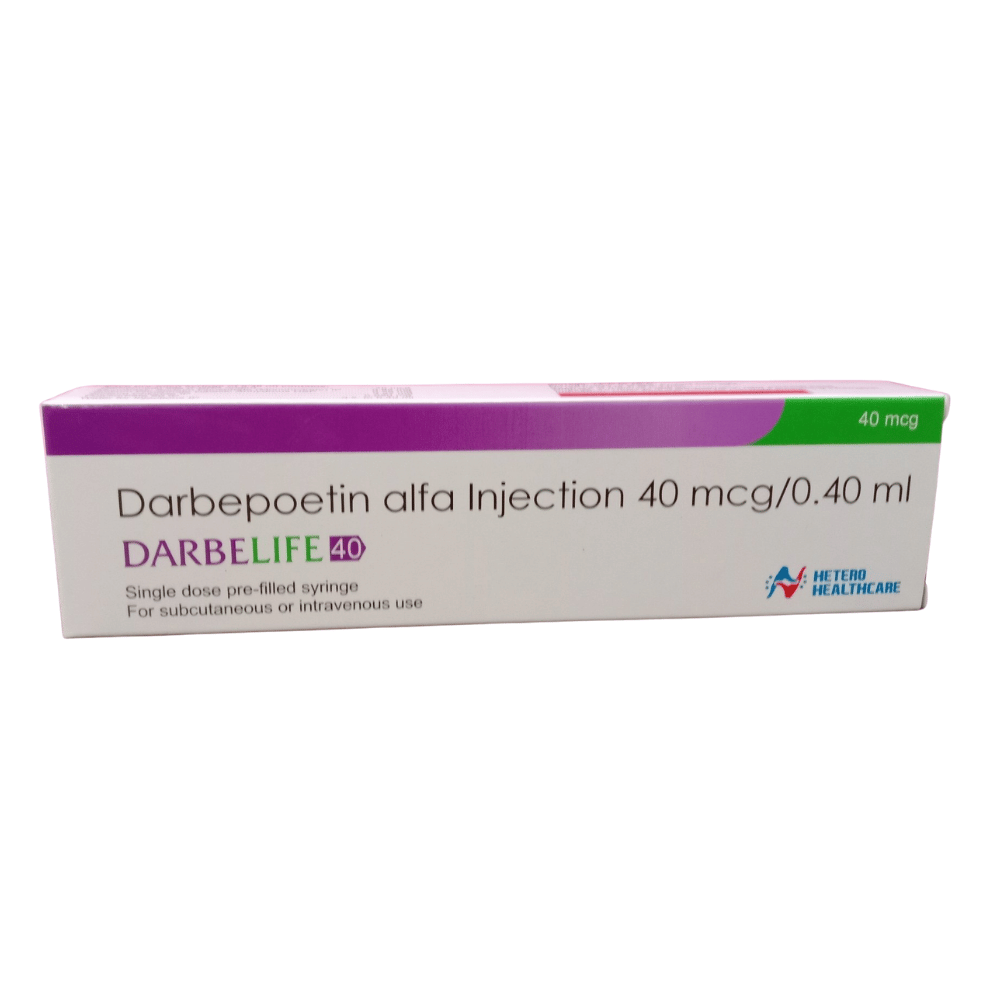
Comprehensive Guide to Darbelife 40mcg Injection (Darbepoetin Alfa)
Darbelife 40mcg Injection is a prescription biological medication containing darbepoetin alfa, an erythropoiesis-stimulating agent (ESA). Manufactured by Hetero Healthcare Ltd., Darbelife is supplied as a pre-filled syringe (PFS) for convenient subcutaneous (under the skin) or intravenous (into a vein) administration.
Darbelife functions as a synthetic form of erythropoietin—a natural hormone produced by the kidneys that signals the bone marrow to produce red blood cells (RBCs). It is used to treat severe anemia caused by chronic kidney disease or chemotherapy.
What is Darbelife 40mcg and How Does It Work?
Red blood cells carry oxygen from your lungs to every tissue and organ in your body. In healthy individuals, the kidneys produce a hormone called erythropoietin in response to low oxygen levels. Erythropoietin travels to the bone marrow and stimulates the production of mature, oxygen-carrying red blood cells.
When the kidneys are damaged or when chemotherapy suppresses bone marrow function, natural erythropoietin levels drop, leading to anemia (low red blood cell count).
Mechanism of Action
Darbepoetin alfa is an engineered version of erythropoietin with added carbohydrate chains (glycosylation):
-
Bone Marrow Stimulation: Darbepoetin alfa binds to erythropoietin receptors on progenitor cells in the bone marrow.
-
Enhanced Red Blood Cell Production: It stimulates these progenitor cells to divide, mature, and enter the bloodstream as active red blood cells.
-
Longer Half-Life: Thanks to its modified molecular structure, darbepoetin alfa stays active in the body about three times longer than standard recombinant human erythropoietin (epoetin alfa). This allows for less frequent injections (such as once weekly or once every 2 to 3 weeks).
Approved Indications
Darbelife 40mcg Injection is prescribed under specialist medical supervision for:
-
Anemia Associated with Chronic Kidney Disease (CKD): For adult and pediatric patients with chronic kidney disease, whether on dialysis (end-stage renal disease) or not on dialysis, to elevate or maintain hemoglobin levels and reduce the need for red blood cell transfusions.
-
Anemia in Cancer Patients Receiving Chemotherapy: For adult patients with non-myeloid malignancies (cancers that do not involve the bone marrow) whose anemia is caused by concurrent chemotherapy, where chemotherapy is planned for at least two additional months.
Standard Dosage and Administration Guidelines
Darbelife must be administered according to your physician’s precise instructions. It is available in a pre-filled syringe (PFS) designed for single use.
Administration Routes
-
Subcutaneous (SC) Injection: Injected into the fatty layer under the skin (usually in the thigh, abdomen, or upper outer arm). This is the preferred route for non-dialysis CKD and chemotherapy-induced anemia.
-
Intravenous (IV) Injection: Administered directly into a vein or through an established vascular access line (commonly used for patients undergoing hemodialysis).
Typical Dosing Intervals
-
Chronic Kidney Disease: Starting doses are calculated based on body weight (typically 0.45 mcg/kg once weekly or 0.75 mcg/kg once every two weeks).
-
Chemotherapy-Induced Anemia: Starting doses are typically 2.25 mcg/kg once weekly or a fixed dose of 500 mcg once every 3 weeks.
Standard Epoetin Alfa: Injected 3 times per week
                 VS.
Darbelife (Darbepoetin): Injected Once Weekly OR Every 2–3 Weeks
Essential Handling & Injection Rules
-
Do Not Shake: Shaking the pre-filled syringe can denature the protein structure and render the medicine inactive.
-
Bring to Room Temperature: Remove the pre-filled syringe from the refrigerator approximately 30 minutes before injecting to allow it to reach room temperature, reducing discomfort during injection.
-
Visual Inspection: Inspect the solution before use. It should be clear and colorless. Do not use if the liquid is cloudy, discolored, or contains visible particles.
-
Rotate Injection Sites: Change the injection site with every dose to avoid skin irritation or lipodystrophy.
Potential Side Effects and Management Strategies
While Darbelife is effective at managing anemia, it can cause side effects that require monitoring.
Common Side Effects
-
Injection Site Reactions: Mild pain, redness, or swelling at the injection site.
-
Hypertension (High Blood Pressure): A sudden rise in blood pressure, especially as red blood cell counts begin to climb.
-
Peripheral Edema: Mild swelling in the hands, ankles, or feet.
-
Flu-like Symptoms: Mild fever, fatigue, body aches, or headache.
-
Gastrointestinal Effects: Nausea, vomiting, or diarrhea.
Serious Adverse Reactions (Seek Immediate Emergency Care)
-
Cardiovascular Events & Stroke: Rapid increases in hemoglobin (above 11 g/dL) raise the risk of heart attacks, stroke, and blood clots (deep vein thrombosis).
-
Vascular Access Thrombosis: In dialysis patients, blood clots can form in the arteriovenous (AV) fistula or graft.
-
Pure Red Cell Aplasia (PRCA): A rare autoimmune condition where the body forms antibodies against darbepoetin alfa, resulting in severe anemia. If anemia suddenly worsens, notify your nephrologist immediately.
-
Severe Cutaneous Adverse Reactions (SCARs): Rare skin reactions such as Stevens-Johnson Syndrome (SJS), marked by flu-like symptoms followed by a painful spreading rash and blisters.
Crucial Precautions and Clinical Monitoring
Because ESAs alter blood volume and viscosity, close physiological tracking is mandatory throughout therapy.
Essential Clinical Baseline & Routine Testing
| Test Parameter | Required Frequency | Clinical Rationale |
| Hemoglobin (Hb) & Hematocrit | Weekly until stable, then monthly | Tracks response to ensure hemoglobin does not exceed target levels (usually 10 to 11 g/dL) to avoid stroke and cardiovascular risks. |
| Iron Panel (Ferritin & TSAT) | Baseline and periodic | Ensures adequate iron stores. Darbelife requires sufficient iron to build new red blood cells; iron supplements are often co-prescribed. |
| Blood Pressure Monitoring | At home weekly; at every clinic visit | High blood pressure must be controlled before starting treatment and monitored continuously throughout. |
Major Health Warnings
-
Target Hemoglobin Warning: Clinical trials show that attempting to raise hemoglobin levels above 11 g/dL increases the risk of death, serious heart problems, and stroke. The lowest dose necessary to avoid red blood cell transfusions should always be used.
-
Uncontrolled Hypertension: Darbelife is contraindicated in patients with severe, uncontrolled high blood pressure.
-
Pure Red Cell Aplasia History: Patients who have developed PRCA following treatment with any erythropoietin product must not receive Darbelife.
Drug Interactions & Special Populations
-
Iron Supplements: Concurrent iron therapy (oral or intravenous) is frequently required to maintain transferrin saturation (TSAT ≥ 20%) and serum ferritin levels (≥ 100 ng/mL) for optimal RBC synthesis.
-
Cyclosporine: May interact with Darbelife; blood levels of immunosuppressive agents should be monitored closely if taken concurrently.
-
Pregnancy & Lactation: Use during pregnancy only if the potential benefit outweighs the potential risk to the fetus. It is unknown whether darbepoetin alfa passes into human milk, so caution is advised when administering to nursing mothers.
Storage and Regulatory Compliance
-
Refrigeration Required: Store Darbelife 40mcg PFS in a refrigerator between 2°C and 8°C (36°F to 46°F).
-
Protect from Light: Keep the pre-filled syringe in its original carton until use to protect it from light.
-
Do Not Freeze: Freezing damages the protein structure. Discard the syringe if it has been frozen.
-
Quality Standards: Manufactured by Hetero Healthcare Ltd., Darbelife is produced in facilities compliant with WHO-GMP guidelines and international quality standards.
Frequently Asked Questions (FAQs)
Q1: Why do I need to take iron supplements while receiving Darbelife injections?
Darbelife instructs your bone marrow to produce new red blood cells rapidly. Hemoglobin, the key protein inside these cells, requires iron to bind oxygen. If your body’s iron stores are low, Darbelife cannot work effectively, even at higher doses.
Q2: How quickly will my red blood cell count increase after starting Darbelife?
Hemoglobin levels typically begin to rise within 2 to 6 weeks after starting therapy. Your doctor will adjust your dose based on your response to ensure a smooth, gradual increase in red blood cells.
Q3: Can I self-administer the Darbelife 40mcg injection at home?
Yes, subcutaneous injections can be self-administered at home after proper training from your doctor or nurse on syringe handling, sterile technique, and site rotation. Never attempt to inject yourself without prior training.
Medical Disclaimer
This guide is strictly for educational and informational purposes and should not replace professional medical advice, diagnosis, or treatment. Always consult a qualified nephrologist, oncologist, or healthcare professional before initiating, modifying, or halting any prescription medication or treatment regimen.
References
-
National Center for Biotechnology Information (NCBI):
-
StatPearls Review: Darbepoetin Alfa Pharmacology and Clinical Applications. https://www.ncbi.nlm.nih.gov/books/NBK538202/
-
PMC Clinical Studies: Management of Anemia in Chronic Kidney Disease. https://pmc.ncbi.nlm.nih.gov/articles/PMC3108786/
-
-
U.S. Food and Drug Administration (FDA):
-
Aranesp (darbepoetin alfa) Full Prescribing Information & Safety Updates. https://www.accessdata.fda.gov/drugsatfda_docs/label/2019/103951s5373lbl.pdf
-
-
MedlinePlus Drug Information (US National Library of Medicine):
-
Darbepoetin Alfa Monograph. https://medlineplus.gov/druginfo/meds/a602023.html
-
-
Mayo Clinic:
-
Darbepoetin Alfa (Oral Route, Injection Route) Description & Side Effects. https://www.mayoclinic.org/drugs-supplements/darbepoetin-alfa-injection-route/description/drg-20068412
-


bodhi castillo –
Review from OpenCart migration