Description
What Is Ismo 20 mg Tablets?
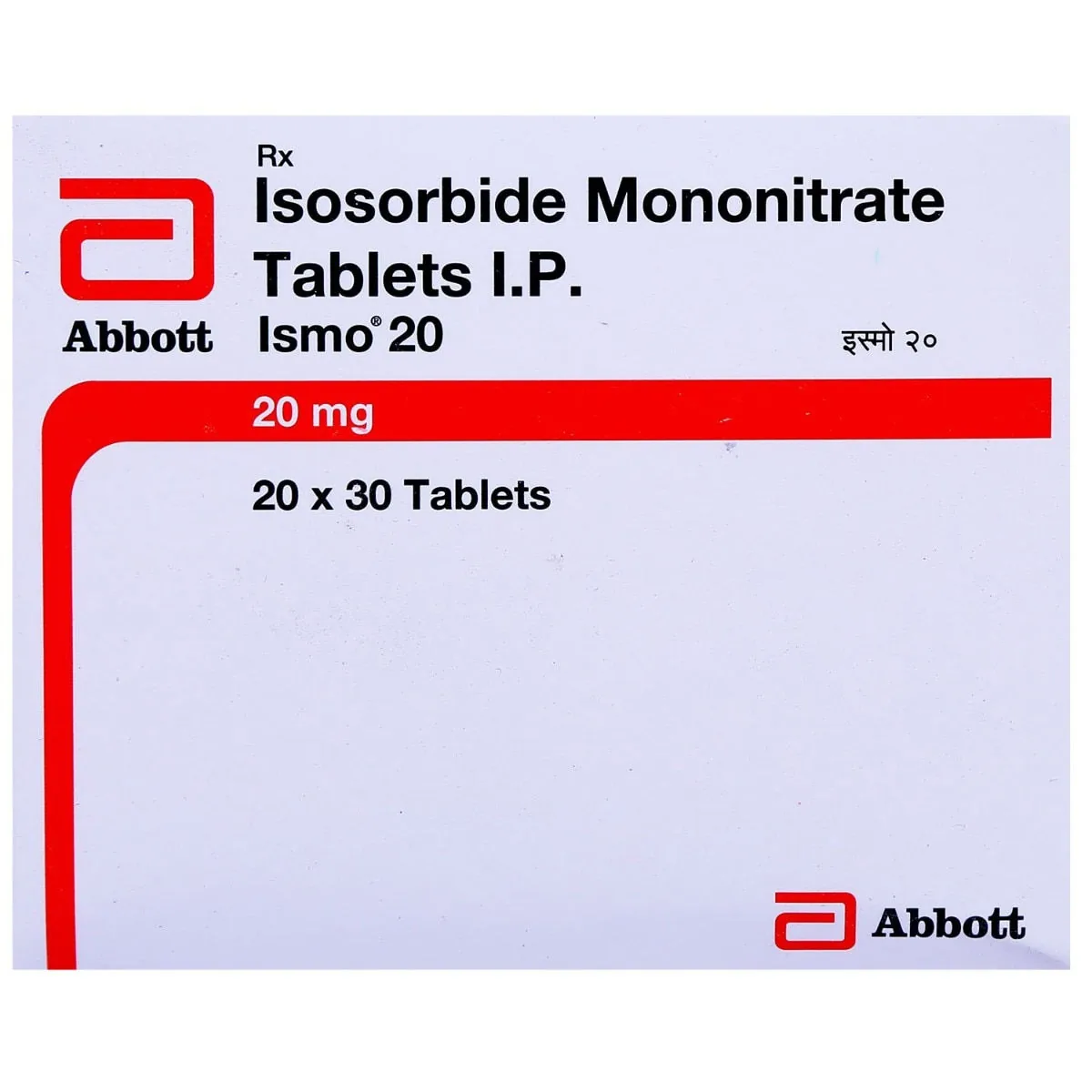
Ismo 20 mg Tablets contain isosorbide mononitrate 20 mg per tablet. Isosorbide mononitrate (ISMN) is an organic nitrate and the principal active metabolite of isosorbide dinitrate. Unlike isosorbide dinitrate, which must be hepatically converted to its active mononitrate metabolites, isosorbide mononitrate does not undergo significant first-pass hepatic metabolism, resulting in nearly complete oral bioavailability (approximately 100%). This pharmacokinetic advantage makes dosing more predictable and reliable. Ismo is used in the prophylaxis and long-term management of angina pectoris (stable angina) in patients with coronary artery disease (CAD), and in the management of chronic heart failure where reduction of cardiac preload is beneficial.
Nitrates remain one of the oldest and most reliably effective classes of antianginal medications. Their primary mechanism — venodilation leading to reduced cardiac preload and myocardial oxygen demand — directly addresses the fundamental pathophysiology of effort-induced angina: an imbalance between myocardial oxygen supply and demand. Isosorbide mononitrate at 20 mg twice daily is the standard immediate-release regimen for prophylaxis; importantly, an asymmetric dosing schedule (morning and early afternoon, not evening) is essential to prevent nitrate tolerance, a critical clinical consideration that distinguishes nitrate prescribing from most other antianginals.
Mechanism of Action
Isosorbide mononitrate is a nitrovasodilator. Its pharmacological effects are mediated through its intracellular conversion to nitric oxide (NO).
Nitric Oxide Generation and Vascular Smooth Muscle Relaxation
ISMN is denitrated within vascular smooth muscle cells by mitochondrial aldehyde dehydrogenase (ALDH2) and other enzymatic pathways to release inorganic nitrite and ultimately nitric oxide (NO). NO activates soluble guanylyl cyclase (sGC), which catalyses the conversion of guanosine triphosphate (GTP) to cyclic guanosine monophosphate (cGMP). Elevated intracellular cGMP activates protein kinase G (PKG), which phosphorylates myosin light chain kinase and reduces myosin-actin interaction, causing smooth muscle relaxation and vasodilation. This occurs in both venous and arterial smooth muscle, though at standard doses the predominant effect is on the venous capacitance vasculature.
Haemodynamic Effects
The principal haemodynamic consequence of ISMN-induced venodilation is a reduction in venous return to the right heart — a decrease in cardiac preload. Lower preload reduces left ventricular end-diastolic volume and pressure (LVEDP), which decreases left ventricular wall tension (by the Law of Laplace) and thus reduces myocardial oxygen consumption (MVO₂). This is the primary antianginal mechanism: by lowering the oxygen requirement, angina threshold is raised and exercise tolerance improved. At higher doses or in combination with other vasodilators, ISMN also causes arterial dilation, reducing afterload and systolic wall stress, further decreasing MVO₂. Additionally, dilation of large epicardial coronary arteries can improve blood flow distribution to ischaemic subendocardial regions, contributing to symptom relief. The net effect is relief of the supply-demand imbalance that precipitates ischaemic chest pain.
Nitrate Tolerance
Tolerance — the progressive attenuation of haemodynamic response with continuous nitrate exposure — is a clinically critical property of all organic nitrates, including ISMN. Tolerance develops within 24 hours of continuous dosing through several mechanisms: depletion of intracellular sulfhydryl groups (necessary for NO generation from some nitrate biotransformation pathways), upregulation of phosphodiesterase activity (which degrades cGMP), neurohormonal counter-regulatory activation (sympathetic activation, renin-angiotensin system activation, endothelin release in response to vasodilation), and impairment of ALDH2 through superoxide generation. To maintain efficacy, a daily nitrate-free interval of 10–12 hours is essential. For the immediate-release 20 mg tablet, this is achieved by the asymmetric dosing regimen: the first dose on waking and the second dose approximately 7 hours later (e.g., 8:00 AM and 3:00 PM). This schedule provides effective coverage during peak activity hours while ensuring a nitrate-free overnight interval.
Indications
- Prophylaxis of angina pectoris in patients with stable coronary artery disease — reduces frequency of anginal episodes and improves exercise capacity
- Long-term management of chronic stable angina — as monotherapy or in combination with beta-blockers or calcium channel antagonists
- Heart failure — adjunctive preload reduction in chronic heart failure where ACE inhibitors or ARBs are insufficient or not tolerated; particularly in combination with hydralazine (the nitrate-hydralazine combination has mortality benefit in certain populations with heart failure with reduced ejection fraction, particularly in Black patients)
- Prophylaxis before exertion — in patients with predictable effort-induced angina, taking a dose prior to known exertion
ISMN is used for prophylaxis, not acute relief of anginal attacks. For acute anginal episodes, sublingual glyceryl trinitrate (GTN/nitroglycerin) or sublingual/spray isosorbide dinitrate acts within minutes and is the appropriate acute treatment.
Dosage and Administration
Standard adult dose (immediate-release 20 mg tablets): 20 mg twice daily using an asymmetric schedule — first dose on waking and second dose approximately 7 hours later. A typical regimen is 20 mg at 8:00 AM and 20 mg at 3:00 PM. The 7-hour interval between doses and the subsequent 17-hour nitrate-free period (overnight) is essential to prevent tolerance. Evening or bedtime dosing should be avoided as it reduces or eliminates the nitrate-free interval.
Initiation: Some patients experience headache when starting nitrate therapy. Starting with one 10 mg dose daily for the first 2–3 days (if 10 mg tablets are available), then increasing to the full 20 mg twice-daily regimen, can improve tolerability. Alternatively, the 20 mg dose can be introduced from the outset, as headache typically subsides after the first week as the cerebrovascular response attenuates.
Modified-release formulations: Isosorbide mononitrate is also available in modified-release (slow-release, SR, retard) formulations at 40 mg and 60 mg, taken once daily in the morning. These provide a gradual rise and fall in plasma concentration with an asymmetric plasma profile that also achieves a partial nitrate-free period. The immediate-release 20 mg twice-daily formulation and the modified-release once-daily formulations are not interchangeable on a dose-to-dose basis.
Elderly patients: No specific dose adjustment is required based on age alone, but elderly patients may be more susceptible to hypotension and dizziness. Starting at the lower end of the dose range and titrating carefully is advisable. Care should be taken with concomitant antihypertensive medications.
Renal or hepatic impairment: ISMN is not significantly metabolised by the liver (unlike isosorbide dinitrate) and is primarily excreted renally. No dose adjustment is routinely required in mild-to-moderate impairment, but caution is warranted in severe hepatic impairment and severe renal impairment.
Swallowing: Tablets should be swallowed whole. They should not be crushed or chewed, as this may alter the release profile.
Contraindications
- Hypersensitivity to isosorbide mononitrate, other nitrates, or any excipient
- Concurrent use of phosphodiesterase type 5 (PDE5) inhibitors — sildenafil (Viagra, Revatio), tadalafil (Cialis, Adcirca), vardenafil (Levitra), avanafil (Stendra). PDE5 inhibitors also increase cGMP by preventing its degradation; combined with nitrate-induced cGMP elevation, the result is profound, potentially fatal hypotension. This contraindication is absolute.
- Concurrent use of soluble guanylate cyclase (sGC) stimulators — riociguat (Adempas). Same mechanism as PDE5 inhibitor interaction; risk of severe hypotension.
- Severe hypotension (systolic BP <90 mmHg) or hypovolaemia
- Hypertrophic obstructive cardiomyopathy (HOCM) — preload reduction can worsen outflow tract obstruction and precipitate haemodynamic collapse
- Constrictive pericarditis or cardiac tamponade — venodilation in a volume-dependent state is hazardous
- Severe aortic stenosis — fixed cardiac output states where preload reduction can cause critical hypotension
Warnings and Precautions
Nitrate Tolerance
As described above, continuous or symmetric nitrate exposure leads to tolerance and loss of efficacy within 24–48 hours. The asymmetric dosing schedule for immediate-release ISMN tablets is non-negotiable for maintained antianginal efficacy. Prescribers should explicitly counsel patients on the importance of timing: second dose no later than mid-afternoon. Patients who experience breakthrough angina overnight should not simply add a third dose — this requires reassessment of the overall antianginal strategy, potentially adding a beta-blocker or calcium channel antagonist for overnight coverage.
Hypotension and Dizziness
ISMN can cause significant hypotension, particularly postural (orthostatic) hypotension. This risk is highest at initiation, with dose increases, and in patients who are volume-depleted (from diuretics, inadequate fluid intake, or hot weather). Patients should be warned to rise slowly from sitting or lying positions and to avoid standing for prolonged periods. Dizziness, lightheadedness, and syncope can occur. Concomitant use of other vasodilators, antihypertensive agents, alcohol, or phosphodiesterase inhibitors substantially increases hypotension risk.
Headache
Nitrate-induced headache from cerebral vasodilation is very common at initiation (up to 50% of patients) and is dose-dependent. It typically diminishes after 1–2 weeks as tolerance develops in the cerebrovascular bed. Analgesics (paracetamol, aspirin) can be used for symptom management. Persistent severe headache that does not resolve after 2 weeks warrants reassessment.
Acute Coronary Syndromes
Oral nitrates should not be used as sole therapy for unstable angina or acute myocardial infarction — these require acute pharmacological intervention. IV nitroglycerin or IV/sublingual nitrates may be appropriate in acute settings, but chronic oral ISMN is not indicated as acute treatment.
Adverse Effects
- Very common (≥10%): Headache (particularly at initiation), flushing
- Common (1–10%): Dizziness, postural hypotension, nausea, palpitations, tachycardia (reflex, from vasodilation)
- Less common (0.1–1%): Vomiting, hypotension, fatigue, somnolence, rash
- Rare: Exfoliative dermatitis, allergic reactions; methaemoglobinaemia (at very high doses; ISMN can oxidise haemoglobin iron from Fe²⁺ to Fe³⁺, impairing oxygen transport — clinically relevant only in overdose or specific enzyme deficiencies)
- Nitrate tolerance: Not an adverse effect per se, but results in clinical inefficacy with symmetric dosing. Properly managed with an asymmetric schedule as described.
Drug Interactions
PDE5 Inhibitors and sGC Stimulators (Absolute Contraindication)
Sildenafil, tadalafil, vardenafil, avanafil, and riociguat are absolutely contraindicated with all nitrates including ISMN. The combination can cause a catastrophic drop in blood pressure (severe hypotension, potentially leading to myocardial infarction or death). This interaction is well-established and applies at any dose of either agent. The nitrate must be withheld for at least 24 hours before PDE5 inhibitor use (longer for tadalafil due to its extended half-life of ~17.5 hours — a minimum of 48 hours is recommended).
Antihypertensive Agents and Vasodilators
Additive hypotension with calcium channel antagonists (particularly dihydropyridines such as amlodipine, which also have vasodilatory effects), beta-blockers (which may enhance the initial hypotensive response), ACE inhibitors, ARBs, diuretics, and alpha-blockers. The combination of ISMN with these agents is clinically common and appropriate, but patients should be aware of the increased hypotension risk, particularly at initiation or during hot weather.
Alcohol
Alcohol causes vasodilation and may potentiate nitrate-induced hypotension. Patients should be advised to moderate alcohol intake, particularly during activity and in hot weather.
Ergotamine
Nitrate-induced vasodilation may antagonise the vasoconstrictive effects of ergotamine used for migraine. The combination is best avoided.
Storage
Store Ismo 20 mg Tablets below 25°C in a dry place, away from light and moisture. Keep in the original blister packaging until use. Store out of the reach of children. Do not use after the expiry date. Organic nitrates are volatile compounds — ensure packaging remains intact to prevent loss of potency through evaporation (this is more relevant for sublingual glyceryl trinitrate tablets, but good storage practice applies to all nitrate formulations).
Related Products
- Rami-Race 5 mg Tablets (Ramipril — ACE inhibitor for cardiovascular risk reduction and heart failure)
- Ramipres 5 mg Tablets (Ramipril — another ACE inhibitor brand for hypertension and cardiovascular protection)
- Lipicard Tricor 200 mg Tablets (Fenofibrate — lipid-lowering agent for cardiovascular risk management)
- Acamprol 333 mg Tablets (Acamprosate — alcohol dependence; alcohol use a risk factor for ischaemic heart disease)
References
- DailyMed. Isosorbide mononitrate tablets — prescribing information. U.S. National Library of Medicine. Available at: https://dailymed.nlm.nih.gov/dailymed/
- MedlinePlus. Isosorbide Mononitrate. U.S. National Library of Medicine. Available at: https://medlineplus.gov/druginfo/meds/a695022.html
- Mayo Clinic. Isosorbide Mononitrate (Oral Route). Available at: https://www.mayoclinic.org/
- Parker JD, Parker JO. Nitrate therapy for stable angina pectoris. New England Journal of Medicine. 1998;338(8):520–531. PMID: 9468470
- Thadani U, Fung HL, Darke AC, Parker JO. Oral isosorbide dinitrate in angina pectoris: comparison of duration of action and dose-response relation during acute and sustained therapy. American Journal of Cardiology. 1982;49(2):411–419. PMID: 7058785
Reviews
There are no reviews yet.