Description
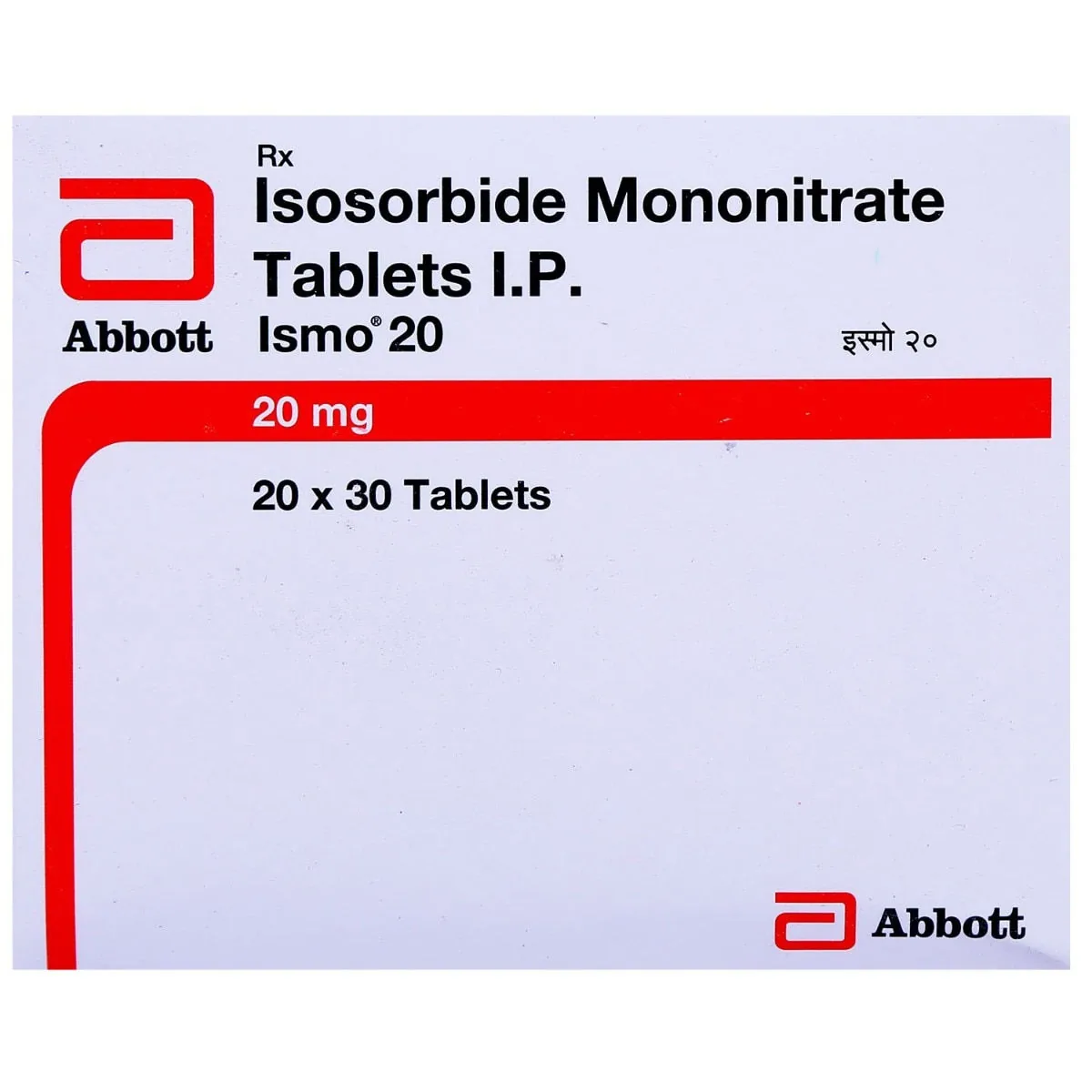
Ismo 20 mg Tablets — Isosorbide Mononitrate for Angina Pectoris
Ismo 20 mg tablets contain isosorbide mononitrate (ISMN), an organic nitrate used in the prophylactic management of stable angina pectoris and in the treatment of chronic heart failure as an adjunct to other therapy. Isosorbide mononitrate is the active metabolite of isosorbide dinitrate and was developed to avoid the extensive first-pass hepatic metabolism that reduces the oral bioavailability of earlier nitrates. Unlike isosorbide dinitrate, isosorbide mononitrate does not undergo significant first-pass hepatic metabolism, resulting in nearly complete oral bioavailability (approximately 100%) and predictable plasma levels. The 20 mg tablet is the standard immediate-release formulation used for twice-daily dosing on an asymmetric schedule designed to prevent tolerance. Isosorbide mononitrate reduces the frequency and severity of anginal episodes, improves exercise tolerance, and reduces the need for short-acting sublingual nitrate rescue doses.
Mechanism of Action
Isosorbide mononitrate belongs to the class of organic nitrate vasodilators. Following absorption, ISMN is converted within vascular smooth muscle cells to nitric oxide (NO) through enzymatic bioconversion involving mitochondrial aldehyde dehydrogenase (ALDH2). Nitric oxide activates soluble guanylate cyclase, increasing the intracellular concentration of cyclic guanosine monophosphate (cGMP). Elevated cGMP activates cGMP-dependent protein kinase G, which phosphorylates myosin light chain kinase and other target proteins, resulting in dephosphorylation of myosin light chains and relaxation of vascular smooth muscle. The vasodilatory effect of ISMN affects venous capacitance vessels more than arteriolar resistance vessels at standard clinical doses, with the following haemodynamic consequences.
Venodilation reduces venous return to the heart (preload reduction), which lowers left ventricular end-diastolic pressure and volume, reducing myocardial wall tension and thus myocardial oxygen demand. At higher doses, ISMN also dilates arterioles, reducing systemic vascular resistance (afterload reduction), further decreasing cardiac work. Additionally, ISMN dilates coronary arteries and collateral vessels, improving blood flow to ischaemic myocardium and reducing vasospasm. Through the combined preload reduction, afterload reduction, and coronary vasodilation, ISMN reduces myocardial oxygen demand while improving myocardial oxygen delivery — the dual mechanism by which it relieves and prevents angina.
Nitrate Tolerance: The Nitrate-Free Interval
A critical consideration with all long-acting nitrates, including isosorbide mononitrate immediate-release tablets, is the development of tolerance — a progressive attenuation of haemodynamic and anti-anginal effects with continuous or frequent nitrate exposure. Nitrate tolerance develops through several mechanisms including depletion of thiol groups needed for nitric oxide bioconversion, increased production of reactive oxygen species (superoxide), activation of neurohumoral counter-regulatory responses (renin-angiotensin-aldosterone activation, sympathetic activation), and desensitisation of guanylate cyclase. To prevent tolerance, it is essential to maintain a daily nitrate-free interval of at least 8–12 hours, during which nitrate plasma levels are low and the nitrate responsiveness of vascular smooth muscle is restored.
For Ismo 20 mg immediate-release tablets, the standard asymmetric dosing schedule is 20 mg twice daily with the first dose taken in the morning upon waking and the second dose taken approximately seven hours later (e.g., 8:00 am and 3:00 pm). This schedule provides therapeutic nitrate levels for the most symptomatic daytime period while allowing a nitrate-free overnight interval. This distinguishes the immediate-release formulation from modified-release isosorbide mononitrate preparations, which are taken as a single daily dose in the morning and are designed to release the drug gradually over the day, also preserving an overnight nitrate-free period.
Clinical Indications and Use
Prophylaxis of stable angina pectoris: Isosorbide mononitrate 20 mg twice daily (asymmetric schedule) is effective in reducing the frequency of anginal episodes and the amount of short-acting nitrate (sublingual glyceryl trinitrate) required for rescue. It improves exercise duration before the onset of angina and ST-segment depression on exercise testing. ISMN is used as monotherapy in patients who cannot tolerate beta-blockers, or in combination with beta-blockers and/or calcium channel blockers for patients with inadequately controlled angina on single-agent therapy.
Vasospastic (Prinzmetal) angina: Nitrates are effective in relieving and preventing coronary artery spasm and are used in this form of angina, in which ischaemia results from epicardial coronary artery spasm rather than fixed atherosclerotic obstruction.
Chronic heart failure: The combination of isosorbide dinitrate plus hydralazine has an established evidence base in heart failure, particularly in self-identified Black patients in whom ACE inhibitor tolerance may be limited. Isosorbide mononitrate is used in similar applications as an adjunct to reduce cardiac filling pressures and symptoms in patients who cannot tolerate ACE inhibitors, ARBs, or in whom further preload reduction is clinically indicated.
Dosing, Contraindications, and Precautions
The standard dose for prophylaxis of angina is Ismo 20 mg (one tablet) twice daily on the asymmetric schedule: first dose in the morning and second dose 7 hours later. The dose may be titrated to 40 mg (two tablets) per dose in patients who do not achieve adequate symptom control. Tablets may be taken with or without food. The asymmetric dosing schedule must be followed carefully; taking both doses together or at equal intervals throughout the day will prevent an adequate nitrate-free period and lead to rapid tolerance development with loss of efficacy.
Isosorbide mononitrate is contraindicated in patients with hypersensitivity to nitrates, in acute myocardial infarction with low filling pressures or cardiogenic shock, in severe anaemia, in hypertrophic obstructive cardiomyopathy (where preload reduction can worsen outflow obstruction), and critically, in patients taking phosphodiesterase-5 (PDE5) inhibitors (sildenafil, tadalafil, vardenafil, avanafil). The combination of nitrates with PDE5 inhibitors produces profound, potentially life-threatening hypotension due to additive cGMP-elevating effects, and is an absolute contraindication. Patients with aortic stenosis require special caution as they depend on adequate preload to maintain cardiac output.
Adverse Effects
The most common adverse effect of isosorbide mononitrate is headache, occurring in up to 50% of patients particularly at initiation of therapy or dose increase, as a direct consequence of cerebral vasodilation. Headaches are dose-dependent, tend to diminish with continued therapy as tolerance to this effect partially develops, and may be managed with analgesics in the initial weeks. Other common adverse effects include flushing, dizziness, lightheadedness, and postural hypotension, particularly after the first dose and in volume-depleted patients. Reflex tachycardia may occur as a consequence of systemic vasodilation and blood pressure reduction.
References
- MedlinePlus (US National Library of Medicine). Isosorbide Mononitrate. Available at: medlineplus.gov
- US Food and Drug Administration. Ismo (isosorbide mononitrate) prescribing information. Available at: fda.gov
- Mayo Clinic. Isosorbide Mononitrate (Oral Route). Available at: mayoclinic.org
- Münzel T, Daiber A, Mülsch A. Explaining the phenomenon of nitrate tolerance. Circulation Research. 2005;97(7):618–628. PubMed PMID: 16195473.
- Parker JD, Parker JO. Nitrate therapy for stable angina pectoris. New England Journal of Medicine. 1998;338(8):520–531. PubMed PMID: 9468470.
Reviews
There are no reviews yet.