Description
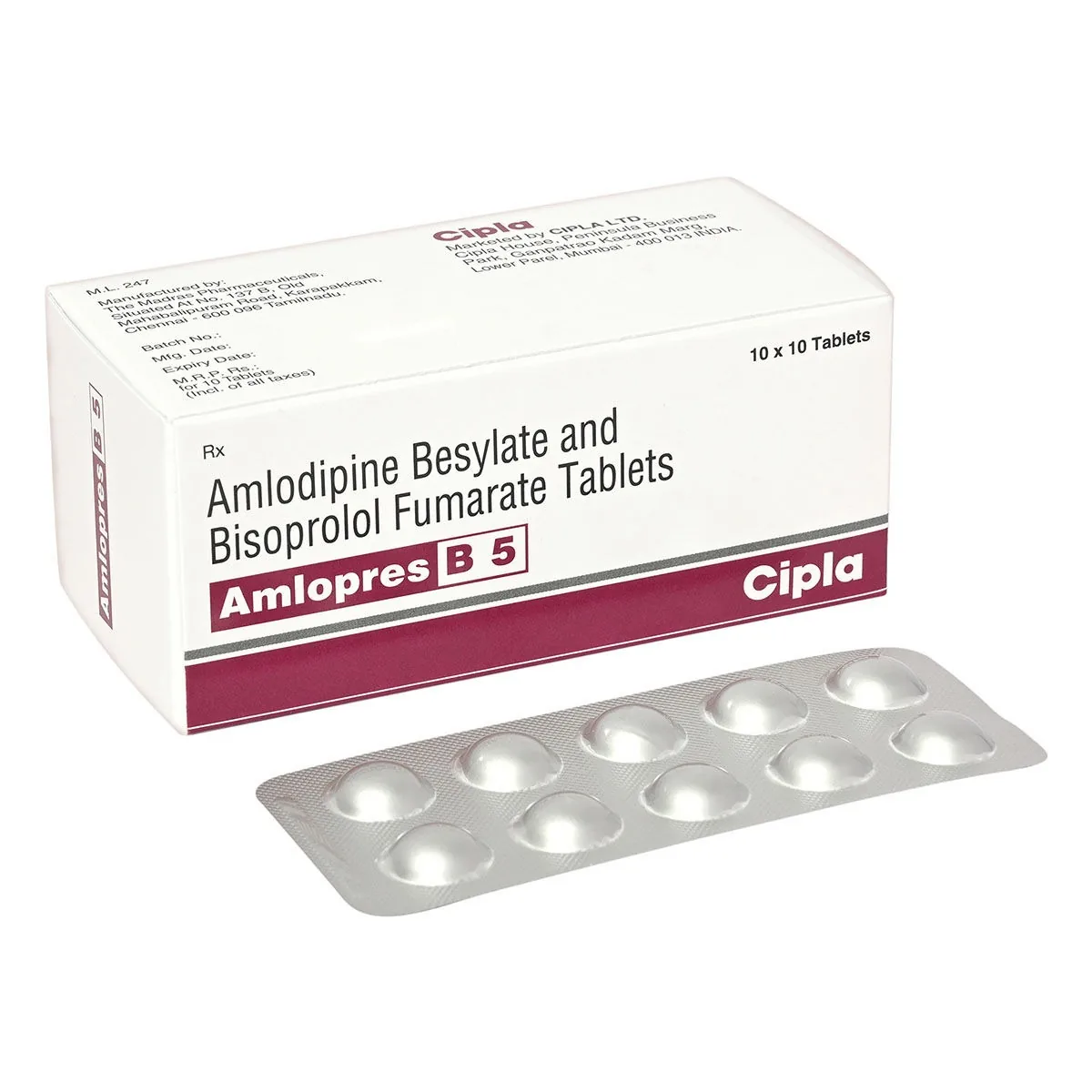
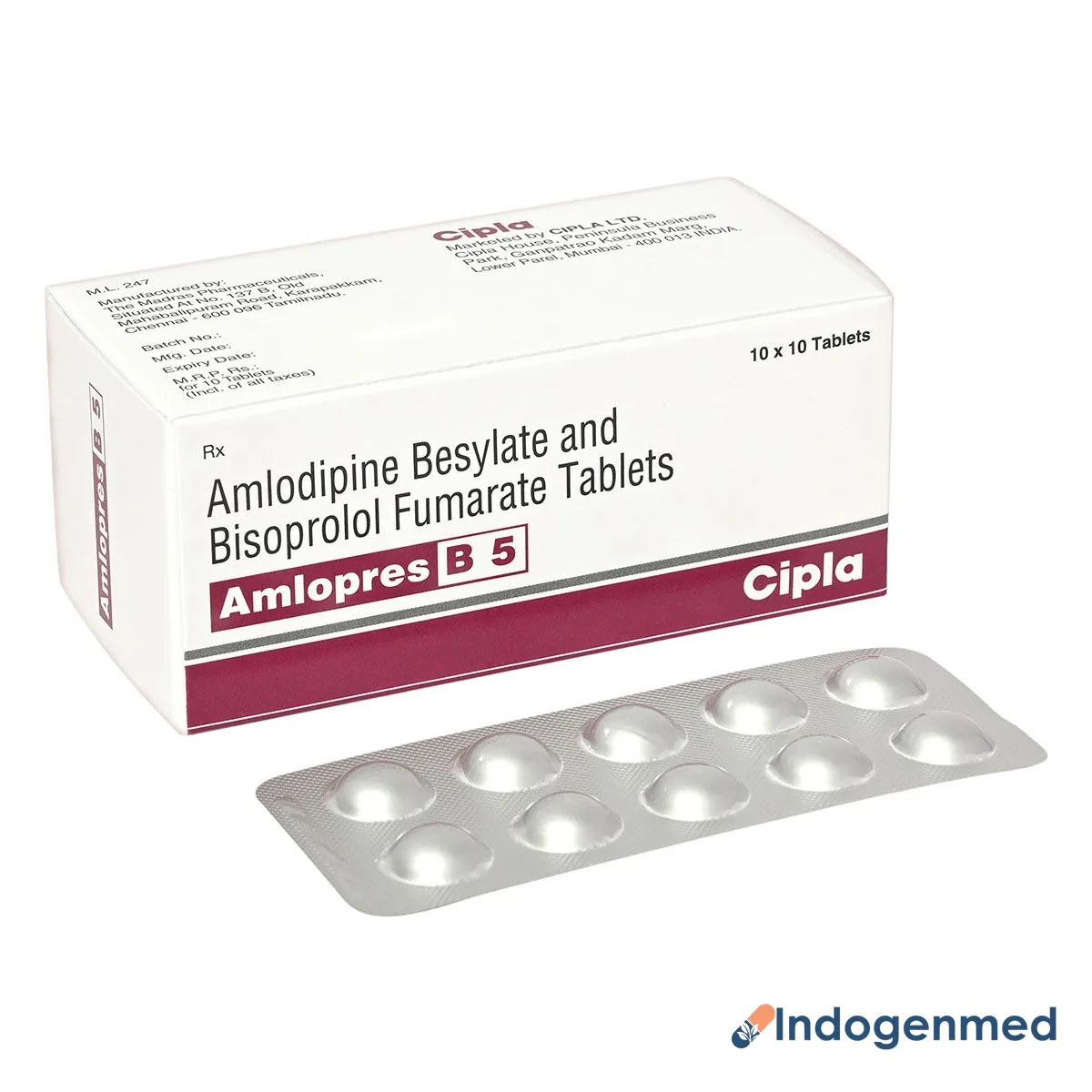
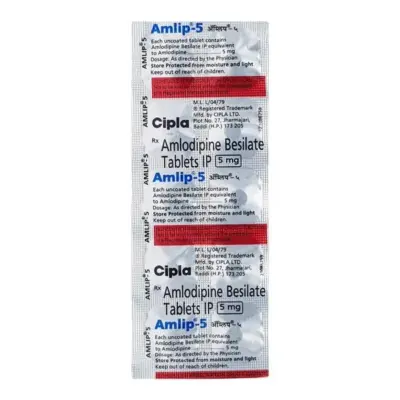
Amlopres 5 Tablet — Amlodipine Besylate 5 mg
Amlopres 5 Tablet contains amlodipine besylate equivalent to 5 mg amlodipine, the standard initiation dose for adults with hypertension or chronic stable angina. Manufactured by Cipla Ltd., it belongs to the dihydropyridine subclass of calcium channel blockers — the most widely prescribed antihypertensive class worldwide. The 5 mg tablet is the most commonly dispensed strength of amlodipine because it balances effective blood pressure reduction with a low incidence of peripheral oedema and other dose-dependent adverse effects. For most adults with uncomplicated hypertension, Amlopres 5 provides adequate blood pressure control as monotherapy, with the option to escalate to 10 mg daily if the response is insufficient after two weeks of treatment.
Composition
Each film-coated tablet of Amlopres 5 contains:
- Amlodipine besylate equivalent to amlodipine 5 mg (active ingredient)
- Microcrystalline cellulose, dibasic calcium phosphate anhydrous, sodium starch glycolate, and magnesium stearate (inactive excipients)
Amlodipine besylate is the benzenesulphonate salt form chosen for its superior solubility and stability compared to the maleate salt. The molecular formula of the besylate salt is C20H25ClN2O5·C6H6O3S (molecular weight 567.1 g/mol). Amlodipine free base has CAS number 88150-42-9 and is classified under ATC code C08CA01 (selective calcium channel blockers with mainly vascular effects, dihydropyridine derivatives).
Mechanism of Action
Amlodipine exerts its antihypertensive effect by selectively blocking voltage-gated L-type calcium channels in the plasma membrane of vascular smooth muscle cells. These channels open during cell membrane depolarisation to allow calcium influx, which triggers the actin-myosin interaction responsible for vasoconstriction. By binding to the channel in its inactivated configuration, amlodipine prevents calcium from entering the cell, causing relaxation of the smooth muscle and dilation of peripheral arterioles.
The haemodynamic result is a sustained reduction in peripheral vascular resistance, leading to lower systolic and diastolic blood pressure without meaningful reduction in heart rate. Amlodipine’s selectivity for vascular smooth muscle over cardiac muscle is several-fold greater than that of non-dihydropyridine agents such as verapamil and diltiazem. Consequently, it does not depress sinoatrial node automaticity or atrioventricular conduction at therapeutic doses, making it suitable for patients with sinus bradycardia or conduction abnormalities where verapamil would be contraindicated.
In coronary artery disease, amlodipine acts through two distinct mechanisms. First, reduced cardiac afterload lowers myocardial oxygen demand, increasing the duration of exercise tolerated before ischaemia occurs. Second, amlodipine directly relaxes coronary vascular smooth muscle, preventing and reversing vasospasm — the mechanism underlying Prinzmetal (variant) angina. Beyond these haemodynamic effects, amlodipine has demonstrated anti-atherosclerotic properties: it reduces oxidative stress within the arterial wall and inhibits smooth muscle cell migration and proliferation, effects that contribute to the reduction in cardiovascular events observed in long-term outcome trials such as ALLHAT and CAMELOT.
Amlodipine’s slow binding to and dissociation from the calcium channel distinguishes it from earlier, rapid-onset dihydropyridines. This slow kinetics, combined with a 30–50-hour half-life, produces a smooth, gradual reduction in blood pressure without reflex sympathetic activation, avoiding the tachycardia and neurohormonal activation seen with short-acting nifedipine.
Pharmacokinetics
| Parameter | Value |
|---|---|
| Oral bioavailability | 64–90% (absolute; unaffected by food) |
| Time to peak plasma concentration (Tmax) | 6–12 hours post-dose |
| Plasma protein binding | ~93% (primarily to albumin) |
| Volume of distribution | ~21 L/kg |
| Primary metabolic pathway | Hepatic CYP3A4/5 — ~90% converted to inactive pyridine metabolites; negligible first-pass effect |
| Elimination half-life (t½) | 30–50 hours (healthy adults); up to 56 hours in hepatic impairment |
| Excretion | Urine: ~10% unchanged parent compound + ~60% inactive metabolites |
| Time to steady state | 7–8 days of once-daily dosing |
| Renal impairment | Plasma levels not significantly changed; standard dose applies; not removed by haemodialysis |
| Hepatic impairment | Clearance reduced; AUC increases ~40–60%; reduce dose to 2.5 mg |
| Elderly patients | Clearance reduced; AUC ~40% higher than younger adults; consider 2.5 mg initiation |
The high volume of distribution (21 L/kg) reflects extensive tissue binding, which together with the long half-life provides consistent plasma levels across the dosing interval. Because metabolism is entirely hepatic to inactive compounds, renal failure does not cause drug accumulation — a clinically important advantage in hypertensive patients with chronic kidney disease. Steady state is reached after 7–8 days, at which point blood pressure measurements accurately reflect the full therapeutic effect of the prescribed dose.
Uses of Amlopres 5 Tablet
- Essential hypertension: First-line management of mild to moderate essential hypertension as monotherapy or in combination with ACE inhibitors, ARBs, or thiazide diuretics. The 5 mg dose is the standard adult starting dose, recommended by major guidelines including JNC-8, ESC/ESH 2018, and Indian hypertension guidelines.
- Renovascular hypertension: Effective as part of a combination regimen in hypertension secondary to renal artery stenosis, where ACE inhibitors may be contraindicated.
- Chronic stable angina: Reduction of frequency and severity of anginal episodes and exercise-induced ischaemia. Amlodipine reduces the need for short-acting nitrate rescue medication.
- Vasospastic (Prinzmetal) angina: Prevention of spontaneous coronary vasospasm. Amlodipine is among the most effective agents for this indication.
- Coronary artery disease: Reduction of hospitalisation for angina and risk of revascularisation procedures in patients with angiographically documented CAD, based on the CAMELOT and ALLHAT trial evidence.
Dosage and Administration
| Indication / Population | Starting Dose | Maximum Dose |
|---|---|---|
| Hypertension (adults) | 5 mg once daily | 10 mg once daily |
| Hypertension (elderly / hepatic impairment) | 2.5 mg once daily | 5–10 mg (titrate slowly) |
| Chronic stable angina (adults) | 5–10 mg once daily | 10 mg once daily |
| Vasospastic angina (adults) | 5–10 mg once daily | 10 mg once daily |
| Coronary artery disease | 5–10 mg once daily | 10 mg once daily |
| Paediatric hypertension (6–17 years) | 2.5 mg once daily | 5 mg once daily |
| Renal impairment | Usual adult dose | Usual adult dose |
Amlopres 5 tablets are taken once daily at any convenient time, with or without food. Because the half-life exceeds 30 hours, the timing of the daily dose has relatively little effect on plasma level fluctuation. If a dose is missed, it should be taken on the same day when remembered. If discovered the following day, the missed dose should be omitted — the next scheduled dose should be taken as usual, and double dosing is not advised. When dose titration to 10 mg is considered, blood pressure should be reassessed after at least 7–14 days on 5 mg before increasing.
Side Effects
Dose-dependent and very common:
- Peripheral oedema: Ankle and lower leg swelling occurs in approximately 3% of patients at 5 mg daily. It arises from arteriolar dilation without compensatory venous constriction, and is not cardiac in origin. Women experience it more than men. Oedema may be managed by reducing the dose, switching to morning dosing, or adding a low-dose ACE inhibitor.
- Flushing: Facial and upper-body warmth or redness, most prominent with the first few doses. Usually transient.
- Palpitations: Awareness of heartbeat, particularly during initiation. Generally non-concerning and self-limiting.
- Dizziness: Related to blood pressure reduction; more pronounced in volume-depleted or elderly patients.
Common (>1%, not clearly dose-related):
- Headache, fatigue, nausea, abdominal discomfort, somnolence — incidence rates in controlled trials are similar to placebo.
Uncommon to rare:
- Gingival hyperplasia (overgrowth of gum tissue) — observed with long-term use; reversible on discontinuation.
- Mood disturbances, insomnia, tremor — reported rarely.
- Erythema multiforme, photosensitivity reactions — post-marketing reports.
Rare but clinically important:
- Worsening angina or myocardial infarction — may occur at initiation or dose increase in patients with severe obstructive CAD.
- Jaundice, hepatitis, elevated transaminases — rare post-marketing hepatic adverse events requiring liver function monitoring.
- Gynaecomastia — reported in post-marketing surveillance.
Precautions and Warnings
- Hepatic impairment: Amlodipine is a high-clearance hepatic drug. Reduced hepatic function substantially increases exposure; initiate at 2.5 mg and titrate cautiously. Liver function tests should be monitored periodically in patients with known liver disease.
- Severe aortic stenosis: Systemic vasodilation may cause haemodynamic decompensation. Use only with close clinical monitoring if no safer alternative exists.
- Hypotension: Blood pressure should be carefully monitored after the first dose and after dose increases, particularly in patients with autonomic dysfunction or volume depletion.
- Heart failure: PRAISE-1 and PRAISE-2 trials showed that amlodipine did not worsen outcomes in heart failure, but it is not indicated as specific heart-failure therapy. Caution is still warranted in severe heart failure with reduced ejection fraction.
- Pregnancy (Category C): No adequate human data; animal studies show embryotoxicity at high doses. Use only when benefit clearly outweighs risk.
- Lactation: Amlodipine is excreted in breast milk; a risk-benefit assessment should guide continuation of treatment or breastfeeding.
- Paediatric use: Established for children aged 6–17 years for hypertension; not recommended for younger children or for other indications in children.
Drug Interactions
- Diltiazem: Increases amlodipine AUC by ~60% via CYP3A4 inhibition. Monitor closely; dose reduction may be needed.
- Strong CYP3A4 inhibitors (ketoconazole, itraconazole, ritonavir, clarithromycin): Increase amlodipine exposure substantially; monitor for hypotension and oedema and reduce dose if necessary.
- CYP3A4 inducers (rifampicin, carbamazepine, phenytoin, St. John’s Wort): May reduce amlodipine plasma concentrations and antihypertensive efficacy; monitor blood pressure and adjust dose upward if required.
- Sildenafil and PDE5 inhibitors: Additive blood pressure lowering; monitor for symptomatic hypotension.
- Simvastatin: Co-administration increases simvastatin AUC by ~77%. Cap simvastatin at 20 mg/day to reduce rhabdomyolysis risk.
- Cyclosporine and tacrolimus: Amlodipine elevates blood levels of both immunosuppressants; monitor drug levels and organ function.
- Other antihypertensives: Additive blood pressure lowering with beta-blockers, ACE inhibitors, ARBs, and diuretics — typically advantageous (combination therapy) but requires monitoring for hypotension.
- No significant interaction: Atorvastatin, digoxin, warfarin, cimetidine, aluminium/magnesium antacids, ethanol.
Contraindications
- Known hypersensitivity or allergy to amlodipine, any other dihydropyridine calcium channel blocker, or any excipient.
- Severe hypotension (systolic BP <90 mmHg).
- Cardiogenic shock.
- Haemodynamically significant aortic stenosis.
- Unstable angina (other than vasospastic angina).
Storage
- Store below 30°C, in a cool, dry place away from direct sunlight and humidity.
- Keep the tablets in their original blister or container to protect from moisture.
- Keep out of sight and reach of children.
- Do not use after the expiry date printed on the pack label.
Related Products
- Amlopres 2.5 Tablet — Amlodipine 2.5 mg, the initiation dose for elderly, hepatic-impaired, or frail patients
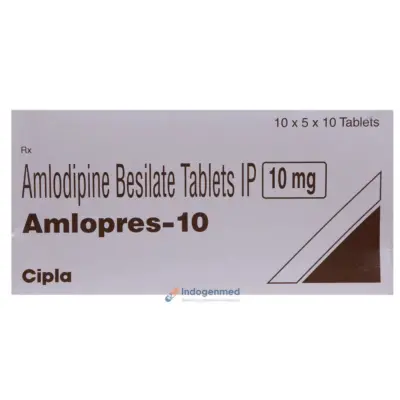
- Amlopres 10 Mg Tablets — Amlodipine 10 mg, for patients requiring maximum antihypertensive effect
- Ramipres 2.5 Tablet — Ramipril 2.5 mg, frequently combined with amlodipine in fixed or free-dose combinations for hypertension
- Cosart 50 Tablet — Losartan 50 mg, an ARB commonly used alongside amlodipine in combination antihypertensive therapy
- Hipres 50 Tablet — Metoprolol 50 mg, a beta-blocker combined with amlodipine for hypertension with angina or tachycardia
- Venpres 40 Tablet — Telmisartan 40 mg, an ARB with complementary cardiovascular protective effects
References
- DailyMed. Amlodipine Besylate Tablets — Prescribing Information. U.S. National Library of Medicine. Available at: https://dailymed.nlm.nih.gov/dailymed/drugInfo.cfm?setid=a1d358b5-c206-463a-a364-18551da8c4e6
- MedlinePlus. Amlodipine. U.S. National Library of Medicine. Available at: https://medlineplus.gov/druginfo/meds/a692044.html
- StatPearls. Amlodipine. National Center for Biotechnology Information, U.S. National Library of Medicine. PMID: NBK519508. Available at: https://www.ncbi.nlm.nih.gov/books/NBK519508/
- Abernethy DR. Clinical pharmacokinetics of amlodipine. Clin Pharmacokinet. 1992 Jan;22(1):22–31. PMID: 1532771.
- ALLHAT Officers and Coordinators for the ALLHAT Collaborative Research Group. Major outcomes in high-risk hypertensive patients randomized to angiotensin-converting enzyme inhibitor or calcium channel blocker vs diuretic. JAMA. 2002;288(23):2981–97. PMID: 12479763.
- UK Electronic Medicines Compendium (EMC). Amlodipine 5 mg Tablets — Summary of Product Characteristics. Available at: https://www.medicines.org.uk/emc/product/101602/smpc
- Mayo Clinic. Amlodipine (Oral Route) — Proper Use. Available at: https://www.mayoclinic.org/drugs-supplements/amlodipine-oral-route/proper-use/drg-20061784

Reviews
There are no reviews yet.