Description
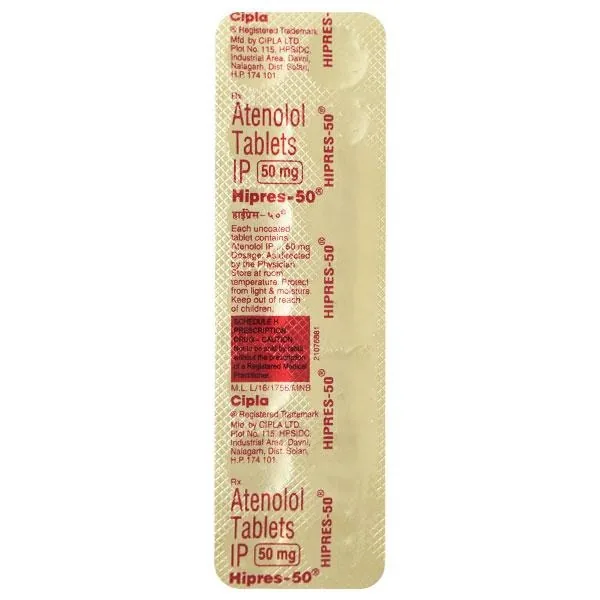
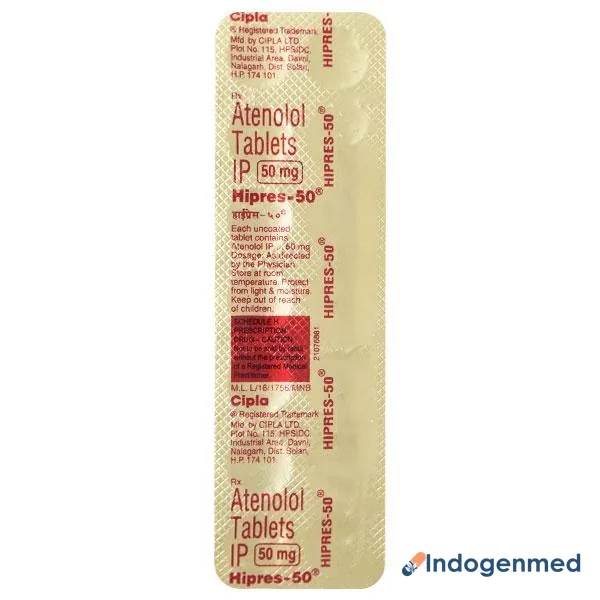
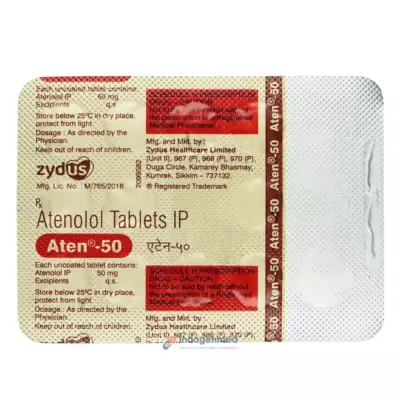
Hipres 50 Tablet — Atenolol 50 mg
Hipres 50 Tablet contains atenolol 50 mg as the active ingredient. Atenolol is a cardioselective beta-1 adrenoceptor blocker widely used in the management of hypertension, angina pectoris, and selected cardiac arrhythmias. Unlike non-selective beta-blockers that also block beta-2 receptors in the lungs and peripheral vasculature, atenolol acts predominantly on cardiac beta-1 receptors at standard doses, reducing heart rate and myocardial oxygen demand while causing less bronchoconstriction than older agents in the class. The 50 mg dose is the most commonly prescribed starting and maintenance dose for hypertension in adults.
Composition of Hipres 50 Tablet
Each tablet of Hipres 50 contains:
- Atenolol — 50 mg (active ingredient)
- Typical inactive ingredients: lactose, maize starch, magnesium stearate, microcrystalline cellulose, sodium lauryl sulphate; film coat: hydroxypropyl methylcellulose, macrogol 400, titanium dioxide
Atenolol is a beta-1 selective adrenoceptor antagonist with no intrinsic sympathomimetic activity and no membrane stabilising activity at therapeutic doses. Chemical name: (RS)-2-[4-[2-hydroxy-3-(propan-2-ylamino)propoxy]phenyl]acetamide. Molecular formula: C14H22N2O3, molecular weight 266.34 g/mol.
How Atenolol Works — Mechanism of Action
Atenolol works by competitively blocking the effects of catecholamines (adrenaline/epinephrine and noradrenaline/norepinephrine) at beta-1 adrenergic receptors. Beta-1 receptors are found predominantly in the heart, with minor representation in the kidneys and juxtaglomerular cells.
Cardiac Effects
By blocking beta-1 receptors on the sinoatrial (SA) node and atrioventricular (AV) node:
- Negative chronotropy: Reduces heart rate (resting and exercise-induced)
- Negative inotropy: Reduces myocardial contractility and hence cardiac output
- Negative dromotropy: Slows AV nodal conduction
- Reduced myocardial oxygen demand: Lower heart rate and contractility reduce the work the heart must perform — particularly beneficial in angina
Antihypertensive Effect
The blood pressure lowering effect of atenolol arises from several mechanisms acting together: reduction in cardiac output, suppression of renin release from juxtaglomerular cells (renin drives angiotensin II production, which raises blood pressure), and central modulation of sympathetic tone. The result is sustained reduction in systolic and diastolic blood pressure throughout the day.
Cardioselectivity
At therapeutic doses (25–100 mg), atenolol has approximately 50-fold greater affinity for beta-1 receptors than beta-2 receptors. This cardioselectivity is relative rather than absolute — at higher doses or in susceptible individuals (e.g., severe asthma), beta-2 blockade can still occur, causing bronchospasm and peripheral vasoconstriction. Patients with mild controlled asthma or COPD may still receive atenolol in selected cases with careful monitoring, but it remains relatively contraindicated in significant obstructive lung disease.
Pharmacokinetics
Absorption
Atenolol is absorbed from the gastrointestinal tract, with oral bioavailability of approximately 40–50% due to incomplete absorption (atenolol is relatively hydrophilic and is not well absorbed across lipid membranes). Peak plasma concentrations are reached in 2 to 4 hours. Food does not significantly alter absorption.
Distribution
Atenolol is poorly lipid-soluble (hydrophilic), which means it has limited penetration into the central nervous system. This is clinically relevant — CNS-related side effects such as nightmares, sleep disturbances, and depression are significantly less common with atenolol than with lipophilic beta-blockers such as propranolol or metoprolol. Plasma protein binding is low at 6–16%. Volume of distribution is approximately 0.7 L/kg.
Metabolism
Atenolol is minimally metabolised by the liver. Unlike propranolol (CYP2D6 substrate with extensive first-pass metabolism), atenolol undergoes little hepatic biotransformation and is excreted largely unchanged. This makes atenolol a predictable drug with limited hepatic drug interactions.
Elimination
Approximately 50% of an absorbed dose is excreted unchanged in urine, with the remainder eliminated in faeces. The elimination half-life is 6 to 9 hours, supporting once-daily dosing. In renal impairment, atenolol accumulates significantly, requiring dose reduction. The drug is effectively removed by haemodialysis.
Uses of Hipres 50 Tablet
- Hypertension (high blood pressure): Atenolol 50 mg once daily is a first-line or adjunct treatment for essential hypertension. It lowers blood pressure sustainably over 24 hours with once-daily dosing. Used alone or combined with calcium channel blockers, ACE inhibitors, ARBs, or diuretics.
- Angina pectoris: Prophylaxis of stable angina. By reducing heart rate and myocardial oxygen demand, atenolol reduces the frequency of anginal episodes and improves exercise tolerance.
- Cardiac arrhythmias: Management of supraventricular tachycardias (SVT), rate control in atrial fibrillation and atrial flutter, and suppression of inappropriate sinus tachycardia.
- Post-myocardial infarction (MI): Early initiation post-MI reduces mortality from ventricular arrhythmias and reinfarction. Long-term treatment post-MI reduces sudden death risk.
- Hyperthyroidism (adjunct): Controls thyrotoxicosis-related symptoms (tachycardia, tremor, palpitations, anxiety) while definitive treatment (antithyroid drugs, radioiodine) takes effect.
- Migraine prophylaxis: Reduces frequency and severity of migraine attacks in susceptible individuals.
Dosage and Administration
Hypertension
- Initial dose: 50 mg once daily
- If response inadequate after 1–2 weeks: increase to 100 mg once daily
- Higher doses rarely provide additional blood pressure reduction — combination therapy is preferred
- Take at the same time each day, with or without food
Angina Pectoris
- Initial dose: 50 mg once daily
- Target resting heart rate 55–60 beats per minute
- May be increased to 100 mg if needed; some patients require twice-daily dosing
Post-MI
- 50 mg twice daily or 100 mg once daily, initiated within days of MI
- Continue for at least 1–3 years; long-term therapy beneficial in most patients
Renal Impairment — Dose Reduction Required
| eGFR (mL/min/1.73 m²) | Recommended Dose |
|---|---|
| 15–35 | 50 mg once daily (or 100 mg every other day) |
| Below 15 | 50 mg every other day (or as directed by nephrologist) |
| Haemodialysis | 50 mg after each dialysis session (closely monitored) |
Elderly Patients
No specific dose reduction required in elderly patients with normal renal function; begin at 25–50 mg if sensitive to hypotension or bradycardia.
Stopping Atenolol
Never stop abruptly. Abrupt withdrawal of beta-blockers in patients with ischaemic heart disease can precipitate rebound tachycardia, hypertension, and potentially unstable angina or myocardial infarction. Taper over 1–2 weeks under medical supervision.
Side Effects of Hipres 50 Tablet
Common Side Effects
- Bradycardia: Resting heart rate below 60 bpm is expected; below 50 bpm may require dose adjustment
- Cold extremities: Peripheral vasoconstriction reduces blood flow to hands and feet
- Fatigue and lethargy: Reduction in cardiac output reduces exercise tolerance
- Dizziness: Particularly postural hypotension on rising from sitting or lying
- Gastrointestinal: Nausea, diarrhoea — usually mild
Less Common Side Effects
- Breathlessness: Even with cardioselective agents, some beta-2 blockade can worsen asthma or COPD at higher doses
- Sleep disturbances: Less common than with lipophilic agents; atenolol rarely causes nightmares
- Erectile dysfunction — class effect; mechanism includes reduced peripheral blood flow
- Raynaud’s phenomenon: Vasospasm worsened by peripheral beta-2 blockade
- Depression: Less common than with propranolol due to low CNS penetration
Rare but Serious
- Heart block (second or third degree AV block)
- Severe bronchospasm in susceptible individuals
- Hyperkalaemia (by blocking beta-2-mediated potassium uptake)
Precautions and Warnings
Masking of Hypoglycaemia
In diabetic patients, atenolol blunts the adrenergic warning signs of hypoglycaemia — particularly tachycardia and tremor. Sweating is preserved. This is particularly important in insulin-treated or sulphonylurea-treated diabetes. Patients taking Glypride 2 Tablet (glimepiride 2mg) or Glypride 4 Tablet alongside atenolol must be specifically counselled about this interaction.
Respiratory Disease
Atenolol should be used with extreme caution — or avoided — in patients with reactive airway disease, asthma, or severe COPD. Even cardioselective agents can precipitate life-threatening bronchospasm in asthma patients.
Abrupt Withdrawal
Gradual dose reduction over 1–2 weeks is mandatory in patients with coronary artery disease. Rebound angina, MI, and arrhythmias have been reported after abrupt cessation.
Surgical Anaesthesia
Inform anaesthetists of beta-blocker therapy before elective surgery. Atenolol may be continued perioperatively to prevent rebound tachycardia; the interaction with anaesthetic agents causing hypotension requires anticipation.
Drug Interactions
- Calcium channel blockers (verapamil, diltiazem): Combined use can cause severe bradycardia, heart block, and hypotension — avoid concurrent use or use with extreme caution under monitoring
- Other antihypertensives: Additive hypotensive effect — monitor blood pressure, adjust doses
- Antidiabetic agents (sulphonylureas, insulin): Masks hypoglycaemia warning signs; see precautions above
- Digoxin: Both agents slow AV conduction; combined use increases risk of heart block
- Clonidine: Stopping clonidine while on atenolol can cause severe rebound hypertension; atenolol should be discontinued first
- NSAIDs: May attenuate the antihypertensive effect of atenolol by causing sodium and water retention
- Sympathomimetics (adrenaline): Unopposed alpha-adrenergic stimulation may cause hypertension when adrenaline is given to a beta-blocked patient
- Antiarrhythmics (amiodarone, flecainide): Additive cardiac depression; monitor closely
- Aluminium hydroxide antacids: Reduce atenolol absorption — separate dosing by 2 hours
Contraindications
- Cardiogenic shock
- Uncontrolled heart failure
- Sick sinus syndrome (without pacemaker)
- Second or third degree AV block (without pacemaker)
- Severe bradycardia (resting heart rate below 45–50 bpm)
- Severe peripheral arterial circulatory disorders (critical limb ischaemia)
- Severe asthma or bronchospasm
- Untreated phaeochromocytoma (beta-blocker alone without prior alpha-blockade)
- Known hypersensitivity to atenolol or other beta-blockers
Storage Instructions
Store Hipres 50 Tablets below 25°C in a cool, dry place. Protect from light and moisture. Store in original packaging. Keep out of reach of children. Do not use after the expiry date printed on the pack.
Related Products
Patients managing cardiovascular conditions may also find the following products at IndoGenMed useful:
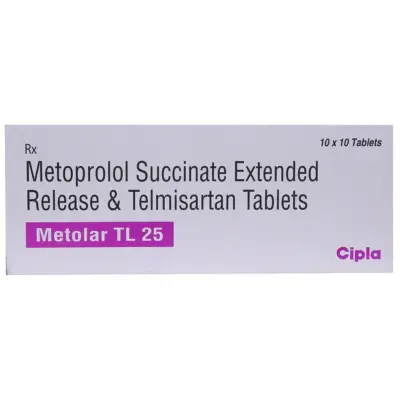
- Metolar 100 Tablet — Metoprolol succinate 100 mg, another cardioselective beta-1 blocker with similar indications, often preferred in patients with heart failure due to its extended-release formulation
- Glypride 2 Tablet — Glimepiride 2 mg; diabetic patients on this sulphonylurea must be aware that atenolol masks hypoglycaemia symptoms
- Glypride 4 Tablet — Glimepiride 4 mg; same hypoglycaemia masking interaction applies
- Lipicard Capsule — Fenofibrate 200 mg, commonly co-prescribed for dyslipidaemia in hypertensive patients
- Naprosyn 250 Mg Tablet — Naproxen; NSAIDs can reduce the antihypertensive efficacy of atenolol
References
- U.S. Food and Drug Administration. Atenolol Tablets — Prescribing Information. Available at: https://www.accessdata.fda.gov/drugsatfda_docs/label/2008/018240s025lbl.pdf
- MedlinePlus (U.S. National Library of Medicine). Atenolol. Available at: https://medlineplus.gov/druginfo/meds/a684031.html
- Mayo Clinic. Atenolol (Oral Route) — Description and Brand Names. Available at: https://www.mayoclinic.org/drugs-supplements/atenolol-oral-route/description/drg-20062485
- Electronic Medicines Compendium (UK EMC). Atenolol 50 mg Tablets — Summary of Product Characteristics. Available at: https://www.medicines.org.uk/emc/search?q=atenolol+50
- National Center for Biotechnology Information (NCBI). Atenolol — PubChem Compound Summary (CID 2249). Available at: https://pubchem.ncbi.nlm.nih.gov/compound/Atenolol
- StatPearls (NCBI Bookshelf). Atenolol. Available at: https://www.ncbi.nlm.nih.gov/books/NBK539844/
Reviews
There are no reviews yet.