Description
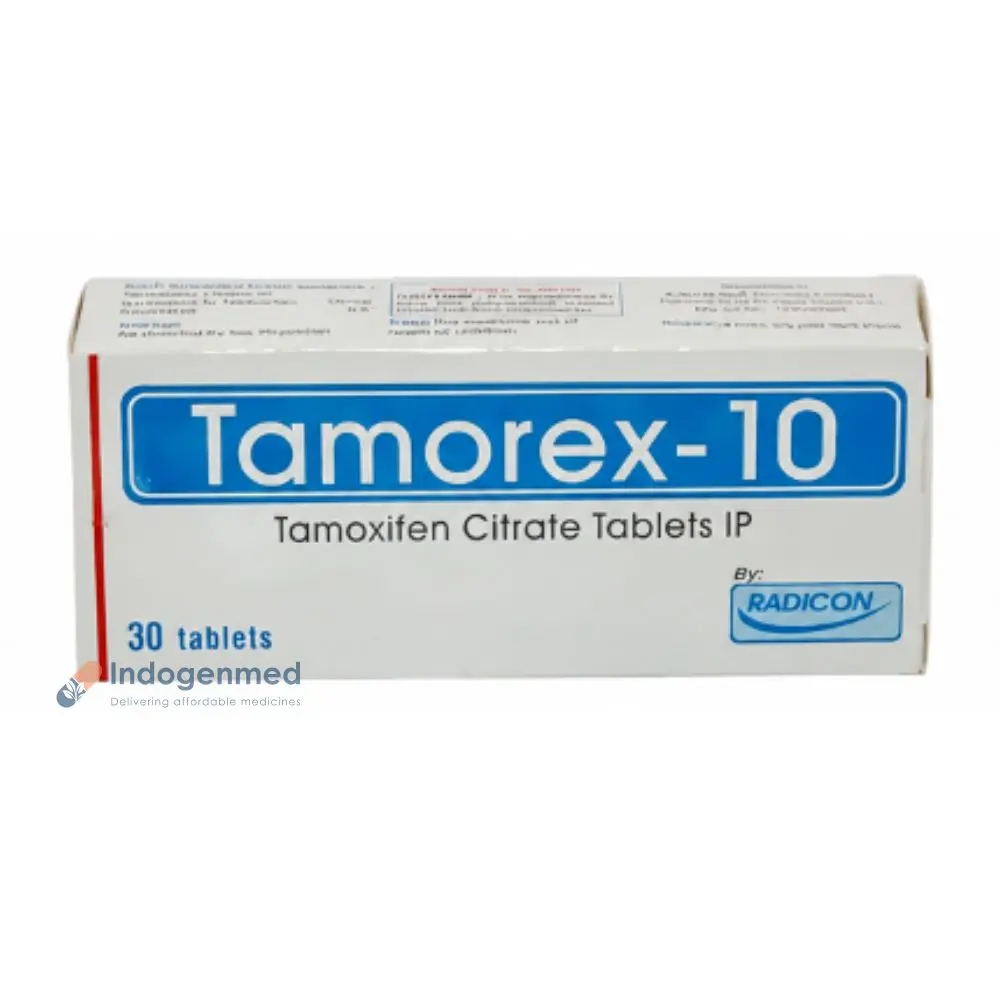
Tamorex 10 mg Tablets — Tamoxifen Citrate for Breast Cancer and Hormone-Responsive Conditions
Tamorex 10 mg tablets contain tamoxifen citrate, a selective oestrogen receptor modulator (SERM) that has been in clinical use for over five decades and remains a cornerstone of hormonal therapy for oestrogen receptor-positive (ER+) breast cancer. Tamoxifen acts as a competitive antagonist of oestrogen at oestrogen receptors in breast tissue while exhibiting partial agonist activity at oestrogen receptors in other tissues including bone, endometrium, and liver. The 10 mg tablet is used as part of dosing regimens for breast cancer treatment and prevention, with the standard therapeutic dose being 20 mg daily (two 10 mg tablets) or 40 mg daily in certain applications. Tamoxifen is prescribed across a wide range of clinical settings including adjuvant treatment of ER+ early breast cancer, treatment of advanced breast cancer, chemoprevention in high-risk individuals, and selected fertility-related applications in specialised oncology and reproductive medicine practice.
Mechanism of Action
Tamoxifen is a prodrug that undergoes extensive hepatic metabolism to form active metabolites. The principal active metabolite is endoxifen (4-hydroxy-N-desmethyltamoxifen), formed via sequential CYP2D6-mediated oxidation and CYP3A4-mediated N-demethylation, which binds oestrogen receptors with approximately 100 times greater affinity than tamoxifen itself. The other clinically important metabolite is 4-hydroxytamoxifen, also formed via CYP2D6, which has similar high receptor affinity. These metabolites bind competitively to oestrogen receptors alpha (ERα) and beta (ERβ), preventing oestradiol from binding and activating transcriptional programmes that drive cell proliferation in ER+ breast cancer cells.
The tamoxifen-oestrogen receptor complex recruits co-repressor proteins rather than co-activators, resulting in transcriptional repression of oestrogen-responsive genes including those encoding cyclin D1, c-Myc, and growth factor receptors involved in tumour cell proliferation. The net effect in breast tissue is inhibition of cell cycle progression through G1-S arrest, reduced tumour cell proliferation, and induction of apoptosis in oestrogen-dependent cancer cells. In contrast, tamoxifen-ER complexes in bone, endometrium, and liver recruit co-activators that produce partial agonist effects, underlying the drug’s beneficial effect on bone mineral density and its adverse effect of increasing endometrial cancer risk with long-term use.
Clinical Indications
Adjuvant treatment of ER+ early breast cancer: Tamoxifen 20 mg daily for five years reduces the annual breast cancer recurrence rate by approximately 40% and the annual mortality rate by approximately 30% in women with ER+ early breast cancer, regardless of whether they received chemotherapy, age, nodal status, or menopausal status. Extended adjuvant therapy for a total of ten years provides further reduction in recurrence and mortality compared with five years, based on the ATLAS and aTTom trials. For premenopausal women, tamoxifen is the standard hormonal adjuvant agent; postmenopausal women may use aromatase inhibitors instead, which demonstrate superior efficacy over tamoxifen in this setting.
Treatment of advanced or metastatic ER+ breast cancer: Tamoxifen is effective as first-line hormonal therapy for advanced ER+ breast cancer in premenopausal women and as an alternative in postmenopausal women in whom aromatase inhibitors are contraindicated or not tolerated. Objective response or disease stabilisation is achieved in approximately 50–60% of patients with ER+ advanced disease.
Chemoprevention of breast cancer: In women at high risk of breast cancer (defined by family history, prior atypical hyperplasia, or Gail model scores), tamoxifen 20 mg daily for five years reduces the risk of invasive ER+ breast cancer by approximately 50%. Risk reduction continues for at least ten years after stopping treatment. The benefit must be weighed against risks including thromboembolic events and endometrial cancer.
Dosing and Administration
The standard dose for breast cancer treatment and prevention is tamoxifen 20 mg daily, administered as two Tamorex 10 mg tablets. Some protocols use 40 mg daily for advanced disease. Tamoxifen may be taken with or without food. It should be taken at approximately the same time each day for consistency of plasma levels. The duration of treatment is typically five to ten years for adjuvant therapy, and five years for chemoprevention. Treatment should not be stopped without medical guidance, as early discontinuation substantially reduces the proven survival benefit of adjuvant therapy.
Pharmacogenomics: CYP2D6 and Tamoxifen Efficacy
CYP2D6 genetic polymorphism substantially affects tamoxifen metabolism and clinical outcomes. Poor metabolisers (individuals with two non-functional CYP2D6 alleles, approximately 7–10% of Caucasian populations) generate significantly lower endoxifen plasma concentrations and may have reduced benefit from tamoxifen therapy. Potent CYP2D6 inhibitors — particularly paroxetine and fluoxetine, commonly co-prescribed for the management of hot flushes and depression in breast cancer patients — reduce endoxifen levels by 50–70% and should be avoided in patients receiving tamoxifen. Venlafaxine, escitalopram, and citalopram have substantially less CYP2D6 inhibitory activity and are preferred alternatives for mood and vasomotor symptom management in tamoxifen-treated patients. Where available, CYP2D6 genotyping can guide clinical decision-making about whether to use tamoxifen or switch to an alternative agent.
Drug Interactions
Beyond CYP2D6 inhibitors, warfarin and other anticoagulants interact significantly with tamoxifen — tamoxifen inhibits CYP2C9-mediated warfarin metabolism, substantially increasing the anticoagulant effect and risk of bleeding. INR should be monitored closely when tamoxifen is initiated or stopped in anticoagulated patients. Oestrogen-containing hormonal contraceptives and postmenopausal hormone therapy will oppose tamoxifen’s anti-oestrogenic effect in breast tissue and should not be used concurrently. Rifampicin and other CYP3A4/2D6 inducers reduce tamoxifen and endoxifen plasma concentrations.
Adverse Effects and Risks
Common adverse effects of tamoxifen include hot flushes, vaginal discharge, irregular menstrual periods in premenopausal women, and mood changes. These are related to anti-oestrogenic activity in reproductive tissues. Serious risks with long-term tamoxifen use include endometrial cancer (risk approximately doubled relative to unexposed women, primarily low-grade type I tumours), venous thromboembolic events including deep vein thrombosis and pulmonary embolism (risk two- to three-fold increased), and cataracts. Any abnormal vaginal bleeding in women taking tamoxifen should be investigated promptly to exclude endometrial pathology. Patients with a personal history of deep vein thrombosis or pulmonary embolism require careful risk-benefit assessment before initiating tamoxifen.
References
- MedlinePlus (US National Library of Medicine). Tamoxifen. Available at: medlineplus.gov
- Mayo Clinic. Tamoxifen (Oral Route) — Description and Brand Names. Available at: mayoclinic.org
- US Food and Drug Administration. Nolvadex (tamoxifen citrate) prescribing information. Available at: fda.gov
- Early Breast Cancer Trialists’ Collaborative Group (EBCTCG). Relevance of breast cancer hormone receptors and other factors to the efficacy of adjuvant tamoxifen: patient-level meta-analysis of randomised trials. Lancet. 2011;378(9793):771–784. PubMed PMID: 21802721.
- Davies C, Pan H, Godwin J, et al. Long-term effects of continuing adjuvant tamoxifen to 10 years versus stopping at 5 years after diagnosis of oestrogen receptor-positive breast cancer: ATLAS, a randomised trial. Lancet. 2013;381(9869):805–816. PubMed PMID: 23219286.








Reviews
There are no reviews yet.