Description
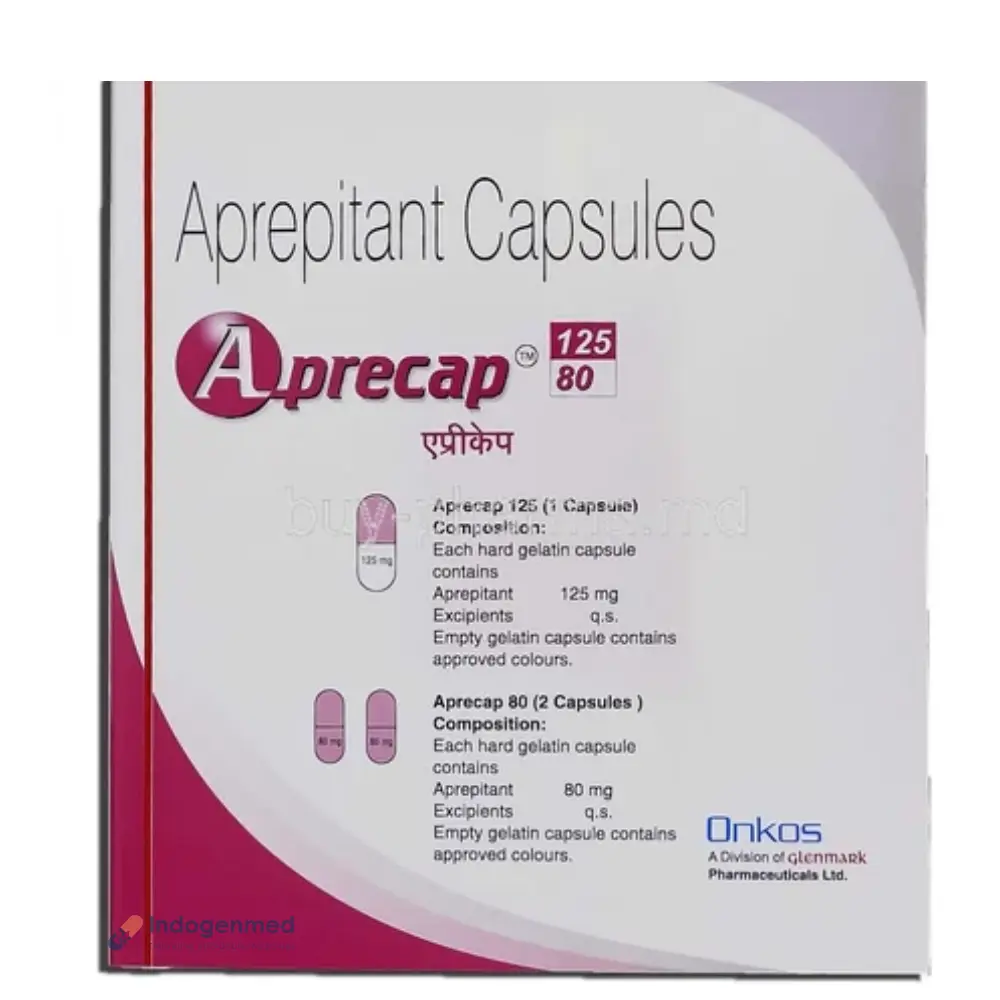
Aprecap 125 Mg Capsules — Aprepitant NK1 Receptor Antagonist for Chemotherapy-Induced Nausea and Vomiting
Aprecap 125 Mg Capsules contain Aprepitant 125 mg, a selective neurokinin-1 (NK1) receptor antagonist antiemetic used for the prevention of chemotherapy-induced nausea and vomiting (CINV), including both acute and delayed phases. It is used as part of a combination antiemetic regimen on Day 1 of a 3-day oral aprepitant protocol. Aprecap is a prescription-only oncology-supportive medicine.
Composition
| Active Ingredient | Strength per Capsule | Drug Class |
|---|---|---|
| Aprepitant | 125 mg | NK1 (Neurokinin-1) Receptor Antagonist / Antiemetic |
How Aprecap Works — Mechanism of Action
Aprepitant is a selective, high-affinity antagonist of human substance P neurokinin-1 (NK1) receptors. The vomiting centre in the brain stem and the gastrointestinal tract contain NK1 receptors that respond to substance P (a neuropeptide) released during chemotherapy-induced tissue stress. Aprepitant blocks this response:
- Central NK1 blockade: Aprepitant penetrates the blood-brain barrier and blocks NK1 receptors in the brainstem nucleus tractus solitarius (the vomiting centre) → suppresses the efferent vomiting reflex triggered by substance P
- Peripheral NK1 blockade: Also blocks peripheral NK1 receptors in the gastrointestinal tract → reduces the entero-vagal afferent input that contributes to delayed nausea and vomiting after chemotherapy
- Augments 5-HT3 antagonism: Aprepitant enhances the efficacy of ondansetron (5-HT3 antagonist) for both acute and delayed CINV when used in combination
- Superior delayed-phase coverage: NK1 receptor antagonists specifically address the delayed phase of CINV (24–120 hours post-chemotherapy) — the phase least well covered by 5-HT3 antagonists alone
Clinical Indications
- Prevention of acute and delayed CINV: As part of a triple antiemetic regimen — Aprepitant (Day 1: 125 mg) + Ondansetron (5-HT3 antagonist) + Dexamethasone — for prevention of nausea and vomiting associated with highly emetogenic chemotherapy (HEC), including cisplatin-based regimens, and moderately emetogenic chemotherapy (MEC)
- Delayed CINV specifically: Aprepitant 80 mg on Days 2 and 3 of the 3-day regimen extends coverage into the delayed phase where 5-HT3 antagonists lose efficacy
Note: The 125 mg capsule is the Day 1 dose. The 80 mg formulation (separate product) is used on Days 2 and 3. Confirm the full regimen with the prescribing oncologist.
Dosage and Administration — Standard 3-Day CINV Regimen
- Day 1: Aprepitant 125 mg orally, 1 hour before chemotherapy, PLUS ondansetron 32 mg IV (or equivalent oral dose) + dexamethasone 12 mg orally
- Day 2: Aprepitant 80 mg orally once daily in the morning + dexamethasone 8 mg orally
- Day 3: Aprepitant 80 mg orally once daily in the morning + dexamethasone 8 mg orally
- Can be taken with or without food.
- Swallow capsule whole with a glass of water. Do not crush, chew, or open the capsule.
Dexamethasone doses in combination regimens are reduced by approximately 50% when co-administered with aprepitant, due to CYP3A4 inhibition by aprepitant increasing dexamethasone plasma levels. The prescribing oncologist will specify the adjusted dose.
Special Populations
- Elderly (≥65 years): No dose adjustment required. Well tolerated in older patients.
- Pregnancy: Limited data. Animal reproductive studies showed no embryotoxicity; however, aprepitant should be used in pregnancy only if clearly necessary. Consult oncology team.
- Breastfeeding: Unknown if excreted in breast milk. Avoid during breastfeeding unless benefits clearly outweigh risks.
- Renal impairment: No dose adjustment required, including in severe renal impairment and patients on dialysis.
- Hepatic impairment: No adjustment for mild to moderate impairment. Limited data in severe hepatic impairment (Child-Pugh C) — use with caution.
- Children: Paediatric dosing differs from adult dosing. Use paediatric-specific guidance under oncology specialist supervision.
Precautions
- CYP3A4 inhibitor: Aprepitant is a moderate inhibitor of CYP3A4 — the enzyme responsible for metabolising many oncology drugs, corticosteroids, and common medications. Drug interaction review by a pharmacist or oncologist is essential before starting aprepitant.
- Warfarin monitoring: Aprepitant may cause a clinically significant decrease in INR (international normalised ratio) in patients on warfarin — typically appearing 7–10 days after the 3-day course. Monitor INR closely in warfarin users.
- Hormonal contraceptives: Aprepitant may reduce the efficacy of oral contraceptives via CYP3A4 induction. Use alternative or additional contraception during treatment and for 1 month following the last dose.
Contraindications
- Hypersensitivity to aprepitant or any excipient
- Concurrent use with pimozide, terfenadine, astemizole, or cisapride (CYP3A4 substrates with narrow therapeutic index — risk of serious cardiac arrhythmia)
Side Effects
Common (≥1/100): Fatigue, constipation, headache, diarrhoea, nausea (not prevented entirely by antiemetics), anorexia, hiccups.
Uncommon (≥1/1,000): Dizziness, drowsiness, elevated liver enzymes (ALT/AST), alopecia, pruritus.
Rare but serious: Severe hypersensitivity reactions (anaphylaxis, angioedema), Stevens-Johnson syndrome, toxic epidermal necrolysis.
Seek immediate medical attention if you develop facial or throat swelling, severe skin reactions, or difficulty breathing.
Drug Interactions
- CYP3A4 substrates: Aprepitant inhibits CYP3A4 → increases plasma levels of dexamethasone, methylprednisolone, midazolam, vincristine, ifosfamide, imatinib, and many other drugs. Doses of CYP3A4 substrates may need reduction.
- Warfarin: Clinically significant reduction in INR 7–10 days post-treatment. Monitor closely.
- Oral contraceptives: Reduced efficacy. Use additional contraception.
- Strong CYP3A4 inhibitors (ketoconazole, itraconazole, ritonavir): May significantly increase aprepitant exposure.
- Strong CYP3A4 inducers (rifampicin, carbamazepine, phenytoin): May significantly reduce aprepitant efficacy.
Storage Instructions
- Store at room temperature (below 30°C) in a dry place, away from direct heat and light.
- Keep out of reach of children.
- Keep in original packaging until use.
- Do not use past the expiry date on the pack.
Frequently Asked Questions
What is Aprecap 125 Mg used for?
Aprecap (Aprepitant 125 mg) is used to prevent chemotherapy-induced nausea and vomiting (CINV), specifically the Day 1 component of a 3-day antiemetic regimen. It works by blocking NK1 receptors in the brain’s vomiting centre. It is always used as part of a combination regimen — typically with a 5-HT3 antagonist (e.g. ondansetron) and dexamethasone — as prescribed by an oncologist.
How is Aprecap different from ondansetron?
Ondansetron is a 5-HT3 (serotonin) receptor antagonist that is very effective for preventing acute nausea and vomiting occurring in the first 24 hours after chemotherapy. Aprepitant is an NK1 receptor antagonist that provides additional coverage — especially for delayed nausea and vomiting occurring 24–120 hours after chemotherapy — through a completely different mechanism. The two drugs are complementary, and triple-therapy (ondansetron + dexamethasone + aprepitant) provides superior protection compared to ondansetron + dexamethasone alone.
Can Aprecap interact with my other medicines?
Yes — importantly. Aprepitant is a moderate CYP3A4 enzyme inhibitor, which means it can increase blood levels of many medicines processed by that enzyme. It significantly affects dexamethasone (doses are reduced in combination regimens), warfarin (INR may fall — monitor closely), and oral contraceptives (use backup contraception). Always give your oncologist and pharmacist a full list of your current medicines before starting aprepitant.
When exactly should I take the Aprecap 125 Mg capsule?
Take Aprecap 125 mg approximately 1 hour before your chemotherapy infusion begins on Day 1 of your treatment cycle. It can be taken with or without food. Continue with the 80 mg dose on Days 2 and 3 of the aprepitant course as directed, even if you feel well and are not experiencing nausea.
Does Aprecap treat nausea that has already started, or only prevent it?
Aprecap is a preventive (prophylactic) antiemetic — it works best when taken before nausea begins. It is not approved or effective as a rescue treatment for nausea that has already started. If breakthrough nausea occurs despite the regimen, your oncology team may adjust the treatment plan or add a rescue antiemetic.
References
- MedlinePlus — Aprepitant. U.S. National Library of Medicine.
- FDA Prescribing Information — Emend (Aprepitant) Capsules. U.S. Food and Drug Administration.
- EMA — European Public Assessment Report: Emend (Aprepitant). European Medicines Agency.
- NHS — Chemotherapy Side Effects: Nausea and Vomiting. National Health Service, UK.
Disclaimer: This product information is provided for general educational purposes only. Aprecap 125 Mg is a prescription-only oncology-supportive medicine. It must be used only as directed by a qualified oncologist or healthcare professional familiar with chemotherapy-induced nausea management. This content does not constitute medical advice. IndoGenMed.org supplies this product to licensed healthcare professionals and registered pharmacies only.
Reviews
There are no reviews yet.