Description
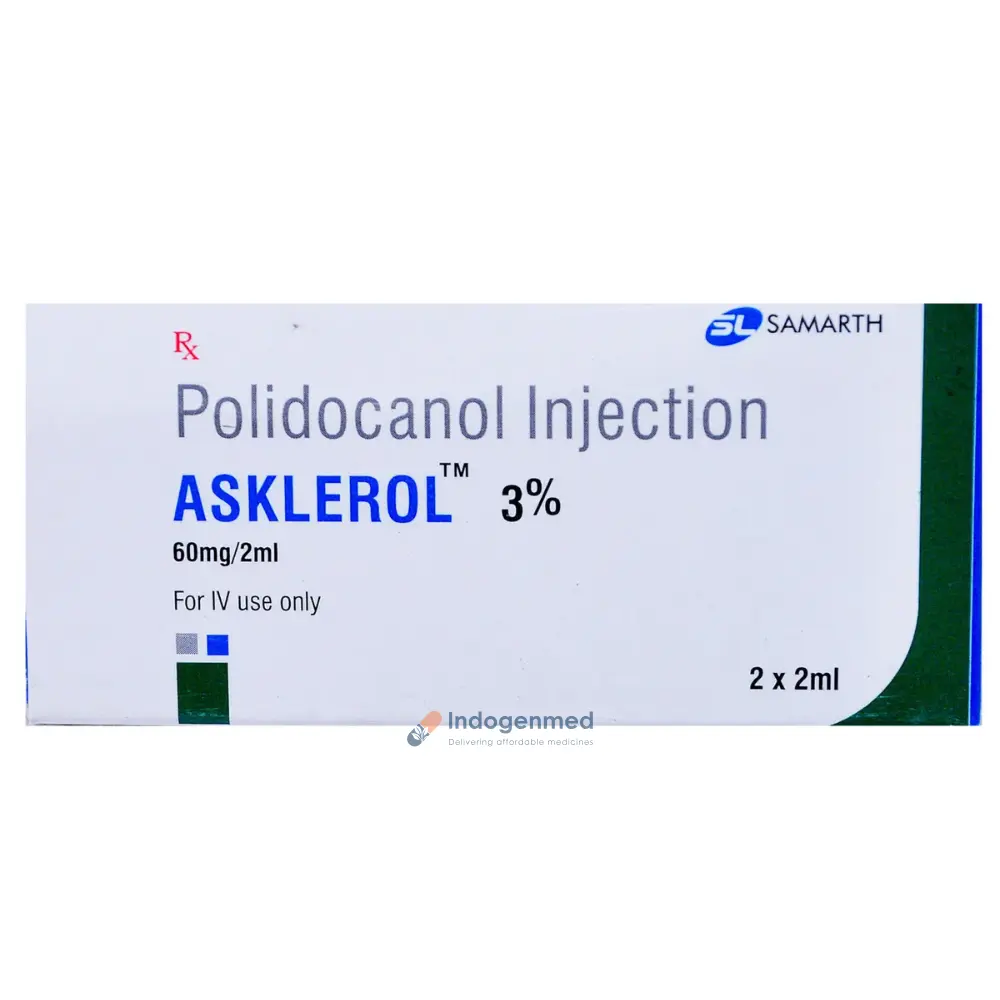
Asklerol 2 Ml Injection — Polidocanol Solution for Sclerotherapy
Asklerol 2 Ml Injection is a sterile aqueous solution for intravenous sclerotherapy containing Polidocanol (also known as hydroxypolyethoxydodecane or Laureth-9), supplied as a 2 ml ampoule. It is used by trained vascular specialists for the sclerotherapy treatment of varicose veins and superficial telangiectasias (spider veins) of the lower limbs.
Asklerol is a specialist-only prescription medicine. It must be administered exclusively by a qualified physician experienced in sclerotherapy procedures in an appropriate clinical setting. It is not suitable for self-administration.
Composition
| Active Ingredient | Concentration | Category |
|---|---|---|
| Polidocanol (Hydroxypolyethoxydodecane) | As per product specification | Sclerosing Agent |
Available in multiple concentrations (commonly 0.5%, 1%, 2%, 3%) for different vessel sizes. Confirm concentration from product label before use. Supplied as 2 ml ampoules.
How Asklerol Works — Mechanism of Action
Polidocanol is a non-ionic surfactant and local anaesthetic agent. When injected directly into a varicose or spider vein, it disrupts the endothelial cell lipid bilayer, causing:
- Endothelial cell destruction: Polidocanol denatures endothelial cell surface proteins and disrupts cell membrane integrity → endothelial necrosis
- Thrombosis and fibrosis: Local inflammatory response → platelet aggregation and thrombus formation within the damaged vessel → progressive fibrous obliteration
- Vascular occlusion: The treated vein collapses and is gradually absorbed by the body over weeks to months, eliminating the visible varicosity
- Local anaesthetic effect: Polidocanol has intrinsic local anaesthetic properties, making the injection itself relatively painless compared to other sclerosants
The concentration used is matched to vessel diameter: lower concentrations (0.5–1%) for small telangiectasias, higher concentrations (2–3%) for larger reticular veins and varicosities.
Clinical Indications
- Varicose veins: Sclerotherapy of small to medium varicose veins of the lower limb (reticular veins and their tributaries) where surgery is not indicated or preferred
- Spider veins (telangiectasias): Cosmetic and medical treatment of superficial capillary telangiectasias of the lower limbs
- Foam sclerotherapy: Polidocanol may be used to prepare sclerosant foam (Tessari method or similar) for treatment of larger varicosities under ultrasound guidance
All sclerotherapy procedures must be performed by a physician experienced in the technique. Patient selection, vessel assessment, and appropriate concentration choice are essential for safety and efficacy.
Dosage and Administration
- Administration route: Intravenous injection directly into the target vein only. Intradermal or perivenous injection must be avoided — extravasation causes tissue necrosis.
- Concentration selection: Use the lowest effective concentration for the target vessel size. Higher concentrations for larger veins; lower concentrations for telangiectasias.
- Volume per session: Total volume per session should not exceed the manufacturer’s recommended maximum (typically 2 mg/kg body weight of polidocanol). Multiple sessions may be required.
- Post-procedure: Compression bandaging or graduated compression stockings after treatment improve outcomes and reduce the risk of post-sclerotherapy hyperpigmentation and thrombosis. Patients are usually advised to walk immediately after the procedure.
- Foam preparation: When used as foam, mix polidocanol solution with air or physiological gas using the Tessari technique immediately before use.
This medicine must only be administered by or under direct supervision of a trained vascular specialist or phlebologist.
Special Populations
- Pregnancy: Contraindicated — sclerotherapy is generally deferred until after delivery.
- Breastfeeding: Not recommended. Defer elective sclerotherapy until breastfeeding is complete.
- Elderly: No specific dose adjustment but careful patient selection (venous insufficiency, mobility) is important.
- Renal/hepatic impairment: No specific data; use with caution. Systemic absorption is minimal with correct intravenous injection technique.
- Patients with deep vein thrombosis history: Active DVT is a contraindication. History of DVT requires specialist assessment before sclerotherapy.
Precautions
- Resuscitation readiness: Anaphylaxis has been reported. Resuscitation equipment and trained personnel must be immediately available during and after injection.
- Avoid intra-arterial injection: Accidental intra-arterial injection causes severe ischaemia and may lead to gangrene. Aspirate before injecting; if blood is not easily withdrawn or is bright red, withdraw needle immediately.
- Avoid perivenous injection: Extravasation causes local tissue necrosis and ulceration.
- Foam sclerotherapy — neurological risk: Foam sclerotherapy of large veins or in patients with patent foramen ovale (PFO) carries a risk of transient ischaemic attack or stroke due to foam entering the arterial circulation via right-to-left shunt. Assess for PFO in patients with large veins requiring foam.
- Post-treatment monitoring: Monitor for deep vein thrombosis, superficial thrombophlebitis, and pigmentation after each session.
- Not for trunk varicosities: Large saphenous trunk varicosities are more appropriately treated surgically or with endovenous thermal ablation; sclerotherapy alone may be insufficient.
Contraindications
- Hypersensitivity to polidocanol or any excipient
- Acute deep vein thrombosis or pulmonary embolism
- Severe arterial occlusive disease of the lower limbs
- Known symptomatic patent foramen ovale (for foam sclerotherapy)
- Pregnancy and breastfeeding
- Severe systemic illness or bedridden patients
- Local infection at the injection site
Side Effects
Common (≥1/100): Injection-site pain, bruising, hyperpigmentation along the treated vessel, transient urticaria at the injection site, temporary telangiectatic matting (fine new vessels appearing alongside treated area).
Uncommon (≥1/1,000): Superficial thrombophlebitis, allergic skin reactions, transient visual disturbances (with foam sclerotherapy), headache, dizziness.
Rare but serious: Anaphylaxis/anaphylactoid reactions, deep vein thrombosis, pulmonary embolism, transient ischaemic attack or stroke (with foam), tissue necrosis at perivenous injection sites, nerve injury.
Contact emergency services immediately if the patient develops chest pain, difficulty breathing, sudden neurological symptoms, or signs of severe allergic reaction during or after the procedure.
Drug Interactions
- Anticoagulants (warfarin, heparin, DOACs): May alter the thrombotic response to sclerotherapy. Specialist assessment required; some practitioners defer sclerotherapy or adjust anticoagulation.
- Other sclerosants: Do not combine different sclerosing agents in the same session without specialist guidance.
Storage Instructions
- Store at room temperature, below 25°C. Protect from light.
- Keep out of reach of children.
- Do not use past the expiry date on the ampoule. Discard opened ampoules immediately after use — do not store partially used ampoules.
- Inspect visually before use: do not use if the solution is cloudy, discoloured, or contains visible particles.
Frequently Asked Questions
What conditions can Asklerol treat?
Asklerol (Polidocanol) is used to treat varicose veins — enlarged, twisted veins visible under the skin — and spider veins (telangiectasias), which are small clusters of red, blue, or purple surface vessels. The injection causes the target vein to close and fade from view over several weeks. It is performed as an outpatient procedure by vascular specialists or phlebologists.
How many sessions of sclerotherapy are needed?
The number of sessions depends on the number and size of veins to be treated. Most patients require 2–5 sessions spaced 4–6 weeks apart for optimal results. Your specialist will assess the response after each session and plan accordingly.
Is sclerotherapy painful?
Polidocanol has mild intrinsic local anaesthetic properties, so it tends to be less painful than some other sclerosants. Most patients experience only a mild stinging or pressure sensation during injection. Topical anaesthetic cream may be used for very sensitive patients.
How long does it take for veins to disappear after sclerotherapy?
Spider veins typically fade within 3–6 weeks after treatment. Larger varicose veins may take 3–4 months to fully resolve. Some patients develop temporary post-treatment hyperpigmentation (darkening) along treated vessels, which usually fades over several months. Wearing compression stockings as directed speeds recovery and reduces pigmentation.
Can varicose veins come back after sclerotherapy?
Sclerotherapy permanently destroys treated veins, but it does not prevent new varicosities from forming in adjacent areas — especially in patients with underlying venous insufficiency, obesity, or a strong family history of varicose veins. Compression stockings and regular review help manage recurrence.
References
- NHS — Varicose Veins: Treatment (Sclerotherapy). National Health Service, UK.
- MedlinePlus — Sclerotherapy. U.S. National Library of Medicine.
- EMA — European Public Assessment Report: Polidocanol (Aethoxysklerol). European Medicines Agency.
- NHS — Varicose Veins: Overview. National Health Service, UK.
Disclaimer: This product information is provided for general educational purposes only. Asklerol Injection is a prescription-only specialist medicine for intravenous administration by trained physicians only. This content does not constitute medical advice and must not be used to self-diagnose, self-prescribe, or self-administer. IndoGenMed.org supplies this product to licensed healthcare professionals and registered pharmacies only.
Reviews
There are no reviews yet.