Description
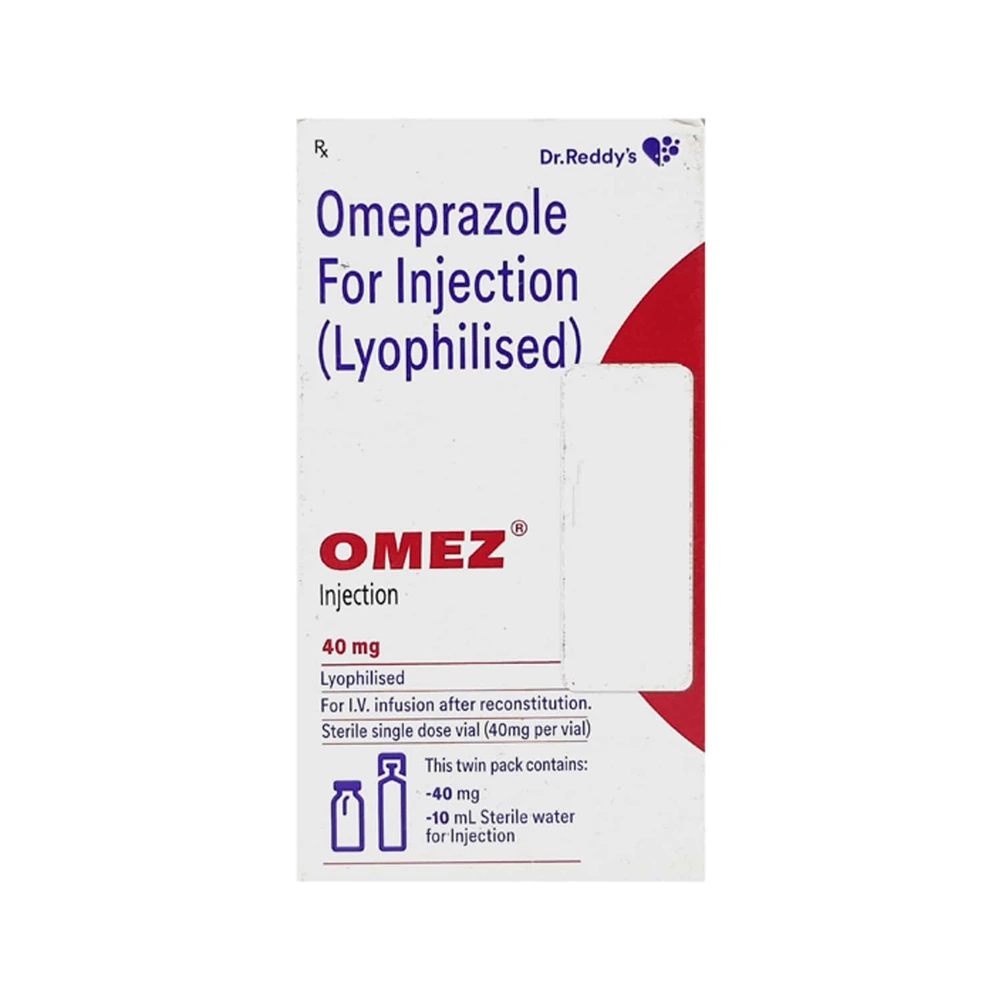
Omez 40 mg Injection — Omeprazole 40 mg for Intravenous Use
Omez 40 mg Injection contains omeprazole sodium 40 mg (equivalent to omeprazole 40 mg), a proton pump inhibitor (PPI) formulated for intravenous administration. It is indicated for adult patients who cannot take oral proton pump inhibitors and require parenteral acid suppression, including those with severe erosive oesophagitis, upper gastrointestinal bleeding, Zollinger-Ellison syndrome (a rare condition of gastric acid hypersecretion due to a gastrin-secreting tumour), and prophylaxis of stress ulcers in critically ill patients in intensive care settings. Omeprazole belongs to the benzimidazole class of PPIs and irreversibly inhibits the H⁺/K⁺-ATPase (proton pump) on the secretory canalicular membrane of gastric parietal cells, suppressing both basal and stimulated gastric acid secretion regardless of the stimulus (histamine, acetylcholine, gastrin). The IV formulation is particularly important in settings where swallowing is impaired (severe vomiting, postoperative states, unconscious patients, bowel obstruction) or where rapid, reliable acid suppression is essential to prevent rebleeding after endoscopic haemostasis. Omez 40 mg Injection should be reconstituted with the appropriate diluent and administered as an intravenous infusion or bolus injection as specified; it must not be mixed with other drugs or used for intramuscular injection.
Composition of Omez 40 mg Injection
- Omeprazole sodium equivalent to omeprazole 40 mg per vial (lyophilised powder for reconstitution)
- Excipients: sodium hydroxide (for pH adjustment), disodium edetate or other stabiliser (formulation-dependent)
Omeprazole is chemically 5-methoxy-2-[(4-methoxy-3,5-dimethylpyridin-2-yl)methylsulfinyl]-1H-benzimidazole, a racemic mixture of the R- and S-enantiomers. It is supplied as the sodium salt in the injectable form to improve water solubility. After reconstitution, the pH of the solution is approximately 9–10 (alkaline), which is essential for the drug’s stability in solution; it must not be mixed with acidic solutions or other medications.
Mechanism of Action
- Prodrug activation in the acid environment of the parietal cell: Omeprazole is a prodrug. After intravenous administration, it is taken up by the parietal cell of the gastric mucosa and transported to the acidic secretory canaliculus (pH ~1). In this acid environment, omeprazole is protonated and undergoes acid-catalysed conversion to its active sulphenamide form (a reactive thiol derivative)
- Irreversible H⁺/K⁺-ATPase inhibition: The active sulphenamide reacts covalently with cysteine residues (Cys813 and Cys892) on the α-subunit of the H⁺/K⁺-ATPase (proton pump), forming a stable disulphide bond. This irreversibly blocks the final step of acid secretion — the exchange of H⁺ (proton) from the parietal cell into the gastric lumen in exchange for K⁺. Because the inhibition is irreversible, acid secretion recovers only when new proton pump molecules are synthesised (over approximately 24–48 hours)
- Profound and long-lasting acid suppression: A single 40 mg IV dose suppresses 24-hour intragastric acid output by approximately 90–95%. Because recovery requires new protein synthesis, the duration of effect (24–48 hours) far exceeds the plasma half-life (60–90 minutes), making once-daily dosing sufficient for most indications. In acute upper GI bleeding, continuous IV infusion maintains intragastric pH above 6, preventing fibrinolysis of blood clots and re-dissolution of haemostatic platelet plugs — this is the physiological basis for high-dose PPI infusion after endoscopic haemostasis
- Effect on pepsin: By raising gastric pH well above 4, omeprazole indirectly inhibits pepsin activity (pepsin is inactive above pH 4), reducing the proteolytic digestion of mucosal defences and existing haemostatic clots
Pharmacokinetics
| Parameter | Detail |
|---|---|
| Administration | Intravenous (IV bolus or infusion); 100% bioavailability (bypasses first-pass effect) |
| Protein binding | Approximately 95% bound to plasma albumin and alpha-1-acid glycoprotein |
| Distribution | Volume of distribution ~0.3 L/kg; concentrates in parietal cells due to acid trapping |
| Metabolism | Extensively hepatic via CYP2C19 (major; ~80%) and CYP3A4; forms inactive metabolites (hydroxyomeprazole, omeprazole sulphone). CYP2C19 polymorphism affects metabolism: poor metabolisers have 3–4× higher plasma AUC than extensive metabolisers |
| Half-life (plasma) | 60–90 minutes; but biological effect (acid suppression) lasts 24–48 hours due to irreversible enzyme inhibition |
| Elimination | Urine (77% as metabolites); faeces (18%); no active drug in urine |
| Renal impairment | No dose adjustment needed (metabolites excreted renally but not pharmacologically active) |
| Hepatic impairment | Plasma AUC increased significantly; reduce dose in severe hepatic impairment |
Uses of Omez 40 mg Injection
- Acute upper gastrointestinal bleeding (peptic ulcer haemorrhage): After endoscopic haemostasis of a bleeding peptic ulcer, high-dose IV omeprazole (80 mg bolus followed by 8 mg/hour continuous infusion for 72 hours, or high-dose intermittent infusion) maintains intragastric pH above 6 to prevent fibrinolysis and re-bleeding. This is a critically important indication supported by level 1 evidence from multiple randomised controlled trials. Omez 40 mg Injection provides the parenteral formulation required in these patients who are fasted and cannot take oral medications
- Severe erosive oesophagitis requiring parenteral therapy: In patients with grade C or D erosive oesophagitis who cannot swallow due to severe odynophagia or in postoperative states, IV omeprazole provides effective acid suppression until oral therapy can be resumed
- Zollinger-Ellison syndrome: This rare gastrin-secreting tumour (gastrinoma) causes massive gastric acid hypersecretion, leading to severe peptic ulceration and diarrhoea. High-dose IV omeprazole controls acid hypersecretion in hospitalised patients, with doses titrated upward to achieve basal acid output below 10 mEq/hour (or below 5 mEq/hour in patients with prior gastric surgery)
- Stress ulcer prophylaxis in intensive care: Critically ill patients on mechanical ventilation, with coagulopathy, major burns, severe head injury, or multi-organ failure are at high risk of stress-related mucosal disease (SRMD) and upper GI bleeding. IV omeprazole is used as prophylaxis in these settings, particularly when enteral nutrition cannot be established. Note: current evidence (SUP-ICU trial, 2018) shows IV pantoprazole reduces GI bleeding risk but may increase pneumonia risk; clinical decisions involve risk-benefit assessment
- Prophylaxis of aspiration pneumonitis (anaesthesia): Pre-operative IV omeprazole raises gastric pH before induction of general anaesthesia, reducing the severity of chemical pneumonitis if aspiration of gastric contents occurs (Mendelson’s syndrome prophylaxis)
Dosage and Administration
| Indication | Dose and Regimen | Duration |
|---|---|---|
| Upper GI bleeding (post-endoscopic haemostasis) | 80 mg IV bolus over 30 min, then 8 mg/hour continuous infusion; OR 40 mg IV twice or three times daily (intermittent) | 72 hours (high-dose), then switch to oral PPI |
| Erosive oesophagitis / standard acid suppression | 40 mg IV once daily (over 20–30 minutes or slow bolus) | Until oral therapy can be established |
| Zollinger-Ellison syndrome | 60 mg IV once daily initially; titrate upward to 120 mg/day or higher if needed; doses above 60 mg may be divided twice daily | Until oral therapy established; long-term in inoperable cases |
| Stress ulcer prophylaxis (ICU) | 40 mg IV once daily | Duration of ICU stay or until enteral nutrition established |
| Pre-anaesthesia (aspiration prophylaxis) | 40 mg IV the evening before surgery and 40 mg on the morning of surgery | Single or double dose |
Reconstitution and administration:
- Reconstitute each 40 mg vial with 10 mL of normal saline (0.9% sodium chloride) for IV bolus, or dilute further in 100 mL normal saline or 5% dextrose for IV infusion
- Administer IV bolus over at least 5 minutes; IV infusion over 20–30 minutes (or as slow infusion per institutional protocol)
- Use within 4 hours of reconstitution (normal saline) or 12 hours (dextrose 5%); protect from light
- Do not mix with other drugs in the same infusion line — omeprazole sodium is alkaline and incompatible with most IV medications
- Not for IM injection
Side Effects
Common (≥1%):
- Injection site reactions: Phlebitis, pain, burning, or thrombophlebitis at the injection site — more common with repeated administration into peripheral veins; prefer central venous access for high-dose continuous infusions
- Gastrointestinal: Nausea, vomiting, diarrhoea, constipation, abdominal pain, flatulence — these are uncommon at standard doses and self-limiting
- Headache, dizziness
Uncommon but clinically important:
- Hypomagnesaemia: Prolonged PPI use (usually >3 months) can cause hypomagnesaemia (low serum magnesium), which may be asymptomatic or manifest as muscle cramps, tremor, tetany, seizures, or cardiac arrhythmias. IV magnesium supplementation and PPI dose review may be needed
- Clostridium difficile infection: Acid suppression reduces gastric sterilisation of ingested bacteria; PPIs increase the risk of Clostridioides difficile-associated diarrhoea, particularly in hospitalised patients on antibiotics
- Community-acquired pneumonia: Epidemiological data suggest a modest increase in pneumonia risk with PPI use in ICU patients (aspiration of less-acid gastric contents)
- Hypersensitivity reactions: Anaphylaxis, urticaria, bronchospasm — rare but potentially serious with IV administration; have resuscitation equipment available
Precautions and Warnings
- Duration of parenteral therapy: Switch to oral PPI as soon as the patient can tolerate oral medications; IV therapy is intended as a short-term bridge, not long-term treatment
- Hepatic impairment: Omeprazole is extensively metabolised by the liver. Severe hepatic impairment significantly increases plasma exposure; reduce dose (20 mg once daily in severe hepatic disease) and monitor liver function
- CYP2C19 polymorphism: Poor metabolisers (~3% of Caucasians, ~15–20% of Asians) have markedly higher plasma omeprazole levels; this increases efficacy but also the risk of side effects. No dose adjustment is universally recommended, but awareness is important in patients with unexpected side effects
- Bone fracture risk: Long-term oral PPI use has been associated with an increased risk of hip, wrist, and spine fractures in population studies; mechanism may involve impaired calcium absorption at higher gastric pH. This is primarily relevant to chronic oral use rather than short-term IV therapy
- Masking of gastric malignancy: PPIs relieve symptoms of gastric cancer by reducing acid; do not use empirically without investigation of underlying pathology in patients with alarm symptoms (dysphagia, weight loss, haematemesis, persistent anaemia)
Drug Interactions
| Drug / Class | Interaction | Clinical Action |
|---|---|---|
| Clopidogrel (antiplatelet agent) | Omeprazole inhibits CYP2C19, reducing conversion of clopidogrel to its active metabolite; may reduce antiplatelet efficacy and increase cardiovascular event risk | Prefer pantoprazole (weaker CYP2C19 inhibitor) in patients on clopidogrel; this interaction is clinically significant |
| Methotrexate | PPIs may increase methotrexate plasma levels (possibly via competition for renal transport), increasing methotrexate toxicity | Monitor methotrexate levels and toxicity signs closely; consider temporary PPI discontinuation during high-dose methotrexate |
| Warfarin and other vitamin K antagonists | CYP2C19 inhibition may reduce warfarin metabolism, increasing INR and bleeding risk | Monitor INR closely when starting or stopping omeprazole in warfarin patients |
| Ketoconazole, itraconazole, posaconazole (azole antifungals) | Raised gastric pH markedly reduces oral absorption of these drugs (they require acid for dissolution and absorption); less relevant for IV omeprazole affecting IV antifungal absorption | Use with caution; monitor antifungal efficacy; consider IV azoles where needed |
| Atazanavir (HIV protease inhibitor) | Requires low gastric pH for absorption; PPIs substantially reduce atazanavir plasma levels, potentially causing virological failure | Contraindicated — do not use omeprazole with atazanavir; use alternative HIV regimen or alternative acid suppression |
Contraindications
- Known hypersensitivity to omeprazole, other PPIs (benzimidazole compounds), or any excipient in the formulation (cross-reactivity between PPIs exists)
- Co-administration with atazanavir or nelfinavir (HIV protease inhibitors whose absorption is critically pH-dependent) — absolute contraindication
- Not for intramuscular injection
Storage Instructions
- Lyophilised powder vials: store below 25°C, protected from light and moisture
- After reconstitution: use within 4 hours (normal saline) or 12 hours (5% dextrose) at room temperature; do not refrigerate reconstituted solution
- Keep all vials out of reach of children
- Do not use after the expiry date printed on the vial
Related Products
The following medicines on IndoGenMed are frequently used alongside Omez 40 mg Injection in hospital and critical care settings:
- Floricot 100 mcg Tablet (Fludrocortisone Acetate 100 mcg) — mineralocorticoid used in adrenal insufficiency; critically ill patients with Addison’s disease may require both IV omeprazole for GI protection and fludrocortisone for haemodynamic stability
- Dalacin C 300 mg Capsule (Clindamycin 300 mg) — antibiotic used in patients with upper GI infection or aspiration pneumonia alongside acid suppression
- Monocef 1g Injection (Ceftriaxone 1 g) — cephalosporin antibiotic used in hospitalised patients with GI infection or sepsis requiring concurrent acid suppression
- Valzaar H 160 Tablet (Valsartan + Hydrochlorothiazide) — ARB antihypertensive used in patients who may also need PPI therapy for GI protection on antihypertensive or antiplatelet regimens
- Linox 600 mg Infusion 300 ml (Linezolid 600 mg) — IV antibiotic for serious infections in ICU patients who also receive stress ulcer prophylaxis with IV omeprazole
References
- DailyMed (FDA). Omeprazole Sodium for Injection — Full Prescribing Information. Available at: https://dailymed.nlm.nih.gov/dailymed/search.cfm?labeltype=all&query=omeprazole+injection
- MedlinePlus (U.S. National Library of Medicine). Omeprazole. Available at: https://medlineplus.gov/druginfo/meds/a693050.html
- Laine L, Jensen DM. Management of patients with ulcer bleeding. Am J Gastroenterol. 2012;107(3):345–360. PubMed PMID: 22310222. Available via: https://pubmed.ncbi.nlm.nih.gov/22310222/
- Krag M, Marker S, Perner A, et al. Pantoprazole in patients at risk for gastrointestinal bleeding in the ICU (SUP-ICU trial). N Engl J Med. 2018;379(23):2199–2208. PubMed PMID: 30415601. Available via: https://pubmed.ncbi.nlm.nih.gov/30415601/
- Mayo Clinic. Omeprazole (Intravenous Route) — Description and Brand Names, Before Using, Proper Use, Precautions, Side Effects. Available at: https://www.mayoclinic.org/drugs-supplements/omeprazole-intravenous-route/description/drg-20074715

Reviews
There are no reviews yet.