
Description
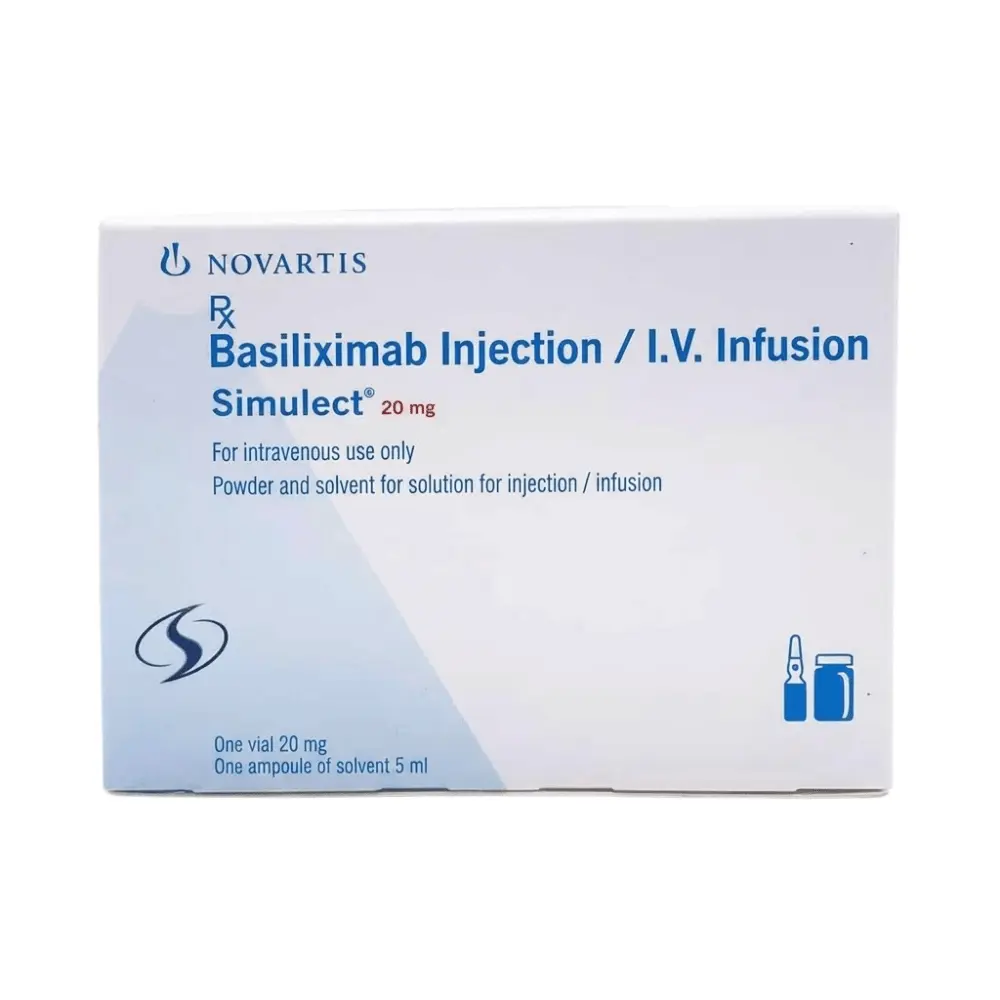
Comprehensive Guide to Simulect 20mg Injection (Basiliximab)
Simulect 20mg Injection is an immunosuppressive biological medication containing basiliximab as its active substance. Developed and manufactured by Novartis, Simulect is a recombinant chimeric monoclonal antibody ($IgG_{1\kappa}$) that functions as an interleukin-2 (IL-2) receptor antagonist.
Simulect is used in transplant medicine to prevent organ rejection in patients undergoing renal (kidney) transplantation. It is administered as part of an immunosuppressive regimen alongside other medications, such as cyclosporine and corticosteroids.
What is Simulect 20mg and How Does It Work?
When a patient receives a transplanted kidney, their immune system recognizes the new organ as foreign and activates T-lymphocytes (T-cells) to attack it. A critical step in this immune response involves Interleukin-2 (IL-2), a protein that binds to receptors on T-cells, signaling them to multiply and target the transplanted organ.
Mechanism of Action
Basiliximab functions as a targeted immune inhibitor:
-
Targeted CD25 Binding: Basiliximab specifically binds to the alpha chain of the IL-2 receptor (CD25 antigen), which is expressed on the surface of activated T-lymphocytes.
-
Competitive Blockade: By occupying the CD25 receptor, basiliximab blocks IL-2 from binding to activated T-cells.
-
Inhibition of Rejection: Without the IL-2 signal, T-cells cannot multiply, suppressing the immune response against the transplanted kidney.
Key Clinical Feature: Simulect selectively targets activated T-cells without causing systemic depletion of general white blood cells, maintaining basic immune protection against unrelated pathogens.
Approved Indications
Simulect 20mg Injection is indicated for:
-
Prophylaxis of Acute Organ Rejection in Renal Transplantation: Used to prevent early acute organ rejection in adult and pediatric patients receiving a kidney transplant. It is administered as part of an induction therapy regimen alongside cyclosporine for microemulsion and corticosteroids.
Standard Dosage and Administration Guidelines
Simulect must be administered under the supervision of a transplant specialist in a hospital or clinical setting.
Standard Dosage Protocols
Simulect is given in a two-dose regimen:
-
Adults (≥ 35 kg): The total recommended dose is 40 mg, given in two separate 20 mg doses.
-
First Dose (20 mg): Administered within 2 hours before transplant surgery.
-
Second Dose (20 mg): Administered 4 days after transplant surgery.
-
-
Pediatric Patients (< 35 kg): The total recommended dose is 20 mg, given in two separate 10 mg doses.
-
First Dose (10 mg): Administered within 2 hours before transplant surgery.
-
Second Dose (10 mg): Administered 4 days after transplant surgery.
-
[1st Dose: Within 2 Hours Before Surgery] ---> [Transplant] ---> [2nd Dose: Day 4 Post-Surgery]
Administration Methods
-
Intravenous Infusion: The reconstituted solution is diluted in 0.9% Sodium Chloride or 5% Dextrose and infused intravenously over 20 to 30 minutes.
-
Intravenous Bolus: Can also be given as a direct intravenous bolus injection over a few minutes.
Potential Side Effects and Management Strategies
Because Simulect is given as part of a multi-drug immunosuppressive regimen, side effects are often combined with those of co-administered medications (such as cyclosporine and steroids).
Common Side Effects
-
Gastrointestinal Effects: Constipation, nausea, diarrhea, abdominal pain, or vomiting.
-
Metabolic & Fluid Shifts: Hyperkalemia (high potassium), hypokalemia (low potassium), hyperglycemia (high blood sugar), or peripheral edema (swelling in legs/feet).
-
Cardiovascular Effects: Hypertension (high blood pressure) or hypotension (low blood pressure).
-
General Effects: Fever, headache, insomnia, or pain at the surgical site.
Serious Adverse Reactions (Seek Immediate Emergency Care)
-
Severe Hypersensitivity / Anaphylaxis: Severe allergic reactions can occur during or following infusion. Symptoms include difficulty breathing, wheezing, hives, facial swelling, chest tightness, or a sudden drop in blood pressure.
-
Increased Risk of Infections: Immunosuppression increases susceptibility to opportunistic viral, bacterial, and fungal infections (such as Cytomegalovirus / CMV, urinary tract infections, or wound infections).
-
Lymphoproliferative Disorders: Long-term immunosuppressive therapy carries a potential risk of developing secondary lymphoproliferative disorders or skin cancers.
Crucial Precautions and Clinical Monitoring
Patients receiving Simulect undergo close monitoring during their transplant stay.
Essential Clinical Monitoring
| Test / Parameter | Recommended Frequency | Clinical Rationale |
| Complete Blood Count (CBC) | Baseline and routine post-transplant | Tracks white blood cells and platelets to monitor for immunosuppression-related changes. |
| Renal Function (Cr / BUN) | Daily during hospital stay; routine post-discharge | Monitors graft function and checks for signs of early organ rejection or nephrotoxicity. |
| Blood Pressure & Vitals | Continuous during infusion; daily thereafter | Monitors for infusion reactions and secondary hypertension. |
| Infection Screenings | Routine clinical monitoring | Evaluates for signs of viral (CMV, EBV) or bacterial infections post-surgery. |
Vaccination & Handling Warnings
-
Live Vaccines (Contraindicated): Live attenuated vaccines (such as MMR, yellow fever, or varicella) should not be administered during immunosuppressive treatment with Simulect due to the risk of vaccine-derived infection.
-
Re-administration Caution: Simulect should be used with extreme caution if given for a subsequent transplant, as prior exposure can increase the risk of severe hypersensitivity reactions.
Special Population Guidelines
-
Pregnancy (Category B / Caution): Simulect should be used during pregnancy only if the potential benefit justifies the potential risk to the fetus. Females of childbearing potential should use effective contraception before starting treatment, during therapy, and for at least 4 months after the second dose.
-
Lactation: It is unknown whether basiliximab is excreted in human milk. Because of the potential for adverse effects in nursing infants, breastfeeding is not recommended for at least 4 months following the last dose.
Reconstitution, Storage, and Regulatory Compliance
-
Refrigeration Required: Store un-reconstituted Simulect vials in a refrigerator between 2°C and 8°C (36°F to 46°F). Protect from light.
-
Reconstitution Rules: Reconstitute the 20 mg vial with 5 mL of Sterile Water for Injection under aseptic conditions. Shake gently to dissolve.
-
Usage Window: After reconstitution, the solution should ideally be used immediately. If necessary, it can be stored under refrigeration (2°C–8°C) for up to 24 hours or at room temperature for up to 4 hours.
-
Quality Standards: Manufactured by Novartis, Simulect complies with global quality, safety, and regulatory standards for biological products.
Frequently Asked Questions (FAQs)
Q1: Why is the second dose of Simulect given exactly on Day 4 after the transplant?
The two-dose regimen (Day 0 and Day 4) provides therapeutic antibody concentrations in the blood for approximately 4 to 6 weeks following transplantation. This covers the period of highest risk for early acute organ rejection.
Q2: Will Simulect cause hair loss or severe bone marrow suppression?
No. Unlike standard cytotoxic chemotherapy agents, Simulect is a targeted monoclonal antibody that blocks a specific lymphocyte receptor (CD25) without directly causing hair loss or general bone marrow destruction.
Q3: Can Simulect be used to treat an ongoing kidney rejection episode?
No. Simulect is approved for prevention (prophylaxis) of acute organ rejection, not for treating an established, active acute rejection episode.
Medical Disclaimer
This guide is strictly for educational and informational purposes and should not replace professional medical advice, diagnosis, or treatment. Always consult a qualified transplant surgeon, nephrologist, or healthcare professional regarding transplant therapies and prescription medications.
References
-
National Center for Biotechnology Information (NCBI):
-
StatPearls Review: Basiliximab Pharmacology and Immunosuppressive Profile. https://www.ncbi.nlm.nih.gov/books/NBK545182/
-
PMC Clinical Studies: Induction Therapy with Basiliximab in Renal Transplantation. https://pmc.ncbi.nlm.nih.gov/articles/PMC3108786/
-
-
U.S. Food and Drug Administration (FDA):
-
Simulect (basiliximab) Prescribing Information & Safety Updates. https://www.accessdata.fda.gov/scripts/cder/daf/index.cfm?event=overview.process&ApplNo=103764
-
-
Medscape Reference:
-
Basiliximab (Rx) Drug Monograph & Dosing Details. https://reference.medscape.com/drug/simulect-basiliximab-343193
-
-
Mayo Clinic:
-
Basiliximab (Intravenous Route) Description & Side Effects. https://www.mayoclinic.org/drugs-supplements/basiliximab-intravenous-route/description/drg-20062147
-



Reviews
There are no reviews yet.