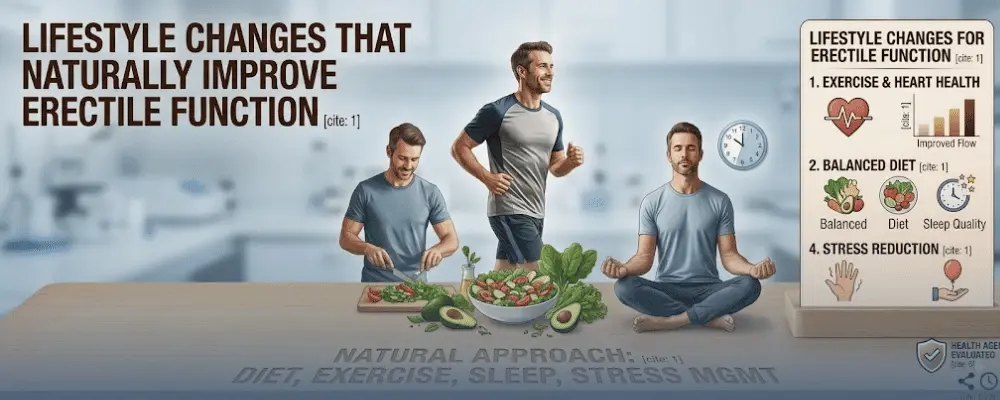
Lifestyle Changes That Naturally Improve Erectile Function
Erectile dysfunction is arguably one of the most widespread health issues among men; however, it is commonly regarded simply as a standalone sexual problem or as an unavoidable part of aging. For physicians specializing in urology and cardiology, erectile health is considered an indicator of overall cardiometabolic and vascular health in a male patient. Due […]
Medically reviewed by Dr. William Paul Abram, MB BCh · Doctor
Last reviewed 20/09/2026
On this page
- The Cardiovascular Connection: Why Vascular Health Drives Erections
- Targeted Exercise for ED: Aerobic Conditioning and Pelvic Training
- Dietary Modifications: The Mediterranean Pattern for Vascular Health
- Quitting Smoking: Reversing Microvascular Damage
- Restorative Sleep, Stress Management, and Hormonal Balance
- Alcohol Consumption and Substance Use
- Summary Comparison: Lifestyle Interventions and Clinical Impact
- When Lifestyle Modifications Need Medical Support
- Conclusion: A Daily 5-Point Action Plan for Natural Improvement
- References
Erectile dysfunction is arguably one of the most widespread health issues among men; however, it is commonly regarded simply as a standalone sexual problem or as an unavoidable part of aging.
For physicians specializing in urology and cardiology, erectile health is considered an indicator of overall cardiometabolic and vascular health in a male patient.
Due to its small size (about one-third of the size of coronary arteries supplying the heart), penile arteries are highly susceptible to any disturbances related to blood vessel elasticity, nerve impulses, or metabolism.
Medical literature stresses that minor to moderate cases of erectile dysfunction can easily be improved or even cured by using some lifestyle changes.
Prescription drugs such as PDE5 inhibitors, which help to increase blood flow temporarily, do not solve the problems of vascular stiffness, inflammation, or metabolism; therefore, adopting a healthy way of life can solve the reasons for poor circulation.
This article highlights physiological relationships between lifestyle and sex health, providing scientifically based ways of enhancing erectile function naturally.
The Cardiovascular Connection: Why Vascular Health Drives Erections
It becomes important to understand the process of mechanical workings of the vascular system during an erection to understand the process of improvement through such changes in lifestyle.
The erection itself can be considered as a cardiovascular process that requires healthy functioning of vessels, balanced nerve signaling, and smooth muscles.
Once there is sexual arousal, the nerves stimulate the endothelial cells that are the lining of the blood vessels in your body to produce and release a very significant bioactive substance called nitric oxide.
Nitric oxide then enters the smooth muscles in the penile arteries, causing the production of cGMP in these muscles.
Due to this action of the cGMP, there is a relaxing of the smooth muscles and an inflow of oxygen-filled blood to the spongy chambers of the corpora cavernosa of the penis.
In cases where your lifestyle choices are having a negative impact on your cardiovascular system, the following process becomes interrupted:
- Endothelial Dysfunction: High blood glucose, high levels of cholesterol, and inflammation lead to damage of the endothelium layer, causing serious inhibition of nitric oxide generation.
- Arterial Narrowing (Atherosclerosis): Plaque deposits narrow the arteries, decreasing the amount of blood able to flow into the erectile tissues.
- Venous Leakage: Due to weak muscle tissue or damage to the pelvic structures, veins carrying blood cannot be squeezed shut.
- By adopting certain healthy habits, you will increase your chances of returning the biological process to its natural course.
Targeted Exercise for ED: Aerobic Conditioning and Pelvic Training
Physical inactivity is one of the most potent independent risk factors for erectile dysfunction associated with the vascular system.
On the other hand, physical exercise is one of the most effective non-pharmacological treatments.
Physical exercise can work through two mechanisms: systemic conditioning and pelvic floor exercise.
Moderate-to-Vigorous Aerobic Exercise
Aerobic activity serves as a very potent natural therapy for your blood vessels. By accelerating your heart rate, the greater amount of friction of the blood flow through the vessels triggers endothelial nitric oxide synthase, an enzyme that synthesizes nitric oxide.
Several clinical studies described in urology literature have shown that sedentary men suffering from vascular ED benefit from aerobic activity to a great extent and show significant progress in IIEF score results in several months.
An effective aerobic routine involves:
- Frequency and Length: Try for 150 to 160 minutes of moderate physical activity, or 75 to 90 minutes of intense physical activity each week. This could be divided into 30 to 40 minutes each session, for four to five days each week.
- Recommended Exercises: Fast walking at a pace of 3.5 to 4 miles per hour, jogging, cycling, swimming laps, rowing, or exercising on an elliptical machine.
- Level of Intensity: One should feel like he is exerting himself in such a way that he breathes more rapidly and begins to perspire, yet can still speak comfortably (“talk test”).
- Through time, this cardiovascular training leads to decreased arterial stiffness, reduced blood pressure, increased insulin sensitivity, and formation of new microvasculature.
Pelvic Floor Muscle Training (Kegel Exercises for Men)
Although aerobic exercises work on the heart and the big arteries, pelvic floor muscle exercises focus on the particular muscles that support rigidity and prevent venous drainage.
There are two important muscles in the pelvic floor that have a direct bearing on erectile physiology:
- Bulbospongiosus Muscle: Surrounds the base of the penis and contracts periodically during climax in order to maintain rigidity during sexual activity.
- Ischiocavernosus Muscle: Presses the base of the erectile bodies to increase blood pressure within the penis for maximum rigidity and to prevent drainage of blood out of the penis.
A significant clinical trial conducted by scientists from the United Kingdom found that pelvic floor muscle exercises resulted in the improvement of function in most patients with erectile dysfunction within three to six months, with most men regaining normal function or improving substantially.
Guide- Kegel Exercises for Men
Step-by-Step Pelvic Floor Protocol for Men:
- Step 1: Muscle Identification. An easy method to identify the pelvic floor muscles involves intentionally stopping the flow of your urine for one second while going to the toilet, or contracting the muscles you use to hold in gas. Those muscles that squeeze up and inwards are the pelvic floor muscles. Avoid the habit of regularly stopping your urine flow, since this will irritate your bladder; use this method only to identify your muscle group.
- Step 2: Contraction Technique. Assume a comfortable lying position on your back, or an upright sitting position in a chair. Tense your pelvic floor muscles, squeezing upwards and inwards. Tighten your muscles for 5 seconds without breathing in and tightening your buttocks, legs, or tummy.
- Step 3: Total Relaxation. Relax your muscles fully and relax for 5 seconds. It is important to fully relax between exercises to avoid any spasms of your muscles or tightening of your pelvis.
- Step 4: Daily Sets. Perform a set of 10 to 15 repetitions, 3 times per day. As your strength builds over 4 to 6 weeks, increase your hold time to 10 seconds per repetition.
Dietary Modifications: The Mediterranean Pattern for Vascular Health
Your nutrient intake defines the biochemical milieu of your blood vessels. Eating a lot of ultra-processed food, refined carbohydrates, and saturated fats induces systemic inflammation, oxidative stress, and insulin resistance—all factors that inhibit nitric oxide production.
Clinical evidence proves the Mediterranean diet is a perfect example of a nutritional protocol that can preserve and restore erectile capacity.
Several long-term trials prove that people following the Mediterranean diet have a much lower prevalence of ED and metabolic syndrome than people who follow regular Western dietary guidelines.
Core Nutritional Components of an ED-Friendly Diet:
- Leafy Greens and Nitrate-Rich Vegetables: Spinach, arugula, kale, Swiss chard, and beetroot naturally contain high levels of dietary inorganic nitrates, which are converted into active nitric oxide by oral and gut bacteria after ingestion, thus promoting vasodilation and flexibility of blood vessels.
- Berries and Flavonoids: Blueberries, blackberries, cherries, and red grapes contain high amounts of flavonoids and anthocyanins. Flavonoids protect blood vessels from oxidative damage by free radicals.
- Healthy Fats: Extra virgin olive oil, avocado, walnuts, chia seeds, and fatty fish like wild salmon, mackerel, and sardines contain healthy fats that include essential omega-3 fatty acids. Omega-3 fatty acids lower vascular inflammation and produce a healthy lipid profile.
- Legumes and Whole Grains: Legumes such as lentils, chickpeas, black beans, quinoa, and whole grains like oats contain healthy carbohydrates and soluble fiber. Healthy carbohydrates prevent harmful insulin spikes after meals that adversely affect endothelial function.
- Micronutrients (Zinc and Magnesium): Oysters, pumpkin seeds, lean meats, and legumes contain zinc, which is an important nutrient for healthy testosterone production. Magnesium, which is present in high amounts in nuts and dark leafy greens, helps with relaxation of vascular smooth muscles.
Foods to Minimize or Eliminate:
- Refined Sugars and Sweetened Beverages: Excess sugar intake drives insulin resistance and glycation, a process where sugar molecules bond to proteins in vessel walls, causing them to stiffen.
- Industrial Trans Fats and Fried Foods: Promote systemic arterial inflammation and raise low-density lipoprotein (LDL) cholesterol, accelerating plaque formation.
- Excess Sodium: Excessive table salt intake promotes fluid retention and hypertension, placing chronic shear stress on delicate penile capillaries.
Quitting Smoking: Reversing Microvascular Damage
Smoking cigarettes, cigars, and vaping nicotine are among the most damaging behaviors for erectile health. Scientific research conducted within the field of urology reveals that men who smoke cigarettes are twice as likely to suffer from erectile dysfunction as those who do not smoke.
The Biological Damage Caused by Nicotine:
- Immediacy of Vasoconstriction: Nicotine is an aggressive chemical vasoconstrictor. Seconds after inhaling the drug, nicotine stimulates the sympathetic nervous system which releases stress hormones that cause constrictions of the small peripheral blood vessels, thus limiting blood flow to the penis.
- Rapid Formation of Atherosclerotic Plaques: Chemicals contained in inhaled tobacco smoke cause significant oxidative stress to the lining of the blood vessel causing the development of fibrous and calcified plaques along the internal pudendal and cavernous arteries.
- Limitation of Nitric Oxide Signals: Smoking affects the function of endothelial nitric oxide synthase.
The Reversibility of Smoking-Related ED:
However, the heartening clinical fact remains that microcirculation repair occurs within a few hours after discontinuation of nicotine consumption:
- 24 to 48 Hours: Carbon monoxide exits the bloodstream, the oxygen-carrying capacity of the body increases, and the vascular tone begins to normalize at rest.
- 4 to 12 Weeks: Endothelial sensitivity increases, and systemic circulation regains strength.
- Long-term: Clinical tests on urology reveal that cessation of smoking, particularly among younger and middle-aged individuals without calcified vascular problems, brings about definite improvements in sexual function.
If you are currently using any tobacco or nicotine product, having a discussion with your health care provider on smoking cessation therapy, nicotine withdrawal treatment, and behavior modification will be among the most significant actions you could consider.
Restorative Sleep, Stress Management, and Hormonal Balance
Even though physical conditioning and nutrition provide the framework for vascular health, neurological and hormonal regulation control the brain’s capability to initiate the sexual response.
Insomnia and chronic stress are just two of the many common yet underappreciated causes of secondary erectile dysfunction.
Deep Sleep and Natural Testosterone Production
Testosterone is the main male hormone that helps maintain a high sex drive and regulates the amount of nitric oxide synthase in penile tissues and maintains erectile tissue elasticity.
Most surprisingly, in contrast to most other hormones, the production of testosterone throughout the day mostly takes place during slow-wave deep sleep and REM sleep. Any interruptions in these processes sharply reduce the level of this hormone secretion:
- It has been found that the restriction of healthy men to 5 hours of sleep at night for 7 days resulted in a drop in the level of testosterone by 10% to 15% during the daytime.
- Obstructive Sleep Apnea (OSA): People suffering from obstructive sleep apnea have periodic drops in blood oxygen levels at night (hypoxia) and microarousals during sleep. Severe sleep disturbance causes inflammation and hormonal disturbances that contribute greatly to erectile dysfunction. Treatment of obstructive sleep apnea with CPAP significantly improves erectile rigidity.
Practical Sleep Guidelines:
- Prioritize 7 to 9 hours of continuous, restorative sleep every night.
- Maintain a consistent sleep schedule by waking up and going to bed at the same time daily, including weekends.
- Keep the bedroom dark, quiet, and cool (between 65 and 68 degrees Fahrenheit or 18 to 20 degrees Celsius).
- Discontinue screen use and blue light exposure 60 minutes before bedtime to support natural melatonin production.
Chronic Stress and the Cortisol-Adrenaline Trap
The human nervous system operates across two primary branches:
- The Parasympathetic Nervous System (The “Rest and Digest” State): Responsible for digestion, recovery, relaxation, and sexual arousal. An erection cannot physically occur unless the parasympathetic state is active.
- The Sympathetic Nervous System (The “Fight or Flight” State): Activated during stress, fear, or physical danger.
When a man experiences chronic workplace pressure, financial anxiety, or relationship distress, his body remains locked in a constant sympathetic state. The adrenal glands continuously pump out cortisol and adrenaline (epinephrine). Adrenaline directly constricts peripheral blood vessels and forces blood away from reproductive organs toward major skeletal muscles.
Furthermore, high baseline anxiety creates a self-fulfilling cycle of performance anxiety: a man worries about his sexual performance, triggering an adrenaline surge that immediately dissipates his erection, reinforcing his worry for future encounters.
Effective Stress Reduction Techniques:
- Daily Box Breathing: Inhale slowly for 4 seconds, hold for 4 seconds, exhale for 4 seconds, and hold empty for 4 seconds. Practicing this for 5 to 10 minutes helps switch your autonomic nervous system from sympathetic to parasympathetic mode.
- Mindful Meditation and Yoga: Lower resting heart rate, reduce baseline cortisol, and improve body awareness.
- Open Communication: Discussing performance worries openly with an intimate partner or working with a licensed sex therapist can dismantle the psychological pressure that perpetuates performance-related ED.
Alcohol Consumption and Substance Use
It has been understood for many years how alcohol can affect sexual functioning. Though a little bit of alcohol (like a glass of wine) can help to decrease social inhibition in the short term, too much alcohol or long-term alcohol abuse hinders erections via many different means.
The Acute Impact of Heavy Drinking
Alcohol is one of the most powerful CNS depressants. It affects the signaling process in the brain, the reflexes, and the communication between the brain and the penile nerves of the brain.
In addition to that, alcohol has a diuretic effect; it causes dehydration, leading to a reduction in the total volume of blood as well as problems in endothelial smooth muscles coordination.
The Long-Term Consequences of Chronic Alcohol Abuse
Hormonal Imbalance: Excessive alcoholism puts stress on the liver, limiting its capacity to process the circulating estrogen in the body. In turn, it causes increased estrogen levels, decreased production of testosterone, and shrinking of the testicles.
- Peripheral Neuropathy: Prolonged alcohol abuse may lead to the damaging of peripheral nerve fibers and result in a permanent loss of sensation and nerve function in the pelvic area.
- Liver Disorders and Vascular System Dysfunction: Chronic liver disease results in problems with blood clotting, lipid metabolism, and regulation of vascular system functioning.
Recommendations for a Healthy Sexuality and General Well-being:
- Reduce alcohol consumption to a moderate level, which is up to one or two drinks per day.
- Do not use alcohol as a way to cope with sexual anxiety since it reduces physiological erections.
Summary Comparison: Lifestyle Interventions and Clinical Impact
The following structured table outlines the core natural interventions, their underlying biological mechanisms, and the realistic timeframes required to observe noticeable clinical improvements:
|
Lifestyle Modification |
Primary Physiological Target |
Key Biological Mechanism |
Typical Timeframe for Results |
|
Moderate Aerobic Exercise |
Systemic Arteries & Heart |
Enhances nitric oxide production and clears arterial stiffness |
4 to 12 Weeks |
|
Pelvic Floor Kegel Training |
Bulbospongiosus Muscles |
Prevents venous blood leakage by strengthening pelvic floor |
8 to 12 Weeks |
|
Mediterranean Nutrition |
Endothelium & Lipid Profile |
Reduces arterial plaque, lowers oxidative stress, and provides dietary nitrates |
8 to 16 Weeks |
|
Smoking & Nicotine Cessation |
Microvascular Capillaries |
Eliminates acute chemical vasoconstriction and repairs vessel lining |
2 to 8 Weeks |
|
Restorative Sleep Optimization |
Endocrine & Nervous Systems |
Normalizes daytime testosterone synthesis and clears brain fatigue |
2 to 4 Weeks |
|
Stress & Anxiety Reduction |
Parasympathetic Nervous System |
Lowers circulating adrenaline and cortisol, breaking performance anxiety |
2 to 6 Weeks |
When Lifestyle Modifications Need Medical Support
While natural lifestyle interventions are powerful, foundational tools for overall health, it is vital to recognize when lifestyle modifications alone may be insufficient and clinical medical support is warranted.
Erectile dysfunction can sometimes stem from severe organic or structural issues that require medical evaluation:
- Advanced Atherosclerosis: Severe, calcified blockages in the pelvic or coronary arteries.
- Post-Surgical Nerve Damage: Trauma following radical prostatectomy, bladder surgery, or pelvic radiation.
- Severe Endocrine Disorders: Severe hypogonadism (extremely low testosterone), thyroid dysfunction, or hyperprolactinemia.
- Neurological Diseases: Multiple sclerosis, Parkinson’s disease, or severe diabetic neuropathy.
The Synergistic Approach
A healthy lifestyle is not opposed to treatment; both should be used hand in hand. Healthy practices improve the initial state of the patient, making drugs like PDE5 inhibitors (Sildenafil or Tadalafil) more effective when taken in lower dosages and causing fewer adverse effects.
When to Seek Immediate Medical Evaluation:
- Sudden, unexplained onset of erectile dysfunction, especially in young men with no prior sexual health issues.
- Erectile difficulties accompanied by chest pain, shortness of breath, palpitations, or exercise intolerance (which can indicate underlying coronary artery disease).
- Presence of numbness or tingling in the groin, legs, or lower back.
- Development of penile curvature, severe pain, or palpable scar tissue during erections (which may indicate Peyronie’s disease).
Conclusion: A Daily 5-Point Action Plan for Natural Improvement
Restoration and maintenance of good erectile health require adherence to certain practices every day that will help you improve the functioning of your cardiovascular, endocrine, and nervous systems.
There are five steps you can use to create your daily regimen for restoration and maintenance of good erectile health:
- Exercise Every Day: You should perform 30 minutes of walking, jogging, cycling, swimming, and three sets of pelvic floor Kegel exercises every day.
- Eat Whole Foods: Include lots of vegetables, berries, grains, nuts, olive oil, and wild fish in your diet while reducing intake of processed sugars and fried foods.
- Guard Your Blood Vessels: Stop smoking and using any other products with nicotine; limit the consumption of alcohol.
- Sleep Well: Make sure that you get 7 to 9 hours of uninterrupted sleep per night to maintain proper natural testosterone production and repair of blood vessels.
- De-Stress Every Day: Do meditation or deep breathing exercises every day to reduce your resting adrenaline levels and allow your parasympathetic nervous system to function normally.
- Taking your erectile function as an important sign of your health will help you to make the right decisions concerning both cardiovascular and sexual wellbeing.
References
- PubMed Central (PMC): Lifestyle Modifications and Erectile Dysfunction: A Systematic Review. Available at: https://pmc.ncbi.nlm.nih.gov/articles/PMC4291878/
- Harvard Health Publishing: 5 Natural Ways to Overcome Erectile Dysfunction. Available at: https://www.health.harvard.edu/mens-health/5-natural-ways-to-overcome-erectile-dysfunction
- Cleveland Clinic: Erectile Dysfunction: Symptoms, Causes, and Natural Management. Available at: https://my.clevelandclinic.org/health/diseases/10035-erectile-dysfunction
- European Association of Urology (Uroweb): Lifestyle Changes for Managing Erectile Dysfunction. Available at: https://patients.uroweb.org/condition/erectile-dysfunction/all-treatments-ed/lifestyle-changes-ed
- NHS UK: Erectile Dysfunction (Erection Problems) Causes and Self-Help Guidelines. Available at: https://www.nhs.uk/conditions/erection-problems-erectile-dysfunction/
- Hartford HealthCare: Can Lifestyle Changes Really Reverse Erectile Dysfunction? Available at: https://hartfordhealthcare.org/about-us/news-press/news-detail?articleId=51359