Description
What Is Mebex 100 mg Tablets?
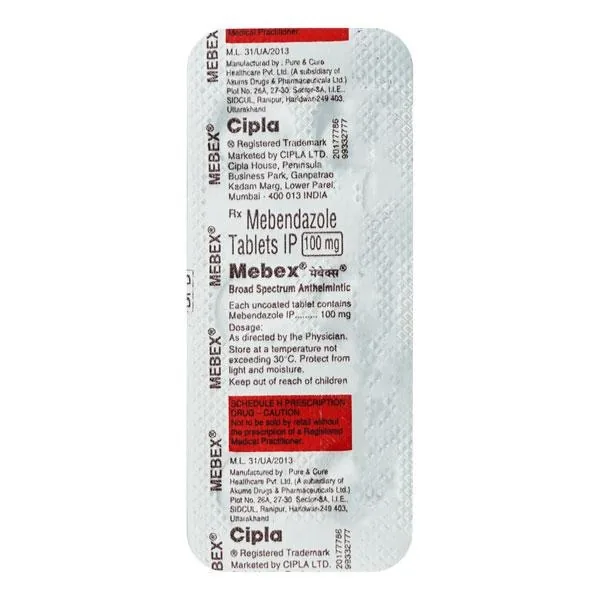
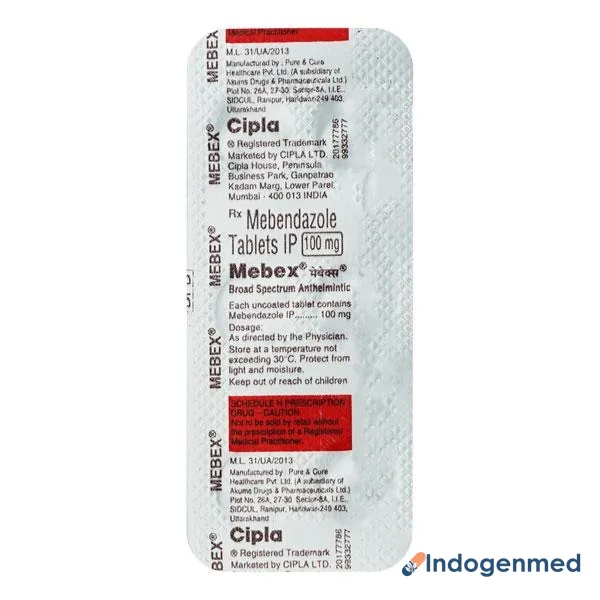
Mebex 100 mg Tablets contains mebendazole 100 mg, a broad-spectrum benzimidazole anthelmintic used to treat intestinal parasitic worm infections (helminthiases). Mebendazole is effective against a wide range of nematode (roundworm) infections including threadworm (Enterobius vermicularis), roundworm (Ascaris lumbricoides), hookworm (Ancylostoma duodenale and Necator americanus), whipworm (Trichuris trichiura), and mixed helminth infections. It is one of the most widely used anthelmintic medicines globally and is included on the World Health Organization (WHO) List of Essential Medicines. The 100 mg formulation allows both single-dose treatment for threadworm and multi-day regimens for other helminthiases.
Mebendazole exerts its antiparasitic effect through highly selective inhibition of tubulin polymerisation within the parasite — a mechanism that is specific to helminthic tubulin and largely spares mammalian tubulin at therapeutic doses, contributing to the drug’s favourable safety profile. Because mebendazole is poorly absorbed from the gastrointestinal tract (oral bioavailability <20% under fasting conditions), it acts primarily at the site of parasite residence in the intestinal lumen, limiting systemic side effects while concentrating drug directly where larvae and adult worms reside.
Mechanism of Action
Tubulin Polymerisation Inhibition
Mebendazole binds selectively and irreversibly to the β-tubulin subunit of helminthic tubulin, preventing its polymerisation into microtubules. Microtubules are essential structural components of the parasite’s cytoskeleton and are critically required for intracellular transport processes — including the uptake of glucose and other nutrients from the host intestinal lumen into the parasite’s intestinal cells. By blocking microtubule formation, mebendazole inhibits the parasite’s glucose uptake machinery and vesicular transport pathways.
Parasite Glucose Depletion and Death
Helminths depend almost exclusively on anaerobic glycolysis (the breakdown of glucose) for energy production — they lack the ability to synthesise glucose de novo. Mebendazole-induced inhibition of glucose uptake causes progressive depletion of the parasite’s glycogen stores, leading to impaired ATP synthesis, reduced motility, disrupted reproductive capacity, and ultimately parasite death. The effect is not immediate — worms may survive for 1–3 days after mebendazole exposure before dying and being expelled in faeces. The selective toxicity arises because mammalian tubulin binds mebendazole with far lower affinity than helminthic tubulin at therapeutic doses.
Indications
Threadworm (Pinworm) — Enterobius vermicularis
The most common helminth infection in developed countries. Treated with a single 100 mg dose. Reinfection is common due to the perianal egg-laying habit of female worms causing pruritus ani and auto-inoculation; a second dose 2–3 weeks later is recommended. Household contacts should be treated simultaneously to prevent reinfection.
Roundworm — Ascaris lumbricoides
Treated with 100 mg twice daily for 3 days or a single 500 mg dose (not the 100 mg formulation alone). Among the most prevalent helminth infections globally.
Hookworm — Ancylostoma duodenale / Necator americanus
Treated with 100 mg twice daily for 3 days. Hookworm is a major cause of iron-deficiency anaemia and protein malnutrition in endemic areas.
Whipworm — Trichuris trichiura
Treated with 100 mg twice daily for 3 days. Mebendazole has lower efficacy against Trichuris (cure rates 30–50%) compared to Ascaris; albendazole or combination therapy may be preferred in heavy Trichuris infections.
Mixed Intestinal Helminth Infections
Mebendazole’s broad spectrum makes it useful when mixed infections are suspected or confirmed, as a single course can treat multiple species simultaneously.
Dosage and Administration
Threadworm (Enterobius): 100 mg as a single dose. Repeat after 2–3 weeks; treat all household members simultaneously.
Roundworm (Ascaris), hookworm, whipworm: 100 mg twice daily for 3 consecutive days. Alternatively, a single 500 mg dose for Ascaris and hookworm (requires a 500 mg formulation).
Administration: Tablets may be chewed, swallowed whole, or crushed and mixed with food. Can be taken with or without food — taking with a fatty meal increases absorption for systemic infections, though for intestinal helminths this is not critical.
Age: Licensed for use in adults and children aged ≥2 years. Not recommended in children under 2 years (insufficient safety data).
Renal/hepatic impairment: No dose adjustment required for intestinal helminthiasis — mebendazole has minimal systemic exposure. Use with caution in severe hepatic impairment for extended treatment of systemic parasitic disease.
Contraindications
- Known hypersensitivity to mebendazole, other benzimidazoles, or any excipient.
- Pregnancy (first trimester) — mebendazole is teratogenic in animal studies at high doses; avoid in the first trimester. Use in the second and third trimesters only if the benefit outweighs risk.
- Children under 2 years of age.
Warnings and Precautions
Reinfection prevention: Treatment of an individual without simultaneously treating household contacts is likely to result in reinfection, particularly for threadworm. Strict personal hygiene measures (handwashing before meals and after using the toilet, cutting fingernails short, washing bed linen and underwear after treatment) are essential to prevent auto-inoculation and household transmission.
Pregnancy: Although systemic absorption is low, mebendazole has shown embryotoxic and teratogenic effects in rodents at high doses. It should be avoided in pregnancy, particularly in the first trimester. For pregnant women in endemic areas, WHO guidelines recommend treatment with mebendazole only after the first trimester when the burden of helminth infection is high.
Hepatic disease: For short-course intestinal helminthiasis treatment, the risk is minimal due to poor absorption. High-dose long-term mebendazole therapy for hydatid disease (echinococcosis) requires liver function monitoring.
Neutropenia and agranulocytosis: Rare cases have been reported with high-dose, prolonged mebendazole use; not relevant for standard short-course intestinal treatment.
Adverse Effects
- Common (short-course): Abdominal pain, diarrhoea, flatulence, nausea — particularly when worm burden is high (partly due to dying parasites in the GI tract).
- Uncommon: Headache, dizziness, skin rash.
- Rare (high-dose/prolonged use): Elevated liver enzymes (transaminases), hepatitis, neutropenia, alopecia, Steven-Johnson syndrome/toxic epidermal necrolysis (very rare).
- Hypersensitivity reactions: Urticaria, angioedema — rare; discontinue if occurs.
Drug Interactions
- Cimetidine: Inhibits mebendazole metabolism, increasing plasma levels. This interaction is clinically significant mainly in high-dose systemic treatment (hydatid disease), not in standard intestinal helminthiasis courses.
- Metronidazole: Co-prescription with high-dose mebendazole has been associated with Steven-Johnson syndrome; avoid this combination in long-term high-dose regimens.
- Anticonvulsants (carbamazepine, phenytoin): CYP inducers may reduce mebendazole plasma levels — relevant mainly for systemic treatment of echinococcosis or tissue helminthiases.
Storage
Store below 25°C in a cool, dry place away from direct sunlight and moisture. Keep in original packaging. Keep out of reach of children. Do not use after the expiry date.
Related Products
Intestinal helminth infections often coexist with bacterial infections in endemic regions. For patients requiring concurrent antibiotic therapy, Moxif 400 mg Tablets (moxifloxacin 400 mg) or Monocef 250 mg Tablets (cefixime 250 mg) may be prescribed alongside anthelmintics for co-existing bacterial infections. Nutritional support is also an important complement to anthelmintic treatment in patients with hookworm-associated iron deficiency anaemia.
References
- U.S. Food and Drug Administration / DailyMed. Mebendazole Tablets 100 mg — Prescribing Information. National Library of Medicine. Available at: https://dailymed.nlm.nih.gov
- National Library of Medicine MedlinePlus. Mebendazole. Available at: https://medlineplus.gov/druginfo/meds/a682231.html
- Mayo Clinic. Mebendazole (Oral Route) — Description and Brand Names. Available at: https://www.mayoclinic.org
- Electronic Medicines Compendium (EMC). Mebendazole 100 mg Tablets — Summary of Product Characteristics. Available at: https://www.medicines.org.uk/emc
- World Health Organization. Soil-transmitted helminthiases: eliminating as public health problem in children. WHO. Available at: https://www.who.int/publications/i/item/9789241500487
Reviews
There are no reviews yet.