Description
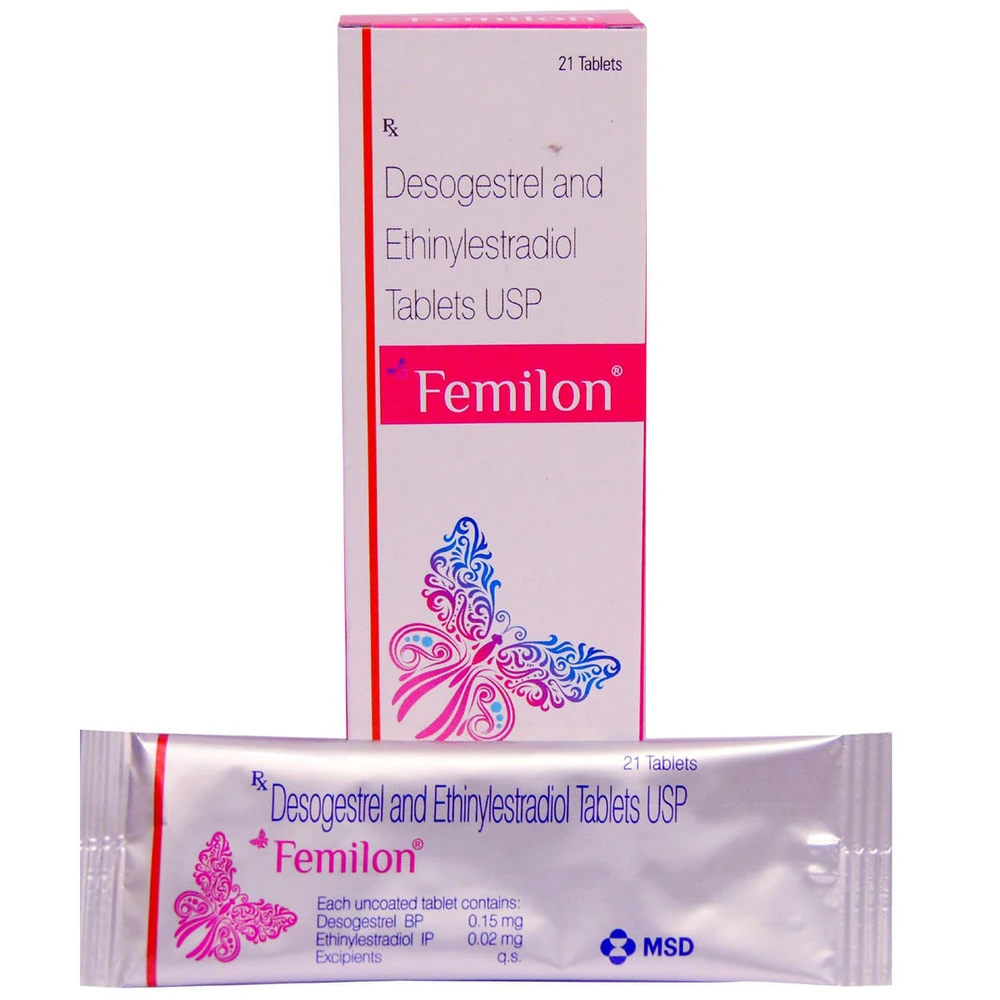
Femilon Tablets
Femilon Tablets are a combined oral contraceptive pill (COCP) containing ethinylestradiol 20 mcg and desogestrel 150 mcg. This is a low-dose, monophasic combination pill — the same hormone dose in every active tablet throughout the cycle. The low 20 mcg oestrogen dose is designed to minimise oestrogen-related side effects (such as nausea, breast tenderness, and venous thromboembolic risk) while maintaining reliable contraceptive efficacy. Desogestrel is a third-generation progestogen with high progestogenic activity and minimal androgenic effect, making Femilon a preferred option for women who experience acne or other androgen-related symptoms with other contraceptives.
Composition
| Active Ingredient | Strength per tablet |
|---|---|
| Ethinylestradiol | 20 mcg |
| Desogestrel | 150 mcg |
About the Manufacturer
Femilon is manufactured by Organon India Limited (formerly MSD Pharmaceuticals Pvt. Ltd.), the Indian subsidiary of Organon & Co., a global women’s health company spun off from Merck & Co. in 2021. Organon focuses exclusively on women’s health, biosimilars, and established brands, and distributes Femilon across India and internationally.
Mechanism of Action
Femilon works through three complementary mechanisms to prevent pregnancy. First, the oestrogen and progestogen components suppress the hypothalamic–pituitary–ovarian axis, inhibiting the mid-cycle LH surge and thereby preventing ovulation — the primary mechanism. Second, desogestrel thickens cervical mucus, making it hostile to sperm penetration and transport. Third, the progestogen component alters the endometrial lining, making implantation of a fertilised egg less likely. When taken correctly, Femilon has a failure rate of less than 1% per year (perfect use), and around 7–9% per year with typical use, in line with other COCPs.
Indications
- Contraception — prevention of pregnancy
- Treatment of dysmenorrhoea (painful periods)
- Management of endometriosis-related symptoms (specialist use)
- Reduction of acne and hirsutism related to androgen excess (due to the low-androgenicity of desogestrel)
Dosage & Administration
- Each blister pack contains 21 active tablets
- Take one tablet daily at approximately the same time each day for 21 consecutive days
- Follow with a 7-day pill-free interval, during which a withdrawal bleed (period-like bleeding) typically occurs
- Begin the next pack on day 8 (the day after the 7-day break), whether or not bleeding has stopped
- Starting the first pack: Start on Day 1 of the menstrual cycle (Day 1 start) — no additional contraception needed; or start on Day 2–5 (use additional barrier contraception for 7 days)
- Missed tablet: If a tablet is missed by fewer than 12 hours, take it immediately and continue as normal. If more than 12 hours late, refer to the PIL; additional contraception may be needed for 7 days
Special Populations
- Adolescents: May be prescribed from menarche (first period) for contraception or cycle-related issues; growth and bone density are not adversely affected
- Women over 35 who smoke: Combined oral contraceptives are contraindicated in women aged 35 and over who smoke due to substantially increased cardiovascular and thromboembolic risk
- Breastfeeding: Combined oral contraceptives are generally not recommended during breastfeeding (oestrogen may reduce milk supply); a progestogen-only pill is usually preferred
- Postpartum (non-breastfeeding): Can be started from 21–28 days postpartum; additional contraception needed if started after day 21
Precautions
- Venous thromboembolism (VTE): All combined oral contraceptives increase the risk of VTE. The absolute risk is small in healthy, non-smoking young women (3–9 per 10,000 per year with COCP use vs. 2 per 10,000 per year in non-users). Desogestrel-containing pills (third-generation) may carry a slightly higher VTE risk than levonorgestrel-containing pills (second-generation)
- Arterial events: Low but measurable increased risk of stroke and myocardial infarction, particularly in women who smoke, have hypertension, migraines with aura, or other cardiovascular risk factors
- Migraine with aura: Contraindicated in women with migraine with aura due to increased stroke risk
- Blood pressure: Check blood pressure before starting and periodically; COCPs can raise blood pressure in susceptible women
- Breast cancer: Current or recent use of COCPs is associated with a small increased risk of breast cancer; this risk reduces over 10 years after stopping
- Cervical cancer: Long-term use (>5 years) is associated with a small increased risk of cervical cancer, though HPV infection and sexual behaviour are the dominant risk factors
- Drug interactions affecting efficacy: Multiple drug interactions can reduce contraceptive efficacy (see Drug Interactions); use additional contraception as needed
Contraindications
- Presence or history of venous or arterial thrombosis
- Migraine with aura (focal neurological symptoms)
- Uncontrolled hypertension (systolic >160 mmHg or diastolic >100 mmHg)
- Diabetes mellitus with vascular complications
- Current or history of breast cancer or other oestrogen-sensitive malignancy
- Current or history of liver disease with abnormal liver function (while hepatic function has not returned to normal)
- Hepatic tumours (benign or malignant)
- Unexplained vaginal bleeding
- Pregnancy (or suspected pregnancy)
- Breastfeeding (within 6 months postpartum)
- Smoking in women aged 35 and over
- Known hypersensitivity to any active ingredient or excipient
Side Effects
- Common: Nausea, headache, breast tenderness, spotting or breakthrough bleeding (especially in the first 3 cycles), mood changes, reduced libido, weight change
- Less common: Hypertension, decreased menstrual flow, contact lens intolerance, skin changes (melasma/chloasma)
- Serious (rare): Venous thromboembolism (deep vein thrombosis, pulmonary embolism), arterial events (stroke, myocardial infarction), hepatic adenoma, cervical cancer (with prolonged use)
Drug Interactions
- Enzyme-inducing drugs (rifampicin, rifabutin, carbamazepine, phenytoin, phenobarbital, primidone, efavirenz, nevirapine, St. John’s Wort): Reduce the efficacy of Femilon significantly; use additional contraception during and for 28 days after stopping these drugs; consider a higher-dose oestrogen pill or a non-hormonal method
- Lamotrigine: COCPs significantly reduce plasma lamotrigine levels, potentially reducing seizure control; adjust lamotrigine dose under neurologist supervision; stopping the pill raises lamotrigine levels again
- HIV protease inhibitors (ritonavir, nelfinavir, lopinavir): May reduce contraceptive hormone levels; additional barrier contraception is recommended
- Antibiotics (broad-spectrum, including ampicillin, doxycycline): Historical concern about reduced pill efficacy; current UK guidance (FSRH) does not recommend additional precautions with antibiotics that are not enzyme inducers, but clinicians may advise individual caution
Storage
Store below 30°C in a dry place, protected from light. Keep tablets in the original blister pack. Keep out of reach of children. Do not use after the expiry date printed on the blister pack.
Related Products
- Humog 75 IU Injection – menotropins for ovulation induction
- Humog 150 IU Injection – menotropins higher dose for fertility
- Erytop 1% 20 Gm Gel – topical erythromycin gel for acne
Frequently Asked Questions
- What is Femilon used for?
- Femilon is primarily used as a combined oral contraceptive pill to prevent pregnancy. It may also be prescribed for painful periods (dysmenorrhoea), acne and excess hair growth in women related to androgen excess, and in some cases for endometriosis. It contains two hormones — ethinylestradiol (a synthetic oestrogen) and desogestrel (a synthetic progestogen).
- What makes Femilon a “low-dose” pill?
- Femilon contains 20 mcg of ethinylestradiol per tablet, which is at the low end of the oestrogen dose range for combined pills (which typically range from 20 to 50 mcg). The lower oestrogen dose is associated with fewer oestrogen-related side effects such as nausea, breast tenderness, fluid retention, and a slightly lower venous thromboembolic risk compared to higher-dose pills, while still providing effective contraception.
- What should I do if I miss a Femilon tablet?
- If you miss a tablet by less than 12 hours, take it as soon as you remember and continue with the rest of the pack as normal — your contraceptive protection is maintained. If you are more than 12 hours late taking a tablet, your contraceptive protection for that cycle may be reduced. Take the missed tablet when you remember, skip any earlier missed tablets, complete the pack, but use additional contraception (such as condoms) for the next 7 days. If the missed tablet falls in the last week of the pack, omit the pill-free interval and start the next pack immediately. When in doubt, refer to the patient information leaflet or contact your doctor or pharmacist.
- Can I use Femilon to skip my period?
- Yes. With any combined oral contraceptive, you can skip the pill-free interval to prevent a withdrawal bleed (period) in a given cycle. After finishing one pack of 21 tablets, start the next pack immediately without a 7-day break. This is safe to do occasionally, though it may result in some breakthrough spotting. Discuss with your doctor if you wish to do this regularly.
- Does the contraceptive pill protect against sexually transmitted infections?
- No. Femilon and all hormonal contraceptives protect only against pregnancy — they do not protect against sexually transmitted infections (STIs), including HIV. If protection against STIs is also needed, condoms should be used alongside hormonal contraception.
References
- NHS – Combined Oral Contraceptive Pill
- MedlinePlus – Desogestrel and Ethinyl Estradiol
- FDA – Mircette (Desogestrel/Ethinyl Estradiol) Prescribing Information
- EMA – Combined Oral Contraceptives Assessment
Disclaimer: This page is for informational purposes only and does not constitute medical advice. Femilon Tablets must be prescribed by a qualified healthcare professional following a thorough assessment of individual risk factors. Report any sudden severe headache, visual disturbances, chest pain, calf pain or swelling, or difficulty breathing immediately to a healthcare professional, as these may be signs of a serious complication.


Reviews
There are no reviews yet.