Description
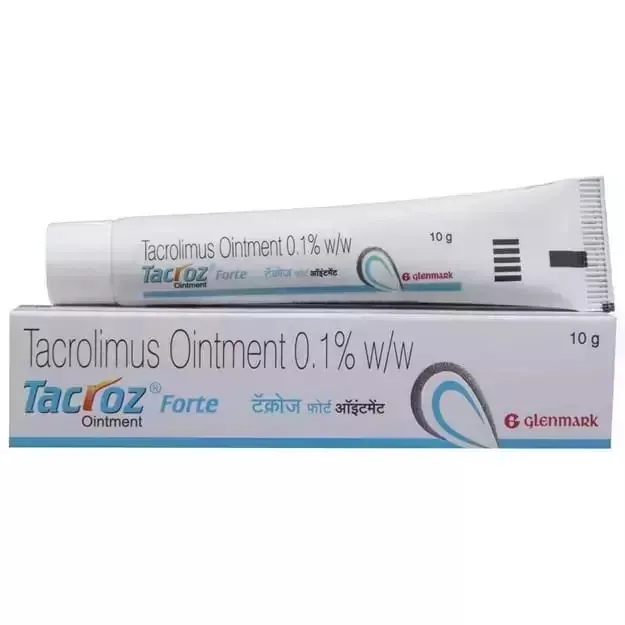
What Is Tacroz Forte 0.1% Ointment 10 gm?
Tacroz Forte 0.1% Ointment contains tacrolimus 0.1% (1 mg/g) in a white soft paraffin-based ointment formulation. Tacrolimus is a macrolide calcineurin inhibitor with potent immunosuppressive activity that suppresses T-lymphocyte activation and cytokine-driven cutaneous inflammation. Unlike topical corticosteroids, tacrolimus does not cause skin atrophy, telangiectasia, or striae — making it particularly valuable for use on sensitive skin areas (face, neck, flexures, periorbital and perioral skin, and genital skin) and for long-term maintenance therapy.
Tacroz Forte 0.1% is the higher-strength tacrolimus ointment, indicated for adult patients with moderate-to-severe atopic dermatitis (eczema) whose condition has not responded adequately to conventional first-line therapies including topical corticosteroids. It is also used as a second-line option for other inflammatory dermatoses where topical steroids are poorly tolerated or contraindicated. The 10 g tube provides sufficient product for a standard treatment course for localised disease. Tacrolimus 0.1% is approved for adults; the lower-strength 0.03% formulation is used in children aged 2–15 years.
Mechanism of Action
Calcineurin Inhibition and T-Cell Suppression
Tacrolimus (FK506) binds with high affinity to the intracellular immunophilin FK506-binding protein 12 (FKBP12). The tacrolimus–FKBP12 complex then binds to and inhibits calcineurin — a calcium-dependent serine-threonine phosphatase that is essential for T-cell activation. In activated T-lymphocytes, calcineurin dephosphorylates the nuclear factor of activated T cells (NFAT), allowing it to translocate to the nucleus and drive transcription of pro-inflammatory cytokines — particularly interleukin-2 (IL-2), interleukin-4 (IL-4), interleukin-5 (IL-5), interferon-gamma (IFN-γ), and tumour necrosis factor-alpha (TNF-α). By inhibiting calcineurin, tacrolimus prevents NFAT dephosphorylation and nuclear translocation, thereby blocking cytokine gene transcription and downstream T-cell proliferation and effector function.
Mast Cell and Langerhans Cell Effects
In addition to T-cell suppression, tacrolimus inhibits mast cell degranulation and reduces release of pre-formed mediators (histamine, tryptase) and newly synthesised inflammatory mediators (prostaglandins, leukotrienes) from mast cells. It also impairs Langerhans cell antigen presentation in the skin, reducing sensitisation to cutaneous allergens. These multiple anti-inflammatory mechanisms produce the anti-itch, anti-eczematous, and skin barrier-normalising effects seen with topical tacrolimus in atopic dermatitis.
Absence of Steroid-Related Side Effects
Unlike topical corticosteroids, tacrolimus does not interact with steroid hormone receptors and does not suppress the production of collagen, glycosaminoglycans, or other dermal structural proteins. It does not cause skin atrophy even with prolonged use on the face and other sensitive areas. This distinguishes it mechanistically from corticosteroids and underpins its role in areas where topical steroid use is limited by atrophy risk.
Indications
Moderate-to-Severe Atopic Dermatitis (Adults)
Tacroz Forte 0.1% Ointment is indicated in adults (≥16 years) for the treatment of moderate-to-severe atopic dermatitis that has not responded adequately to, or where the patient has intolerance to, topical corticosteroids. Atopic dermatitis is a chronic, relapsing inflammatory skin condition characterised by intense pruritus, skin barrier dysfunction, and eczematous plaques. Tacrolimus 0.1% reduces pruritus, erythema, excoriation, lichenification, and oozing lesions. It is effective for both flare treatment and long-term proactive maintenance therapy (twice-weekly application to previously affected areas to prevent relapse).
Sensitive Skin Areas
Tacrolimus is particularly advantageous for atopic dermatitis affecting the face (especially periorbital and perioral skin), neck, and flexural areas — sites where corticosteroid-induced atrophy and telangiectasia are most likely to develop with repeated use. Use of tacrolimus on these sites avoids the cumulative risks of potent topical steroids while maintaining anti-inflammatory efficacy.
Other Inflammatory Dermatoses (Off-Label)
Tacrolimus ointment is used off-label in other inflammatory skin conditions including allergic contact dermatitis, seborrhoeic dermatitis on the face, vitiligo (as an adjunct to narrowband UVB phototherapy — tacrolimus suppresses the autoimmune destruction of melanocytes), psoriasis on the face and flexures, and lichen sclerosus. These uses are supported by clinical evidence but are outside the licensed indications in most countries.
Dosage and Administration
Active flares (adults): Apply a thin layer of Tacroz Forte 0.1% Ointment to affected skin twice daily until the flare resolves — typically 3 weeks, up to 6 weeks maximum for a single course.
Proactive maintenance therapy: Apply twice weekly (e.g., Monday and Friday) to previously affected areas that are currently clear or nearly clear. This proactive approach reduces the frequency and severity of relapse and reduces overall cumulative corticosteroid exposure.
Application technique: Apply a thin layer to affected skin only. Rub in gently. Do not use occlusive dressings, which increase systemic absorption. Avoid application to mucous membranes, eyes, or infected skin.
Sensitive areas: Tacrolimus 0.1% may be applied to the face, neck, and flexures where topical steroids are poorly tolerated. Exercise caution near the eyes.
Sun exposure: Minimise sun exposure during treatment. Apply broad-spectrum sunscreen to treated areas when outdoors — tacrolimus may reduce UV tolerance of the skin.
Children: Tacrolimus 0.1% is NOT recommended for children aged 2–15 years — use the 0.03% strength instead. Not recommended in children under 2 years.
Contraindications
- Known hypersensitivity to tacrolimus, macrolide antibiotics (potential cross-reactivity), or any excipient.
- Active cutaneous viral infections at the site of application (herpes simplex, varicella-zoster, molluscum contagiosum) — tacrolimus immunosuppression may worsen viral infections.
- Application to clinically infected skin — treat infections before or alongside tacrolimus therapy.
- Immunocompromised patients — systemic immunosuppression may increase infection risk; use under specialist supervision.
- Children under 2 years of age.
Warnings and Precautions
Systemic absorption and lymphoma risk (black box warning, US): Although systemic absorption from topical tacrolimus applied to intact skin is minimal, the FDA has issued a boxed warning regarding a theoretical risk of lymphoma and skin malignancy based on the class mechanism (calcineurin inhibition) and rare case reports. The European Medicines Agency (EMA) has not imposed the same restriction. Topical tacrolimus should be used for the shortest effective period and reserved for patients in whom conventional therapy is inadequate or inappropriate. Avoid use in patients with known malignancies or those with severely compromised immune function.
Skin infections: Tacrolimus may increase susceptibility to cutaneous bacterial and viral infections — particularly Staphylococcus aureus skin infections, herpes simplex (eczema herpeticum), molluscum contagiosum, and varicella. If skin infection develops, treat appropriately and consider interrupting tacrolimus until infection resolves.
Sun protection: Avoid excessive UV exposure (sun and tanning beds) during tacrolimus treatment. Animal studies raised concerns about UV-related carcinogenicity in the context of calcineurin inhibition; clinical significance in humans using topical formulations at recommended doses is uncertain, but sun protection is prudent.
Alcohol: Alcohol consumption may cause facial flushing and skin irritation during tacrolimus treatment — advise patients accordingly.
Adverse Effects
- Very common: Application site burning sensation, pruritus, and stinging — most common at treatment initiation, typically improves within the first week of therapy.
- Common: Skin erythema, folliculitis, skin infections (impetigo, herpes simplex).
- Uncommon: Rosacea-like reactions, contact sensitisation, alcohol-related facial flushing.
- Rare: Systemic absorption is minimal from intact skin at recommended doses. Very rare lymphoma cases have been reported with long-term use; causal relationship has not been established.
Drug Interactions
- CYP3A4 inhibitors (erythromycin, itraconazole, fluconazole, diltiazem): Tacrolimus is metabolised by CYP3A4 when systemically absorbed. Although absorption from intact skin is low, significant absorption through severely disrupted skin barrier may theoretically increase tacrolimus exposure when potent CYP3A4 inhibitors are given concurrently — monitor for tacrolimus-related adverse effects.
- Immunosuppressants: Concurrent systemic immunosuppressants — particularly in transplant patients — may enhance immunosuppressive effect. Topical tacrolimus for skin disease is generally not combined with systemic immunosuppressants except under specialist supervision.
- Vaccines: As with other immunosuppressive therapies, concurrent use may reduce vaccine immunogenicity — avoid live attenuated vaccines during treatment.
Storage
Store below 25°C. Do not freeze. Keep the tube tightly closed when not in use. Keep out of reach of children. Protect from moisture. Do not use after the expiry date printed on the tube.
Related Products
For localised bacterial superinfection of eczematous skin, see T-Bact 7.5 gm Cream (mupirocin 2%). For potent corticosteroid treatment of severe non-facial plaque psoriasis or refractory eczema, see Topinate 30 gm 0.05% Cream (clobetasol propionate). For retinoid-based management of acne and keratinisation disorders, see Tazret 0.05% 20 gm Gel (tazarotene).
References
- Electronic Medicines Compendium (EMC). Protopic 0.1% Ointment — Summary of Product Characteristics. Available at: https://www.medicines.org.uk/emc
- National Library of Medicine MedlinePlus. Tacrolimus Topical. Available at: https://medlineplus.gov/druginfo/meds/a602020.html
- Mayo Clinic. Tacrolimus (Topical Route). Available at: https://www.mayoclinic.org
- Reitamo S, Rustin M, Harper J, et al. A 4-year follow-up study of atopic dermatitis therapy with 0.1% tacrolimus ointment in children and adult patients. Br J Dermatol. 2008;159(4):942–951. PubMed PMID: 18681874
- Luger T, Lahfa M, Fölster-Holst R, et al. Long-term safety and tolerability of tacrolimus ointment 0.1% and topical corticosteroids in adults with moderate-to-severe atopic dermatitis. J Dermatolog Treat. 2004;15(5):301–306. PubMed PMID: 15370403
Reviews
There are no reviews yet.