Description
What Is T-Bact 7.5 gm Cream?
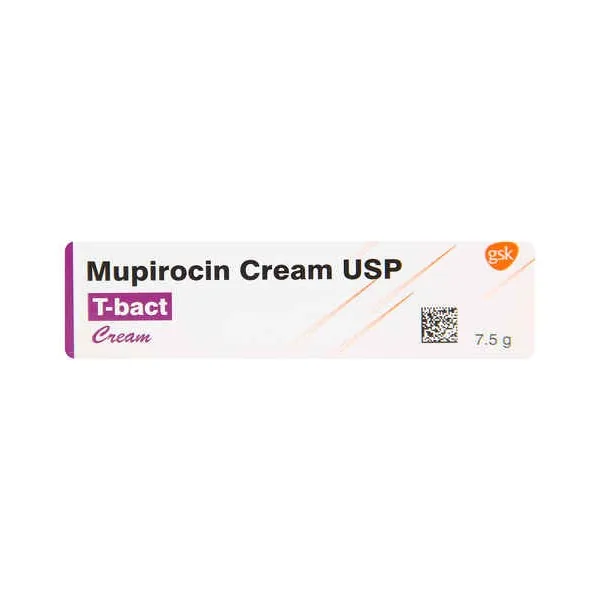
T-Bact 7.5 gm Cream contains mupirocin 2% (20 mg/g) in a water-miscible polyethylene glycol base. Mupirocin is a topical antibiotic derived from Pseudomonas fluorescens that has a unique mechanism of action not shared by any other class of antibiotic, making it free of cross-resistance with systemic antibiotics. T-Bact Cream is indicated for the topical treatment of primary skin infections caused by susceptible gram-positive organisms — particularly Staphylococcus aureus (including meticillin-resistant strains, MRSA) and Streptococcus pyogenes. It is also widely used for the eradication of nasal Staphylococcus aureus carriage as part of infection control and decolonisation protocols.
The 7.5 g tube is a single-course pack suitable for treating localised primary skin infections (impetigo, folliculitis, infected wounds) or for nasal decolonisation. T-Bact Cream is for external use only and must not be applied to the eyes or used in the nasal passages (a dedicated nasal ointment formulation is used for nasal decolonisation). Mupirocin is bactericidal against susceptible organisms at the concentrations achieved in skin and achieves tissue concentrations far exceeding the MIC for Staphylococci and Streptococci.
Mechanism of Action
Isoleucyl-tRNA Synthetase Inhibition
Mupirocin — also called pseudomonic acid A — has a unique mechanism of action: it reversibly and competitively inhibits isoleucyl-tRNA synthetase (IleRS), the bacterial enzyme responsible for charging transfer RNA with isoleucine. By competitively occupying the isoleucine binding site of IleRS, mupirocin prevents the formation of isoleucyl-tRNA — the charged tRNA molecule that delivers isoleucine to the ribosome during translation. Without isoleucyl-tRNA, the bacterium cannot incorporate isoleucine into new proteins and cannot synthesise new RNA. This leads to cessation of protein and RNA synthesis and, at the high concentrations achieved on skin, bactericidal killing.
The bacterial IleRS is structurally distinct from the mammalian enzyme — mupirocin has negligible affinity for human IleRS at therapeutic concentrations — which explains the selectivity and low toxicity of topical mupirocin. The unique target also explains the absence of cross-resistance with any other class of antibiotic: organisms resistant to beta-lactams, macrolides, fluoroquinolones, or glycopeptides remain fully susceptible to mupirocin unless they have acquired specific mupirocin resistance genes (mupA, mupB).
Indications
Impetigo
Impetigo is the most common superficial bacterial skin infection, primarily caused by Staphylococcus aureus and/or Streptococcus pyogenes (group A Streptococcus). Bullous impetigo is caused almost exclusively by S. aureus (phage type 71) producing exfoliative toxins. Mupirocin 2% cream applied three times daily for 5–7 days is as effective as oral antibiotics for localised impetigo and is preferred as first-line treatment to minimise systemic antibiotic exposure. Topical mupirocin reduces lesion count, bacterial load, and time to healing, and avoids the systemic adverse effects of oral therapy.
Folliculitis
Folliculitis — infection of hair follicles — is most commonly caused by S. aureus. Superficial folliculitis (Bockhart’s impetigo) responds well to topical mupirocin. T-Bact Cream applied to affected follicular areas twice to three times daily for 5–7 days treats localised superficial folliculitis effectively without the need for systemic antibiotics.
Infected Wounds and Secondary Skin Infections
Minor wounds, lacerations, abrasions, and eczematous skin that become secondarily infected with S. aureus or streptococcal organisms may be treated with topical mupirocin 2% cream applied to the affected area twice to three times daily. Mupirocin is effective against both meticillin-sensitive S. aureus (MSSA) and MRSA — this MRSA activity is clinically valuable for infected wounds in community and healthcare settings.
MRSA Decolonisation (Skin Lesions)
As part of infection control protocols, mupirocin 2% cream is applied to MRSA-colonised skin lesions or wounds in conjunction with nasal decolonisation using mupirocin nasal ointment and chlorhexidine body wash. Full decolonisation regimens typically last 5 days. T-Bact Cream contributes to reducing the skin reservoir of MRSA, lowering the risk of transmitting MRSA to other patients in healthcare settings or household contacts.
Dosage and Administration
Primary skin infections (impetigo, folliculitis, infected wounds): Apply a small amount of T-Bact Cream to the affected area 2–3 times daily for 5–7 days. The treated area may be covered with a dressing if appropriate.
Response assessment: If no clinical improvement within 3–5 days, re-evaluate — reconsider the diagnosis, obtain swabs for culture and sensitivity, and consider whether systemic antibiotic therapy is required.
Application technique: Apply directly to the affected skin using a clean fingertip or cotton bud. Wash hands after application. Avoid applying near the eyes, mucous membranes, or broken skin with deep penetrating wounds.
Course duration: Do not use for more than 10 days continuously without medical reassessment — prolonged use increases the risk of developing mupirocin-resistant organisms.
Children: Mupirocin 2% cream is suitable for use in children and infants above 2 months of age. Apply as directed.
Contraindications
- Known hypersensitivity to mupirocin, polyethylene glycol (PEG), or any other component of T-Bact Cream.
- Application to the eyes — may cause serious eye irritation; flush immediately with water if accidental eye contact occurs.
- Application to deep penetrating wounds, mucous membranes, or large body surface areas (systemic absorption risk from PEG base in impaired renal function).
Warnings and Precautions
Polyethylene glycol (PEG) base: T-Bact Cream contains a polyethylene glycol (PEG) base, not a paraffin base. PEG can be systemically absorbed through broken skin or mucous membranes and is renally excreted. Do not apply to large areas of broken skin in patients with renal impairment — PEG accumulation may cause toxicity. For application to open wounds, the PEG-free nasal ointment formulation or an alternative topical antibiotic may be preferred.
Mupirocin resistance: Mupirocin resistance in S. aureus (particularly MRSA) has been reported, mediated by acquisition of the mupA or mupB genes encoding alternative IleRS enzymes. High-level resistance (MIC >512 mg/L) renders mupirocin ineffective — this underscores the importance of limiting topical mupirocin use to appropriate indications and not using it prophylactically without clinical indication.
Sensitisation: Sensitisation reactions (contact dermatitis, urticaria) to mupirocin or PEG components can occur — discontinue and seek medical advice if worsening redness, swelling, or itching develops with use.
Avoid prolonged use: Mupirocin should not be used as a long-term prophylactic agent. Restricting use to short courses (5–10 days) for defined indications reduces the emergence of resistant organisms.
Adverse Effects
- Common: Local burning, stinging, or mild skin irritation at the application site — typically transient and resolves with continued use.
- Uncommon: Itching, erythema (redness), dry skin at the application site.
- Rare: Contact sensitisation (allergic contact dermatitis) to mupirocin or PEG base — requires patch testing and discontinuation. Systemic absorption causing PEG toxicity in patients with renal impairment applying to extensive areas of broken skin.
Drug Interactions
Topical mupirocin has negligible systemic absorption when applied to intact or minimally damaged skin and does not cause clinically significant systemic drug interactions at standard doses. It should not be mixed with other topical preparations, as this may alter its activity or formulation stability.
Storage
Store below 25°C in a cool, dry place. Do not refrigerate or freeze — PEG-based creams may solidify at low temperatures. Keep the tube tightly closed. Keep out of reach of children. Do not use after the expiry date printed on the packaging.
Related Products
For topical treatment of fungal skin infections that may co-exist with or mimic bacterial infections, appropriate antifungal creams are available in our Antifungal category. For management of inflammatory skin conditions such as eczema or psoriasis where superimposed infection is a complication, see Topinate 30 gm 0.05% Cream (clobetasol propionate). For tacrolimus-based topical immunosuppression in atopic dermatitis, see Tacroz 0.1% 10 gm Ointment.
References
- Electronic Medicines Compendium (EMC). Bactroban 2% Cream — Summary of Product Characteristics. Available at: https://www.medicines.org.uk/emc
- National Library of Medicine MedlinePlus. Mupirocin Topical. Available at: https://medlineplus.gov/druginfo/meds/a688004.html
- Mayo Clinic. Mupirocin (Topical Route). Available at: https://www.mayoclinic.org
- Koning S, van der Sande R, Verhagen AP, et al. Interventions for impetigo. Cochrane Database Syst Rev. 2012;(1):CD003261. PubMed PMID: 22258953
- Ammerlaan HS, Kluytmans JA, Wertheim HF, et al. Eradication of methicillin-resistant Staphylococcus aureus carriage: a systematic review. Clin Infect Dis. 2009;48(7):922–930. PubMed PMID: 19231983
Reviews
There are no reviews yet.