Description
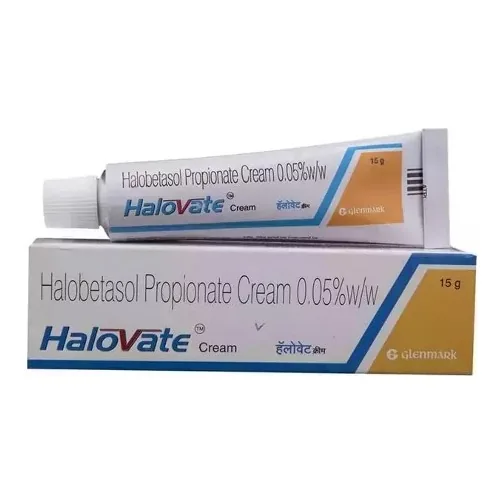
What Is Halovate CR 0.05% 15 gm Cream?
Halovate CR 0.05% 15 gm Cream contains halobetasol propionate 0.05% in a cream base, manufactured by Glenmark Pharmaceuticals Ltd. Halobetasol propionate is a synthetic halogenated corticosteroid classified in the United States Pharmacopeia as a Class I (super-potent/very potent) topical corticosteroid — the most potent category of topical steroids, alongside clobetasol propionate 0.05%. In the UK classification system, halobetasol propionate at 0.05% is classified as very potent (Class I). This level of potency means halobetasol propionate is significantly more active, weight for weight, than hydrocortisone 1% (mild), betamethasone valerate 0.1% (potent), or mometasone furoate 0.1% (potent), and is reserved for the most severe, treatment-resistant or rapidly progressing inflammatory skin conditions.
Halovate CR is indicated for the relief of inflammation and pruritus associated with corticosteroid-responsive dermatoses in adults, including plaque psoriasis, recalcitrant eczema/atopic dermatitis, lichen planus, discoid lupus erythematosus, and other inflammatory skin conditions that have failed to respond adequately to less potent corticosteroids. Due to its very high potency, it is used under strict medical supervision for short durations (up to 2 weeks), on limited body surface areas, and is not recommended for use on the face, flexures, or intertriginous areas unless under specialist direction.
Mechanism of Action
Glucocorticoid Receptor Activation and Genomic Effects
Halobetasol propionate exerts its anti-inflammatory effects primarily through activation of intracellular glucocorticoid receptors (GR) present in dermal and epidermal cells. After penetrating the stratum corneum and entering cells, halobetasol propionate binds the cytoplasmic glucocorticoid receptor with high affinity (considerably higher than less potent corticosteroids due to favourable structural features including halogenation at C-6 and C-9 positions). The halobetasol–GR complex translocates to the nucleus and binds glucocorticoid response elements (GREs) in the promoters of target genes.
Transactivation and Transrepression
The activated GR complex exerts two classes of genomic effects. Through transactivation, GR directly increases transcription of anti-inflammatory genes, most importantly lipocortin-1 (annexin A1), which inhibits phospholipase A2 — the enzyme responsible for liberating arachidonic acid from membrane phospholipids. By limiting arachidonic acid availability, halobetasol propionate reduces the production of all downstream eicosanoid inflammatory mediators: prostaglandins, thromboxanes, leukotrienes, and prostacyclin. Through transrepression, the activated GR complex interacts with and inactivates key pro-inflammatory transcription factors including NF-κB and AP-1, reducing transcription of a large array of pro-inflammatory cytokines (IL-1β, IL-2, IL-6, TNF-α, IFN-γ), adhesion molecules (ICAM-1, VCAM-1), and matrix metalloproteinases.
Vasoconstriction and Antiproliferative Effects
Topical halobetasol propionate causes cutaneous vasoconstriction (the basis of the McKenzie vasoconstrictor assay used to rank topical corticosteroid potency) by reducing the production of vasodilatory prostaglandins and by direct vascular smooth muscle effects. This reduces erythema clinically. It also exerts antiproliferative effects on keratinocytes, which is relevant to its efficacy in psoriasis where keratinocyte hyperproliferation underlies the characteristic plaques.
Indications
Halovate CR 0.05% is indicated for the topical treatment of inflammatory, pruritic manifestations of corticosteroid-responsive dermatoses in adults, with particular utility in:
- Plaque psoriasis: On trunk and limbs; not on face or scalp.
- Recalcitrant atopic dermatitis / eczema: When adequate response has not been obtained with moderate- or potent-class steroids.
- Lichen planus: Including hypertrophic lichen planus on the lower limbs.
- Discoid lupus erythematosus: On non-facial, non-scalp skin.
- Other severe corticosteroid-responsive dermatoses not controlled by less potent agents.
Dosage and Administration
Apply a thin layer to the affected area once or twice daily, as directed by the physician. Gently rub in. Treatment duration should not exceed 2 consecutive weeks. Total weekly dosage should not exceed 50 g. Do not use under occlusion (bandages, cling film, nappies/diapers) unless specifically directed by a physician — occlusion substantially increases systemic absorption and magnifies the risk of side effects. After completing the course, the patient should be reviewed before any further treatment.
Avoid use on: face, groin, axillae and other intertriginous (skin-fold) areas; thin-skinned areas; periorbital skin; mucous membranes. Do not use on children without specialist supervision.
Contraindications
- Hypersensitivity to halobetasol propionate, other corticosteroids, or any excipient.
- Rosacea — corticosteroids worsen underlying rosacea and cause steroid rosacea.
- Perioral dermatitis.
- Acne vulgaris — corticosteroids worsen acne.
- Primary bacterial, viral, or fungal skin infections (e.g., impetigo, herpes simplex, tinea) — corticosteroids suppress the local immune response and can lead to rapid spread and exacerbation of these infections. Treat the infection first.
- Pruritus without inflammation (application without an underlying inflammatory diagnosis offers no benefit and risk without advantage).
Warnings and Precautions
Skin atrophy: Prolonged use of very potent corticosteroids causes irreversible thinning of the dermis and epidermis, telangiectasia, striae (stretch marks), and easy bruising, particularly on the face, flexures, and areas under occlusion. Strictly limit treatment duration to 2 weeks.
Hypothalamic-pituitary-adrenal (HPA) axis suppression: Systemic absorption sufficient to suppress cortisol production can occur, particularly with large surface area application, prolonged use, occlusive dressings, inflamed or broken skin, or use in children. HPA suppression is reversible on discontinuation but requires gradual tapering if prolonged courses have been used.
Rebound: Abrupt discontinuation after prolonged use can precipitate a rebound flare of the treated condition. Consider step-down to a less potent corticosteroid.
Cushing’s syndrome and hyperglycaemia: Rare with topical use at recommended doses, but possible with excessive application; monitor diabetic patients for deterioration in glycaemic control.
Adverse Effects
- Common (application site): Stinging or burning sensation on application, dryness, skin atrophy with prolonged use, folliculitis.
- Uncommon: Telangiectasia, striae, perioral dermatitis, hypertrichosis.
- Rare: Allergic contact dermatitis to halobetasol propionate or an excipient; miliaria.
- Systemic (with prolonged use/large areas/occlusion): HPA axis suppression, Cushing’s syndrome, hyperglycaemia, raised intraocular pressure (if near eyes), glaucoma.
Drug Interactions
Clinically significant pharmacokinetic drug-drug interactions with topical halobetasol propionate are uncommon because systemic absorption at recommended doses is limited. However:
- Other topical corticosteroids: Avoid simultaneous use on the same area.
- Systemic corticosteroids: Combined use increases risk of HPA axis suppression and systemic corticosteroid adverse effects.
- Immunosuppressants: Combined immunosuppression increases risk of local and systemic infections.
Storage
Store below 30°C in a cool, dry place, away from direct sunlight. Do not freeze. Keep the tube tightly closed after use. Keep out of reach of children. Do not use after the expiry date printed on the pack.
Related Products
For patients with mild-to-moderate hyperpigmentation or acne requiring a less potent topical treatment, Glyco 6% 30 gm Cream (glycolic acid 6%) provides keratolytic exfoliation without systemic risk. For infectious skin conditions that may complicate or mimic inflammatory dermatoses, Dalacin C 150 mg Tablets (clindamycin) provides systemic antibacterial coverage. For combined acne management, Retino-AC Gel (tretinoin + clindamycin) offers a topical alternative for inflammatory comedonal acne.
References
- U.S. Food and Drug Administration / DailyMed. Halobetasol Propionate Cream 0.05% — Prescribing Information (Ultravate). National Library of Medicine. Available at: https://dailymed.nlm.nih.gov
- National Library of Medicine MedlinePlus. Halobetasol Topical. Available at: https://medlineplus.gov/druginfo/meds/a601120.html
- Mayo Clinic. Halobetasol (Topical Route) — Side Effects. Available at: https://www.mayoclinic.org
- Electronic Medicines Compendium (EMC). Halciderm (Halobetasol Propionate) — Summary of Product Characteristics. Available at: https://www.medicines.org.uk/emc
- Luger TA, et al. Halobetasol propionate cream in the treatment of plaque psoriasis. Int J Dermatol. 1993;32(5):374–376. PubMed PMID: 8505737
Reviews
There are no reviews yet.