Description
What is Beclate 200 Mcg Inhaler?
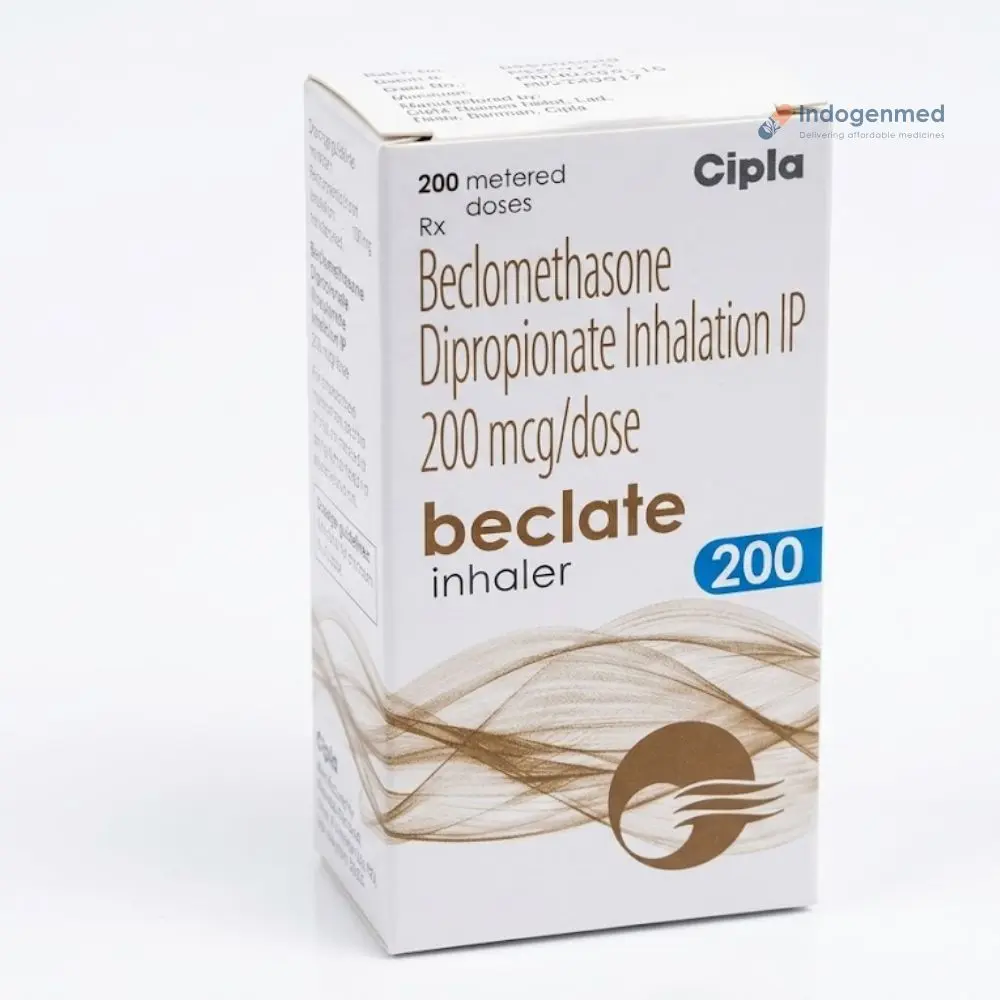
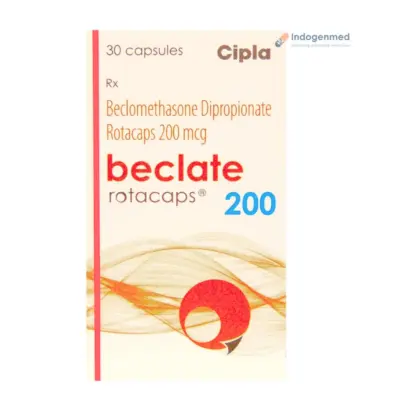
Beclate 200 Mcg Inhaler is a pressurised metered-dose inhaler (pMDI) manufactured by Cipla Ltd., one of India’s leading pharmaceutical companies. Each actuation of the inhaler delivers 200 micrograms (mcg) of Beclometasone Dipropionate directly to the airways. Each inhaler contains 200 metered doses. Beclometasone dipropionate is an inhaled corticosteroid (ICS) used in the long-term management of asthma.
Beclate 200 Inhaler is a maintenance (preventer) therapy — it reduces airway inflammation and helps prevent asthma symptoms from developing over time. It does not provide immediate relief during an acute asthma attack; a short-acting bronchodilator reliever inhaler (such as salbutamol) should always be available for sudden symptom relief. The inhaler contains an HFA (hydrofluoroalkane) propellant, which is ozone-friendly and CFC-free.
Composition and Product Details
| Brand Name | Beclate 200 |
|---|---|
| Generic Name | Beclometasone Dipropionate |
| Strength per Actuation | 200 mcg |
| Dosage Form | Pressurised metered-dose inhaler (pMDI) |
| Total Doses | 200 MDI (metered doses per inhaler) |
| Propellant | HFA (hydrofluoroalkane) — CFC-free |
| Manufacturer | Cipla Ltd., India |
| Therapeutic Class | Inhaled Corticosteroid (ICS) / Anti-asthmatic |
| Prescription Required | Yes |
About Cipla Ltd. and the Beclate Brand
Cipla Ltd. is a globally recognised Indian pharmaceutical company, established in 1935 and headquartered in Mumbai. Cipla is one of the world’s leading manufacturers of respiratory medicines, producing a broad range of inhalers, dry powder devices, nebuliser solutions, and oral formulations for asthma and COPD. The company operates in over 80 countries and is approved by multiple international regulatory authorities including the US FDA, UK MHRA, WHO-PQ programme, and the European EMA.
The Beclate brand is Cipla’s proprietary range of beclometasone dipropionate products for respiratory use, available in multiple strengths and delivery formats. The range includes pressurised inhalers and dry powder inhalation capsules, offering prescribers and patients flexibility in device choice and dose level. Beclate 200 Mcg Inhaler is the pressurised MDI format, providing 200 mcg per actuation from a convenient, portable device that does not require the patient to generate the forceful inhalation needed to activate a DPI capsule.
About Beclometasone Dipropionate
Beclometasone Dipropionate (BDP) is one of the most established inhaled corticosteroids in clinical use, first introduced for asthma management in the early 1970s. It is listed in the clinical guidelines of the Global Initiative for Asthma (GINA) and the British Thoracic Society (BTS), and remains widely prescribed worldwide as an effective, well-tolerated ICS for both adults and children. BDP functions as a prodrug that is converted to its pharmacologically active metabolite, beclometasone-17-monopropionate (17-BMP), within lung tissue — providing potent local anti-inflammatory action with reduced systemic exposure due to high first-pass hepatic metabolism.
How Beclate 200 Inhaler Works
When inhaled from the pMDI, beclometasone dipropionate is deposited across the upper and lower airways. BDP is a prodrug that undergoes enzymatic conversion to its active metabolite, beclometasone-17-monopropionate (17-BMP), directly within lung tissue. 17-BMP binds with high affinity to the intracellular glucocorticoid receptor, suppressing the transcription of pro-inflammatory cytokines and mediators involved in asthmatic airway disease.
The principal anti-inflammatory effects of BDP include:
- Reduction of eosinophilic airway inflammation: BDP suppresses the recruitment and activation of eosinophils in the bronchial mucosa, reducing the chronic inflammation central to asthmatic airway disease and recurrent exacerbations.
- Inhibition of pro-inflammatory cytokines: BDP downregulates interleukin-4 (IL-4), IL-5, and IL-13, reduces mast cell activation, and decreases mucosal oedema — the principal pathological processes of type 2 airway inflammation.
- Reduced airway hyper-responsiveness: Consistent daily treatment with BDP reduces the sensitivity of the airways to common asthma triggers including allergens, cold air, exercise, and respiratory infections, leading to fewer and less severe asthma attacks.
- Decreased mucus hypersecretion: BDP suppresses the excessive mucus production driven by airway inflammation, improving airway clearance.
BDP does not cause immediate bronchodilation. Its anti-inflammatory benefit develops gradually over days to weeks of consistent daily use. Beclate 200 Inhaler must be taken every day as prescribed — including on symptom-free days — to maintain its protective effect.
Indications and Uses
Beclate 200 Mcg Inhaler is indicated for:
- Persistent asthma (maintenance therapy): Long-term prophylactic treatment of mild-to-moderate persistent asthma in adults and adolescents. Reduces the frequency and severity of asthma attacks and decreases reliance on short-acting reliever bronchodilators.
- Step-up asthma therapy: For patients whose asthma is inadequately controlled on lower-dose ICS therapy, dose escalation within the 200 mcg pMDI range (e.g., 200 mcg twice or three times daily) may be considered before progressing to a higher-strength ICS.
Beclate 200 Inhaler is not a reliever and does not treat acute bronchospasm. A short-acting bronchodilator reliever inhaler must always be available.
Dosage and Administration
The dose and frequency of beclometasone must be determined by the prescribing physician based on asthma severity, previous ICS therapy, and clinical response. General guidance for adults and adolescents:
- Mild persistent asthma: 200–400 mcg daily in divided doses (i.e., one actuation of 200 mcg once or twice daily)
- Moderate persistent asthma: 400–800 mcg daily in divided doses (two actuations twice daily, or as directed)
- Step-down: Once optimal asthma control is maintained for at least 3 months, the physician may consider reducing to the lowest effective dose
How to use Beclate 200 Mcg Inhaler correctly (pMDI technique):
- Shake the inhaler well for 5 seconds before each actuation; the suspension must be evenly mixed before use.
- Prime the inhaler before first use, and if the inhaler has not been used for more than 7 days: remove the mouthpiece cap, shake well, and actuate twice into the air away from the face.
- Remove the mouthpiece cap and inspect for loose objects.
- Exhale gently and fully (away from the inhaler mouthpiece) to empty your lungs.
- Place the mouthpiece between your lips, forming a tight seal with your lips. Tilt your head back slightly.
- Begin to inhale slowly and steadily through your mouth, and simultaneously press down firmly on the canister once to release one actuation.
- Continue inhaling slowly until your lungs are full.
- Remove the inhaler and hold your breath for 10 seconds (or as long as comfortable), then exhale slowly.
- If a second actuation is required, wait 30–60 seconds before repeating steps 1–8.
- Rinse your mouth thoroughly with water and spit out after every use to reduce the risk of oral candidiasis (thrush).
- Replace the mouthpiece cap after use.
Spacer device: Using a spacer (holding chamber) device with a pressurised MDI is recommended by asthma guidelines for many patients, particularly those who have difficulty coordinating the press-and-breathe technique, elderly patients, and children. A spacer significantly improves lung deposition, reduces oropharyngeal deposition, and decreases the risk of oral thrush.
Special Populations
Elderly (≥65 years)
No specific dose adjustment is required in elderly patients with normal hepatic function. A spacer device is particularly recommended to improve inhalation technique. Monitor for systemic corticosteroid effects with long-term high-dose therapy.
Renal Impairment
No dose adjustment is necessary for renal impairment, as BDP is primarily metabolised hepatically.
Hepatic Impairment
Beclometasone undergoes significant hepatic first-pass metabolism. Systemic exposure may be increased in severe hepatic impairment; use with caution and under close medical supervision in this group.
Paediatric Use
Beclometasone pMDI inhalers are used in children with asthma; however, dosing must be individually determined by a paediatric respiratory specialist. Children should use a spacer device and a face mask (for younger children) to optimise inhalation technique and lung deposition. Growth should be monitored in children receiving long-term ICS therapy.
Pregnancy and Breastfeeding
Poorly controlled asthma during pregnancy poses significant risks to both mother and foetus. Inhaled beclometasone at therapeutic doses is generally considered acceptable during pregnancy; the risk of stopping effective asthma treatment is considered greater than the theoretical risk of the medicine. Consult your doctor before making any changes to asthma treatment during pregnancy or breastfeeding.
Precautions and Warnings
- Not for acute attacks: Beclate 200 Inhaler does not relieve acute bronchospasm. Always have a short-acting bronchodilator reliever available. Seek emergency care if symptoms are severe or unresponsive to the reliever.
- Oral candidiasis (thrush): Inhaled corticosteroid deposition in the mouth and throat can cause fungal infection. Rinse your mouth with water and spit out after every dose. A spacer device also reduces oropharyngeal deposition and thrush risk.
- Hoarseness and dysphonia: Local corticosteroid effects on the laryngeal mucosa may cause voice changes. Rinsing and use of a spacer help reduce this.
- Systemic corticosteroid effects: At high doses or with long-term use, ICS can cause systemic effects including adrenal suppression, reduced bone mineral density, cataracts, and raised intraocular pressure. Use the lowest effective dose.
- Transferring from oral steroids: Patients switching from systemic corticosteroids to inhaled BDP may experience symptoms of adrenal insufficiency. Transfer must be gradual and under close medical supervision.
- Respiratory infections: ICS may increase susceptibility to respiratory infections. Report new or worsening respiratory symptoms promptly.
- Paradoxical bronchospasm: Inhaled BDP can rarely cause an immediate worsening of wheezing after an actuation. Discontinue immediately, use a reliever bronchodilator, and seek medical attention.
Contraindications
- Hypersensitivity to beclometasone dipropionate, HFA propellant, or any excipient in the formulation
- Acute asthma attacks or rapidly deteriorating asthma (BDP does not provide immediate bronchodilation)
- Use as a reliever inhaler for sudden symptom relief
Possible Side Effects
Common (may affect up to 1 in 10 users)
- Oral and pharyngeal candidiasis (thrush) — greatly reduced by rinsing mouth and using a spacer
- Hoarseness or dysphonia (voice changes)
- Throat irritation or mild cough after inhalation
Uncommon
- Headache
- Nausea
- Skin bruising (thin skin) at higher doses over long periods
Rare but Serious
- Adrenal suppression — at high doses long-term; may present as fatigue, weakness, or hypotension under stress
- Paradoxical bronchospasm — immediate worsening after inhalation; discontinue and seek medical attention
- Hypersensitivity reactions including rash, urticaria, angioedema
- Growth retardation in children with prolonged high-dose ICS use — monitor height regularly
Drug Interactions
- CYP3A4 inhibitors (e.g., ketoconazole, itraconazole, ritonavir, cobicistat, clarithromycin): These inhibit the hepatic metabolism of BDP and 17-BMP, increasing systemic corticosteroid exposure. Avoid concurrent use where possible.
- Systemic corticosteroids: Additive systemic effects with oral or injectable steroids; monitor for adrenal suppression during combined use.
Related Respiratory Products on IndoGenMed
IndoGenMed stocks a range of beclometasone and inhaled corticosteroid products for asthma and COPD management:
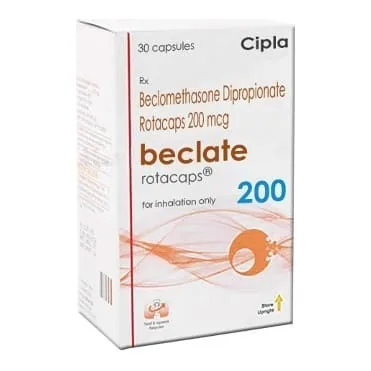
- Beclate 200 Mcg Capsules — Beclometasone 200 mcg in dry powder inhalation capsule form. An alternative delivery format for patients who prefer or require a DPI device, or in settings where an MDI spacer is not available.
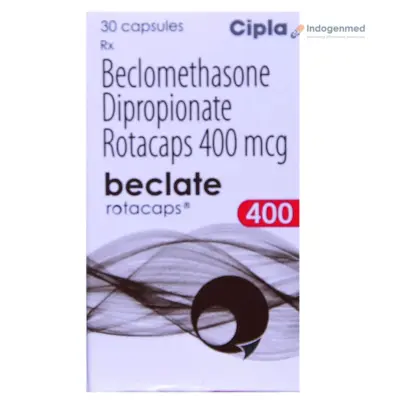
- Beclate 400 Mcg Capsules — Beclometasone 400 mcg DPI capsules for patients with moderate-to-severe persistent asthma requiring high-dose ICS therapy as part of a step-up treatment plan.
- Budecort 400 Mcg Capsules — Budesonide 400 mcg DPI capsules by Cipla, an alternative high-dose ICS for patients for whom budesonide is clinically preferred over beclometasone.
Storage Instructions
- Store below 25°C in a cool, dry place away from direct sunlight, heat sources, and humidity
- Do not refrigerate or freeze the inhaler — cold propellant reduces dose delivery
- Do not puncture or incinerate the canister even when apparently empty; it remains pressurised
- Keep the mouthpiece cap in place when not in use to prevent contamination
- Store out of reach of children
- Do not use after the printed expiry date or when the dose counter (if fitted) reaches zero
- Clean the mouthpiece weekly with a dry cloth; do not wash with water as water can block the valve
Frequently Asked Questions
Q: How is Beclate 200 Mcg Inhaler different from Beclate 200 Mcg Capsules?
A: Both Beclate 200 Mcg Inhaler and Beclate 200 Mcg Capsules contain beclometasone dipropionate 200 mcg and are manufactured by Cipla. The key difference is the delivery device and inhalation mechanism. The inhaler is a pressurised MDI (pMDI) — the propellant in the canister propels the drug as an aerosol when you press the canister, and you inhale slowly. The capsules are a dry powder format (DPI) that must be pierced inside a compatible inhaler device, and you inhale the powder forcefully. The pMDI is generally easier to use for patients who cannot generate sufficient inspiratory flow for a DPI, and works well with a spacer device; the DPI capsule contains no propellant and may be preferred for environmental or sensory reasons. Your doctor or pharmacist can advise on which format suits you.
Q: Do I need a spacer with Beclate 200 Mcg Inhaler?
A: A spacer is not mandatory but is strongly recommended by NHS and GINA asthma guidelines for most patients using a pressurised MDI. A spacer holds the aerosol cloud briefly after actuation, allowing you to inhale it without needing to press and breathe in at exactly the same moment. This improves the amount of medicine that reaches the lungs, reduces the amount deposited in the mouth and throat, and significantly lowers the risk of oral thrush and hoarseness. If you find the press-and-breathe coordination difficult, using a spacer is one of the most effective ways to improve your inhaler technique. Ask your doctor, pharmacist, or asthma nurse about obtaining a compatible spacer.
Q: How many doses are in one Beclate 200 Mcg Inhaler?
A: Each Beclate 200 Mcg Inhaler contains 200 metered doses (actuations). The number of doses remaining depends on your prescribed frequency. For example, at 200 mcg once daily (one actuation daily), one inhaler lasts approximately 200 days. At 200 mcg twice daily (one actuation morning and night), one inhaler lasts approximately 100 days. Some inhalers are fitted with a dose counter to help you track remaining doses. Regardless, do not shake the inhaler to check for remaining contents — the canister can feel light even with doses remaining due to the propellant. Replace it when it reaches the labelled dose count or expiry date.
Q: How do I prevent oral thrush when using Beclate 200 Inhaler?
A: The two most effective preventive steps are rinsing your mouth thoroughly with water and spitting out after every use, and using a spacer device. Rinsing removes residual beclometasone deposited in the mouth and throat before it can be absorbed through the mucosa. A spacer significantly reduces the amount of drug that reaches the mouth in the first place by slowing the aerosol plume so it is inhaled rather than impacting the palate. Brushing your teeth after your preventer inhaler provides additional protection. If thrush develops despite these steps — typically presenting as white patches in the mouth or a sore throat — contact your doctor, who can prescribe antifungal treatment without needing to stop your preventer.
Q: Can Beclate 200 Inhaler be used in children?
A: Yes, beclometasone pMDI inhalers are used in children with persistent asthma, but the dose must be individually determined by a paediatric respiratory specialist. Children below around 5–6 years of age may not be able to use a standard pMDI with a mouthpiece reliably; a spacer device with an appropriately sized face mask is recommended for younger children. A larger-volume spacer is used for older children who can use a mouthpiece. Growth should be monitored in all children on long-term inhaled corticosteroids. Your child’s doctor will determine the appropriate device, dose, and technique for their age and ability.
References
- NHS. Beclometasone inhalers. NHS.uk. Available at: https://www.nhs.uk/medicines/beclometasone-inhalers/
- MedlinePlus. Beclomethasone Oral Inhalation. U.S. National Library of Medicine. Available at: https://medlineplus.gov/druginfo/meds/a682159.html
- Global Initiative for Asthma (GINA). Global Strategy for Asthma Management and Prevention. 2023. Available at: https://ginasthma.org
- British Thoracic Society (BTS) / Scottish Intercollegiate Guidelines Network (SIGN). British Guideline on the Management of Asthma. Available at: https://www.brit-thoracic.org.uk
- European Medicines Agency (EMA). Beclometasone dipropionate — Summary of Product Characteristics. Available at: https://www.ema.europa.eu
Reviews
There are no reviews yet.