Description
What Is Ventolin 100 mcg Inhaler?
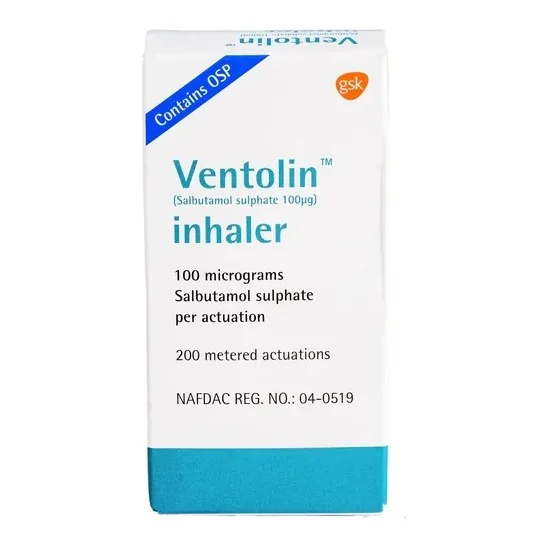
Ventolin 100 mcg Inhaler contains salbutamol (albuterol) 100 micrograms per actuation as the active ingredient, delivered as a pressurised metered-dose inhaler (pMDI). Salbutamol is a selective short-acting beta-2 adrenergic receptor agonist (SABA) that rapidly relaxes the smooth muscle of the bronchioles, producing bronchodilation. It is the most widely prescribed reliever bronchodilator in the world for the management of asthma and chronic obstructive pulmonary disease (COPD).
Ventolin (GSK’s brand of salbutamol) has been available since 1969 and remains the first-line rescue therapy for acute bronchospasm across all major international asthma and COPD guidelines, including GINA (Global Initiative for Asthma) and GOLD (Global Initiative for Chronic Obstructive Lung Disease). Its rapid onset (within 5 minutes) and short duration (4–6 hours) make it ideal for on-demand symptom relief and pre-exercise prophylaxis.
Each actuation of Ventolin 100 mcg Inhaler delivers a metered dose of 100 mcg salbutamol. The device uses a hydrofluoroalkane (HFA) propellant, replacing older chlorofluorocarbon (CFC) formulations in modern manufacturing.
Mechanism of Action
Salbutamol exerts its bronchodilatory effects through selective agonism at beta-2 adrenergic receptors on airway smooth muscle and other cells.
Beta-2 Receptor Agonism and Smooth Muscle Relaxation
Salbutamol binds selectively to beta-2 adrenergic receptors on bronchial smooth muscle cells. Receptor activation stimulates adenylyl cyclase (via Gs proteins), increasing intracellular cyclic adenosine monophosphate (cAMP). Elevated cAMP activates protein kinase A (PKA), which phosphorylates myosin light-chain kinase and reduces its activity. This prevents actin-myosin cross-bridge formation, causing smooth muscle relaxation and bronchodilation. The result is a rapid reduction in airway resistance and improved airflow.
Additional Effects
Beyond smooth muscle relaxation, salbutamol also:
- Inhibits mast cell mediator release (reduces histamine and leukotriene release)
- Increases mucociliary clearance by stimulating ciliary beat frequency
- Reduces microvascular permeability (reduces airway oedema)
At therapeutic inhaled doses, beta-1 receptor stimulation (cardiac effects) is minimal due to salbutamol’s selectivity for beta-2 receptors. However, at high doses, beta-1 effects (tachycardia, palpitations) can occur.
Onset and Duration
Inhaled salbutamol has an onset of bronchodilation within 1–5 minutes of inhalation, with peak effect at 15–30 minutes and duration of 4–6 hours. This rapid onset makes it uniquely suited for acute relief of bronchospasm.
Indications
Ventolin 100 mcg Inhaler is indicated for:
- Relief of acute bronchospasm in asthma — as-needed (PRN) therapy for symptom relief; the first-line rescue inhaler in asthma at all severity levels per GINA guidelines
- Prevention of exercise-induced bronchospasm — 1–2 puffs taken 15–30 minutes before exercise
- Acute exacerbations of COPD — relief of acute airflow obstruction in COPD
- Hyperacute severe asthma — high-dose nebulised salbutamol is a cornerstone of acute severe asthma management in hospital settings; pMDI with spacer is equivalent for mild-moderate exacerbations
- Chronic asthma maintenance (adjunct) — in patients where additional bronchodilation is needed; however, regular scheduled use of SABAs without an inhaled corticosteroid (ICS) is not recommended by current guidelines
Dosage and Administration
Adults and children ≥4 years — Acute relief:
- 1–2 puffs (100–200 mcg) as needed for acute bronchospasm
- Repeat after 20–30 minutes if inadequate response
- If more than 4 inhalations are required in a single acute episode or more than 8 puffs per day on a regular basis, medical review is needed as this indicates poorly controlled asthma
Exercise-induced bronchospasm prevention:
- 1–2 puffs 15–30 minutes before exercise
How to use the pMDI correctly:
- Remove the mouthpiece cap and shake the inhaler vigorously for 5 seconds
- Breathe out gently and completely
- Place the mouthpiece in the mouth and seal the lips around it
- Begin to breathe in slowly and deeply through the mouth; simultaneously press the canister down once to release one actuation
- Continue to inhale slowly to fill the lungs fully
- Hold the breath for 10 seconds (or as long as comfortable)
- Breathe out slowly
- Wait at least 30 seconds before taking a second puff
Spacer device: Use of a spacer (valved holding chamber) is strongly recommended, especially in children, elderly patients, and anyone with difficulty co-ordinating actuation with inhalation. A spacer improves drug delivery to the lungs by 20–30% and reduces oropharyngeal deposition.
Contraindications
- Known hypersensitivity to salbutamol or any ingredient (including the HFA propellant)
- Threatened miscarriage — systemic salbutamol is used to suppress uterine contractions but inhaled salbutamol should be used with caution in obstetric contexts
Warnings and Precautions
Over-Reliance on SABA — Indicator of Poor Asthma Control
Increasing use of Ventolin (more than 2 puffs per day, or use of more than one canister per month) is a recognised marker of poorly controlled asthma and an independent risk factor for severe exacerbations and asthma death. Current GINA guidelines recommend that all patients using a SABA should also use an inhaled corticosteroid (ICS) or ICS-formoterol combination. Patients relying solely on a SABA for asthma control should be reviewed by a clinician.
Cardiovascular Effects
High doses of inhaled salbutamol (or in patients with underlying cardiac disease) can cause tachycardia, palpitations, and peripheral vasodilation. Use with caution in patients with known ischaemic heart disease, arrhythmias, or hypertension. The QTc interval may be prolonged at very high doses.
Hypokalaemia
Salbutamol stimulates potassium entry into cells via beta-2-mediated Na/K-ATPase activation, lowering serum potassium. This effect is dose-dependent and clinically relevant with high-dose nebulisation or repeated pMDI doses. Hypokalaemia is particularly dangerous in patients with concurrent digoxin use, diuretic therapy, or acute severe asthma. Monitor electrolytes during high-dose therapy.
Paradoxical Bronchospasm
Rarely, inhaled salbutamol can cause paradoxical bronchospasm — an acute increase in wheezing immediately after inhalation. This should be managed with an alternative bronchodilator and medical assessment.
Adverse Effects
- Cardiovascular: Tachycardia, palpitations, peripheral vasodilation (flushing, mild blood pressure drop)
- Musculoskeletal: Fine tremor of the hands (the most common side effect at therapeutic doses)
- Metabolic: Hypokalaemia (dose-dependent)
- Neurological: Headache, restlessness, nervousness, insomnia
- Local: Oropharyngeal irritation, dry mouth, cough after inhalation
- Hypersensitivity: Bronchospasm, urticaria, angioedema, hypotension — rare
Drug Interactions
Non-Selective Beta-Blockers
Non-selective beta-blockers (propranolol, timolol, including ophthalmic preparations) block beta-2 receptors and can antagonise salbutamol’s bronchodilatory effect, precipitating severe bronchospasm in asthmatic patients. Cardioselective beta-blockers (atenolol, bisoprolol) are preferred in patients who require beta-blockade, though even these can cause problems at higher doses. This combination requires careful consideration and close monitoring.
Xanthines (Theophylline, Aminophylline)
Concurrent use with xanthine derivatives increases the risk of hypokalaemia (additive effect) and tachyarrhythmias. This combination should be monitored carefully, particularly at high salbutamol doses.
Diuretics and Corticosteroids
Loop diuretics (furosemide), thiazide diuretics, and systemic corticosteroids can exacerbate salbutamol-induced hypokalaemia. Electrolyte monitoring is advisable in patients receiving high-dose salbutamol with these agents.
Digoxin
Salbutamol-induced hypokalaemia increases the risk of digoxin toxicity (arrhythmias). Serum potassium and digoxin levels should be monitored in patients taking both drugs.
Storage
Store Ventolin 100 mcg Inhaler at room temperature, below 25°C. Protect from frost and direct sunlight. Do not puncture, break, or burn the canister, even when empty. The canister is pressurised and should be kept away from heat sources. Keep out of reach of children. Do not use after the expiry date. The mouthpiece should be cleaned weekly by removing the canister, rinsing the mouthpiece with warm water, and allowing it to dry completely before replacing the canister.
Related Products
- Vomistop 10 mg Tablets (Domperidone)
- Rizact 5 mg Tablets (Rizatriptan)
- Acamprol 333 mg Tablets (Acamprosate)
- Linanat 5 mg Tablets (Linagliptin)
References
- DailyMed. Albuterol sulfate inhalation aerosol — prescribing information. U.S. National Library of Medicine. Available at: https://dailymed.nlm.nih.gov/dailymed/
- MedlinePlus. Albuterol Oral Inhalation. U.S. National Library of Medicine. Available at: https://medlineplus.gov/druginfo/meds/a682145.html
- Mayo Clinic. Albuterol (Inhalation Route) — Description. Available at: https://www.mayoclinic.org/
- Global Initiative for Asthma (GINA). Global Strategy for Asthma Management and Prevention 2023. Available at: https://ginasthma.org/reports/
- Rodrigo GJ, Rodrigo C, Hall JB. Acute asthma in adults: a review. Chest. 2004;125(3):1081–1102. PMID: 15006973
Reviews
There are no reviews yet.