Description
What Is Rizact 5 mg Tablets?
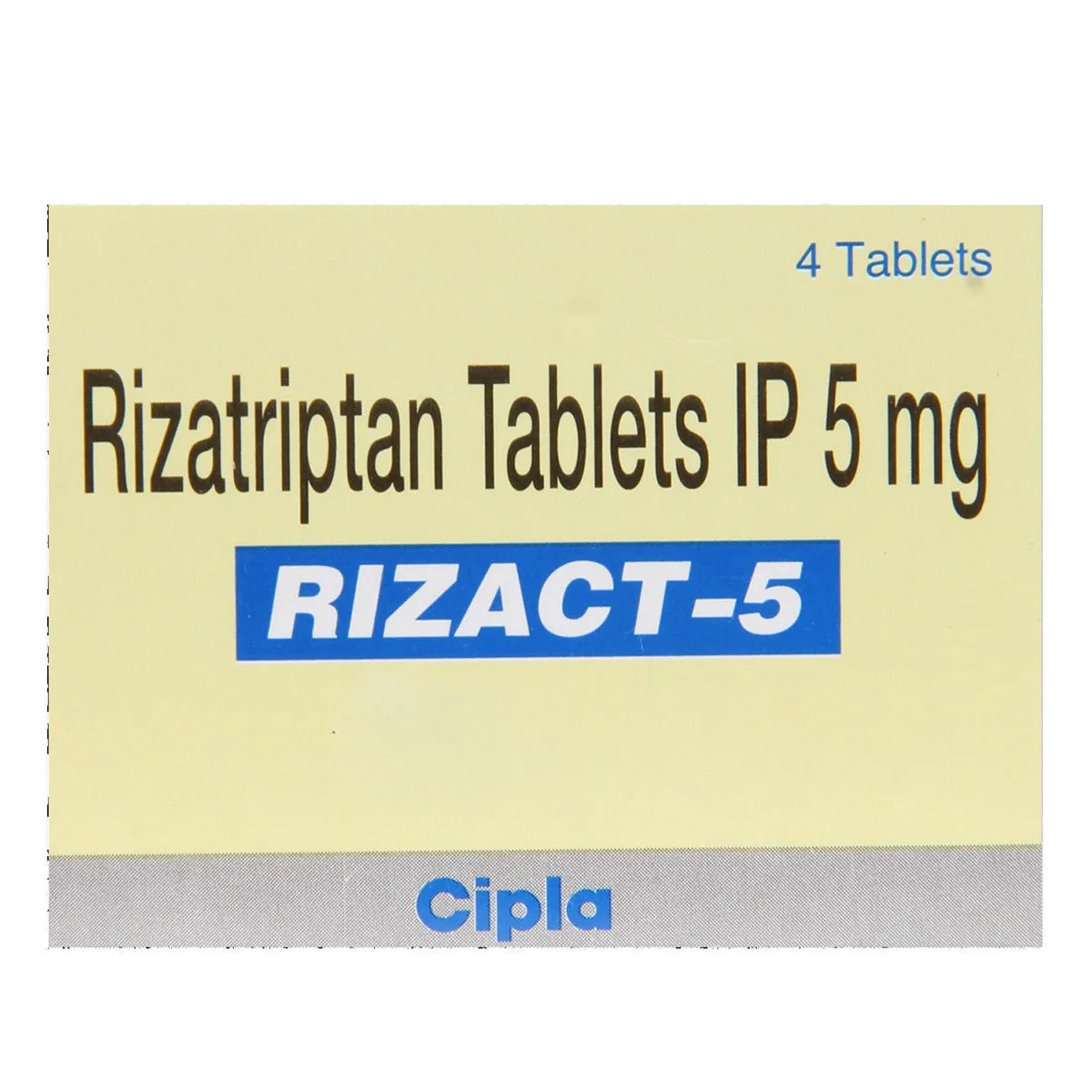
Rizact 5 mg Tablets contain rizatriptan benzoate equivalent to rizatriptan 5 mg as the active ingredient. Rizatriptan is a selective serotonin (5-HT₁B/1D) receptor agonist — a triptan — used specifically for the acute treatment of migraine headaches, with or without aura. It is not indicated for the prevention of migraine attacks, nor for the treatment of hemiplegic or basilar migraine. The 5 mg dose represents the lower of two available strengths; the 10 mg dose is more commonly used as the standard dose, but the 5 mg tablet is clinically important for patients requiring reduced initial dosing or for those on concomitant propranolol.
Rizatriptan was first approved by the FDA in 1998 and belongs to the triptan class, which also includes sumatriptan, zolmitriptan, naratriptan, almotriptan, eletriptan, and frovatriptan. Among the triptans, rizatriptan is notable for its rapid onset of action — with meaningful pain relief typically occurring within 30–60 minutes of oral dosing — and its relatively high oral bioavailability (~45%). It is available as standard film-coated tablets and as orally disintegrating tablets (wafers) for patients who cannot swallow tablets during an attack or who prefer not to use water.
Rizatriptan acts on the pathophysiological mechanisms underlying migraine — cranial vasoconstriction and inhibition of trigeminal nociceptive signalling — to abort the migraine episode. Unlike analgesics, which provide non-specific pain relief, rizatriptan addresses the underlying neurovascular mechanisms of migraine, achieving not only pain relief but also resolution of associated symptoms including nausea, vomiting, phonophobia, and photophobia.
Mechanism of Action
Rizatriptan is a selective agonist at serotonin 5-HT₁B and 5-HT₁D receptors. These receptor subtypes are widely expressed in cranial vasculature and in the trigeminal nervous system, and their activation underlies the principal anti-migraine effects of the triptans.
Cranial Vasoconstriction via 5-HT₁B Receptors
During a migraine attack, neuropeptides released from the trigeminal nerve (particularly calcitonin gene-related peptide, CGRP, and substance P) cause vasodilation of meningeal and other intracranial vessels, including the dural arteries. This vasodilation is associated with the throbbing, pulsatile quality of migraine headache and contributes to perivascular inflammation. 5-HT₁B receptors are expressed on smooth muscle cells of cranial blood vessels. Rizatriptan, by activating these receptors, promotes vasoconstriction of dilated intracranial vessels, reducing abnormal vasodilation and the associated pain. The vasoconstriction is relatively selective for cranial vasculature at therapeutic doses, though coronary artery 5-HT₁B receptors can also be activated, which explains the cardiovascular contraindications of the triptan class.
Trigeminal Inhibition via 5-HT₁D Receptors
5-HT₁D receptors are expressed on presynaptic terminals of trigeminal neurons — both peripheral terminals in the dura mater and central terminals in the trigeminal nucleus caudalis. Activation of presynaptic 5-HT₁D receptors by rizatriptan inhibits the release of neuropeptides (CGRP, substance P) from trigeminal fibres. This reduces neurogenic inflammation around meningeal vessels, decreases the activation of nociceptors, and inhibits the central transmission of pain signals in the trigeminal pathway. This dual mechanism — peripheral vasoconstriction plus central and peripheral trigeminal inhibition — is shared by all triptans but the degree of CNS penetration, speed of onset, and receptor selectivity varies by compound.
Why Rizatriptan Is Fast-Acting
Rizatriptan has a relatively high oral bioavailability (~45%) and rapid absorption, reaching peak plasma concentration (Tmax) within approximately 1–1.5 hours after oral tablet administration. This contributes to its comparatively rapid clinical effect compared with triptans with lower oral bioavailability or slower absorption (such as naratriptan). The orally disintegrating formulation may allow even faster onset in some patients, though it has the same bioavailability as the standard tablet.
Indications
- Acute treatment of migraine with aura: To abort a migraine attack after the onset of headache phase
- Acute treatment of migraine without aura: To provide pain relief and resolve associated migraine symptoms
Rizatriptan is not indicated for:
- Prophylaxis (prevention) of migraine
- Hemiplegic migraine or basilar migraine (risk of serious neurological adverse events)
- Cluster headache (not established as effective)
Dosage and Administration
Standard adult dose: 10 mg at the onset of migraine headache. The 5 mg dose is recommended for specific patient populations (see below).
5 mg dose indications:
- Propranolol co-administration: Propranolol inhibits MAO-A and significantly increases rizatriptan plasma concentrations (~70% increase in AUC). Patients taking propranolol must use the 5 mg dose and should not take more than two 5 mg doses in 24 hours (maximum 10 mg/day).
- Patients sensitive to adverse effects: The 5 mg dose may be used as a starting dose for patients who experience adverse effects at 10 mg, though clinical efficacy may be somewhat reduced.
Repeat dosing: If the initial dose provides partial relief but symptoms return, a second dose may be taken at least 2 hours after the first. The maximum daily dose is 30 mg for the 10 mg tablet strength. For patients on propranolol, maximum is 10 mg/day.
Timing: Rizatriptan should be taken as early as possible after the onset of headache, but it may still be effective when taken later in the attack. It should not be taken during the aura phase before headache begins — there is no established benefit of taking triptans during the aura, and doing so may increase adverse effect risk.
Renal impairment: No dose adjustment required. Rizatriptan is primarily renally excreted; mild-to-moderate renal impairment does not significantly alter pharmacokinetics.
Hepatic impairment: Moderate hepatic impairment increases rizatriptan AUC by approximately 30%; use with caution in hepatic impairment. Avoid in severe hepatic impairment.
Elderly: No dose adjustment required based on age alone. The pharmacokinetics of rizatriptan in elderly patients are similar to those in younger adults.
Adolescents (12–17 years): Safety and efficacy have been evaluated. The 5 mg dose is used in adolescents weighing less than 40 kg; the 10 mg dose may be used in those weighing 40 kg or more. Safety and efficacy in children under 12 have not been established.
Contraindications
- Ischaemic heart disease (angina pectoris, history of myocardial infarction, silent ischaemia, Prinzmetal’s angina) — triptans cause coronary artery vasoconstriction via 5-HT₁B receptors
- Stroke or transient ischaemic attack (TIA) in the patient’s history
- Peripheral vascular disease
- Uncontrolled hypertension
- Severe hepatic impairment
- Hypersensitivity to rizatriptan or any excipient
- Concurrent or recent use (within 24 hours) of another triptan
- Concurrent or recent use (within 24 hours) of ergotamine, dihydroergotamine, or other ergot derivatives — risk of vasospastic reactions
- Concurrent use of MAO inhibitors (non-selective MAOIs or selective MAO-A inhibitors) — MAO-A mediates rizatriptan metabolism; MAOIs significantly increase rizatriptan exposure. Allow at least 2 weeks after stopping an MAOI before using rizatriptan.
- Hemiplegic or basilar migraine
Warnings and Precautions
Cardiovascular Events
Serious adverse cardiac events, including myocardial infarction, have been reported in association with triptan use. Rizatriptan causes coronary artery vasoconstriction and should not be used in patients with known cardiovascular disease. For patients with cardiovascular risk factors who have not had a formal cardiovascular evaluation, it is advisable to perform a cardiovascular assessment before prescribing rizatriptan; if the first dose is prescribed for such a patient, administration in a medically supervised setting with an electrocardiogram is recommended.
Serotonin Syndrome
Serotonin syndrome — a potentially life-threatening condition characterised by hyperthermia, agitation, inco-ordination, tachycardia, and neuromuscular abnormalities — may occur when rizatriptan is used concurrently with selective serotonin reuptake inhibitors (SSRIs), serotonin-noradrenaline reuptake inhibitors (SNRIs), or other serotonergic agents. Caution is required, and patients should be monitored for signs of serotonin syndrome.
Medication Overuse Headache
Use of acute migraine treatments on more than 10 days per month for more than 3 months may lead to medication overuse headache (MOH), also called analgesic rebound headache. This chronic daily headache is distinct from the original migraine and can paradoxically worsen with continued acute treatment. Patients using rizatriptan frequently should be assessed for MOH and, if appropriate, advised to reduce acute medication use.
Adverse Effects
- Common: Dizziness, somnolence (drowsiness), asthenia/fatigue, nausea, dry mouth, paraesthesia (tingling), sensation of warmth, heaviness or pressure (chest, throat, neck, jaw — usually transient and not cardiac in origin)
- Uncommon: Vomiting, dyspepsia, palpitations, tachycardia
- Rare/serious: Myocardial ischaemia, vasospasm, hypersensitivity reactions (including angioedema, anaphylaxis), serotonin syndrome
Drug Interactions
Propranolol (Critical Interaction)
Propranolol is a selective inhibitor of MAO-A and significantly reduces the first-pass metabolism of rizatriptan, increasing its AUC by approximately 70–75%. Patients taking propranolol must use the 5 mg dose of rizatriptan, with a maximum daily dose of 10 mg. This interaction is specific to propranolol among beta-blockers — metoprolol and nadolol do not share this interaction.
MAO Inhibitors
MAO-A metabolises rizatriptan. Non-selective MAOIs (e.g., phenelzine, tranylcypromine) or selective MAO-A inhibitors (e.g., moclobemide) substantially increase rizatriptan plasma concentrations and are contraindicated. Wait at least 2 weeks after stopping an MAOI before using rizatriptan.
Ergot Derivatives
Concurrent use of ergotamine, dihydroergotamine, or methysergide with rizatriptan can cause additive vasospastic effects. These combinations are contraindicated; allow at least 24 hours between ergotamine compounds and rizatriptan use.
Other Triptans
Using two triptans within 24 hours is contraindicated due to the risk of additive vasospastic effects, even if the second triptan is a different compound.
SSRIs and SNRIs
Combining rizatriptan with SSRIs (fluoxetine, sertraline, paroxetine) or SNRIs (venlafaxine, duloxetine) may increase the risk of serotonin syndrome. Use caution and monitor for serotonin toxicity symptoms.
Storage
Store Rizact 5 mg Tablets at room temperature, below 30°C, away from moisture and direct sunlight. Keep in the original blister packaging. Keep out of the reach of children. Do not use after the expiry date printed on the outer carton.
Related Products
- Voltaflam 50 mg Tablets (Diclofenac — alternative analgesic for pain management)
- Tiniba 300 mg Tablets (Tinidazole — antiprotozoal/antibacterial)
- Acamprol 333 mg Tablets (Acamprosate — treatment of alcohol dependence)
- Zinetac 150 mg Tablets (Ranitidine — gastric protection)
References
- DailyMed. Rizatriptan benzoate tablets — prescribing information. U.S. National Library of Medicine. Available at: https://dailymed.nlm.nih.gov/dailymed/
- MedlinePlus. Rizatriptan. U.S. National Library of Medicine. Available at: https://medlineplus.gov/druginfo/meds/a601116.html
- Mayo Clinic. Rizatriptan (Oral Route) — Description and Brand Names. Available at: https://www.mayoclinic.org/
- Ferrari MD, Roon KI, Lipton RB, Goadsby PJ. Oral triptans (serotonin 5-HT₁B/₁D agonists) in acute migraine treatment: a meta-analysis of 53 trials. Lancet. 2001;358(9294):1668–1675. PMID: 11728541
- Tepper SJ, Millson D. Safety profile of the triptans. Expert Opinion on Drug Safety. 2003;2(2):123–132. PMID: 12904117
Reviews
There are no reviews yet.