Description
What are Bigomet 250 Mg Tablets?
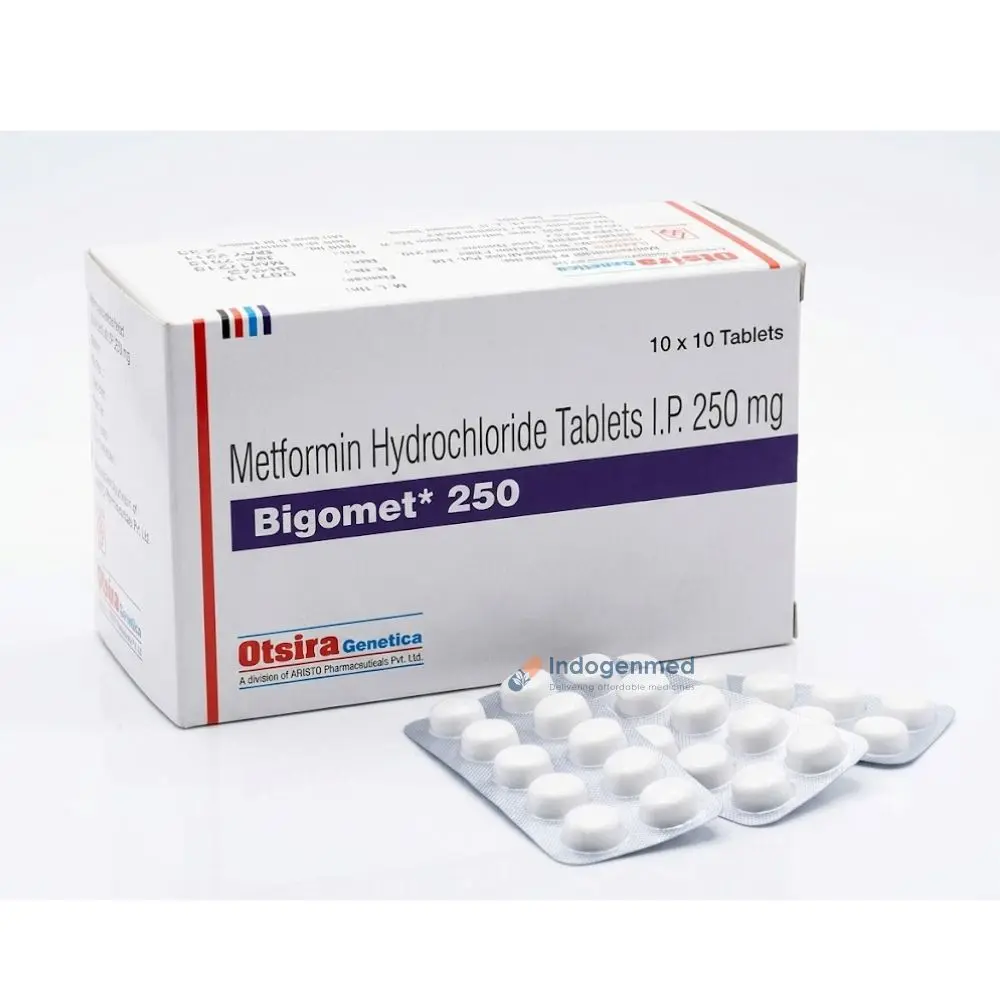
Bigomet 250 Mg Tablets are oral antidiabetic tablets manufactured by Aristo Pharmaceuticals Pvt. Ltd., an established Indian pharmaceutical company. Each tablet contains 250 mg of Metformin Hydrochloride as the active ingredient. Metformin is a biguanide class antidiabetic agent and the most widely prescribed first-line oral medication for type 2 diabetes mellitus (T2DM) worldwide.
Bigomet 250 provides a lower-dose metformin option within the Bigomet range. It is particularly useful for treatment initiation in patients who benefit from a gradual dose increase to minimise gastrointestinal side effects, or for patients requiring a reduced dose due to tolerability or renal considerations. It helps lower blood glucose by reducing hepatic glucose production and improving insulin sensitivity, without causing hypoglycaemia or significant weight gain when used as monotherapy. Each pack contains 10 tablets.
Composition and Product Details
| Brand Name | Bigomet 250 |
|---|---|
| Generic Name | Metformin Hydrochloride |
| Strength | 250 mg per tablet |
| Dosage Form | Film-coated oral tablet |
| Pack Size | 10 tablets |
| Manufacturer | Aristo Pharmaceuticals Pvt. Ltd., India |
| Therapeutic Class | Biguanide / Oral Antidiabetic Agent |
| Prescription Required | Yes |
About Aristo Pharmaceuticals and the Bigomet Brand
Aristo Pharmaceuticals Pvt. Ltd. is a Mumbai-based pharmaceutical manufacturer with more than four decades of experience in the formulation and supply of generic and branded medicines across a broad therapeutic spectrum including cardiovascular, endocrine, anti-infective, and central nervous system categories. Aristo serves both domestic Indian markets and international export markets.
The Bigomet brand is Aristo’s metformin product range, available in multiple tablet strengths to accommodate the full clinical range of metformin dosing used in type 2 diabetes management. Bigomet 250 provides the lower-strength option in this range, supporting gradual dose titration at therapy initiation or maintenance at reduced doses where clinically appropriate.
How Bigomet 250 Mg Works
Metformin works through three principal mechanisms that collectively lower blood glucose levels in patients with type 2 diabetes:
- Reduction of hepatic glucose production (gluconeogenesis): This is metformin’s primary mechanism. The liver in type 2 diabetes overproduces glucose, particularly overnight during fasting. Metformin inhibits mitochondrial complex I in hepatocytes, reducing the energy available for gluconeogenesis and substantially lowering fasting plasma glucose.
- Improved peripheral insulin sensitivity: Metformin enhances glucose uptake and utilisation in skeletal muscle and adipose tissue by improving insulin receptor signalling, allowing circulating insulin to clear glucose more efficiently from the bloodstream.
- Slowed intestinal glucose absorption: Metformin reduces the rate at which glucose is absorbed from the gut following meals, blunting post-prandial glucose peaks.
Because metformin does not stimulate insulin secretion from the pancreas, it does not cause hypoglycaemia (low blood sugar) when used as monotherapy — a key safety advantage over sulphonylurea antidiabetic drugs. Metformin also does not cause weight gain and may be associated with modest weight loss in some patients.
Indications and Uses
Bigomet 250 Mg Tablets are indicated for:
- Type 2 diabetes mellitus (T2DM) in adults: As part of first-line pharmacological treatment when dietary management and exercise are insufficient to achieve target blood glucose levels. Can be used as monotherapy or in combination with other antidiabetic agents.
- Treatment initiation in metformin-naive patients: The 250 mg tablet enables gradual dose titration, starting low and increasing incrementally to reduce the likelihood of gastrointestinal adverse effects.
- Patients requiring dose reduction: For patients who cannot tolerate higher doses due to gastrointestinal side effects, or who require lower doses because of mild-to-moderate renal impairment (subject to prescriber assessment of eGFR).
- Type 2 diabetes in children and adolescents aged 10 years and over — under specialist supervision.
Dosage and Administration
Dosing must be directed by the prescribing physician. All metformin tablets should be taken with or immediately after meals to minimise gastrointestinal side effects.
- Initiation dose: 250 mg once or twice daily with meals. Dose is titrated upward gradually (e.g., every 1–2 weeks) based on blood glucose response and tolerability, typically progressing to Bigomet 500 Mg as the standard maintenance tablet.
- Maintenance dose: The target maintenance dose for most patients with T2DM is 1,500–2,000 mg per day in divided doses. At 250 mg per tablet, this corresponds to 6–8 tablets daily — using Bigomet 500 Mg for maintenance is therefore more convenient for most patients once tolerability is established.
- Maximum dose: Up to 3,000 mg per day in divided doses, as directed by a physician.
- Tablets should be swallowed whole with a glass of water; do not crush or chew unless specifically directed.
Do not adjust your dose without your doctor’s guidance. Your doctor will determine the dose most appropriate for your individual blood glucose targets, renal function, and overall health.
Special Populations
Elderly (≥65 years)
Renal function typically declines with age. Since metformin is eliminated by the kidneys, regular monitoring of eGFR is essential in elderly patients. The 250 mg strength may be useful in elderly patients where dose reduction is required. Metformin should be withheld when eGFR falls below 30 mL/min/1.73 m².
Renal Impairment
Metformin is contraindicated in patients with significantly impaired renal function (eGFR < 30 mL/min/1.73 m²) due to the risk of metformin accumulation and lactic acidosis. For eGFR 30–45 mL/min/1.73 m², a reduced dose may be appropriate with close monitoring. The 250 mg strength supports careful dose titration in patients with mild-to-moderate renal impairment under medical supervision. Your doctor will assess renal function before and during treatment.
Hepatic Impairment
Use with caution in hepatic impairment due to increased theoretical risk of lactic acidosis from impaired hepatic lactate clearance. Generally avoided in severe hepatic impairment (Child-Pugh Class C).
Paediatric Use (10–17 years)
Metformin is licensed for use in children aged 10 and above with type 2 diabetes under specialist supervision. The 250 mg strength allows flexible dose adjustment in younger or smaller patients. Dosing is individually determined by the specialist.
Precautions and Warnings
- Lactic acidosis: A rare but serious complication of metformin therapy. Risk increases with renal failure, hepatic failure, dehydration, excessive alcohol use, sepsis, or conditions causing tissue hypoxia (low oxygen). Symptoms include muscle pain, breathing difficulties, abdominal discomfort, dizziness, and feeling unusually cold. Seek urgent medical attention immediately if these occur.
- Contrast media (iodinated dye): Metformin must be temporarily withheld before and after procedures using intravenous iodinated contrast agents (e.g., CT scans with contrast). Always inform your radiologist that you take metformin.
- Surgery: Metformin is typically withheld 24–48 hours before major surgery requiring general anaesthesia. Your doctor will advise when it is safe to restart.
- Alcohol: Excessive alcohol intake increases lactic acidosis risk. Limit consumption.
- Vitamin B12: Long-term metformin use may reduce vitamin B12 absorption. Periodic monitoring and supplementation may be recommended, particularly if you develop symptoms of neuropathy or anaemia.
- Combination therapy: When Bigomet 250 is used alongside insulin or sulphonylureas, the risk of hypoglycaemia increases. Learn how to recognise and treat low blood sugar.
Contraindications
- Severely reduced renal function (eGFR < 30 mL/min/1.73 m²)
- Type 1 diabetes mellitus (insulin-dependent diabetes)
- Diabetic ketoacidosis
- Severe hepatic impairment
- Acute or chronic metabolic acidosis
- Dehydration, severe infection, shock, or significant tissue hypoxia
- Excessive alcohol use
- Hypersensitivity to metformin hydrochloride or any excipient in the formulation
Possible Side Effects
Common (especially at treatment initiation)
- Nausea and vomiting
- Diarrhoea
- Abdominal discomfort or cramping
- Loss of appetite
- Metallic taste in the mouth
Gastrointestinal side effects are most common when starting metformin and in the first few weeks of treatment. Starting with a low dose (such as 250 mg) and taking tablets with meals significantly reduces these effects. They usually improve as treatment continues.
Uncommon
- Headache
- Skin reactions (rare rash or urticaria)
Rare but Serious
- Lactic acidosis — rare with normal renal function but potentially life-threatening. Seek immediate medical attention if symptoms develop.
- Vitamin B12 deficiency — with long-term use; may manifest as anaemia or peripheral neuropathy
- Severe hypoglycaemia — only when used in combination with insulin or sulphonylureas
Drug Interactions
- Iodinated contrast agents: Withhold metformin 48 hours before and after contrast-enhanced procedures (see Precautions).
- Alcohol: Increases lactic acidosis risk; limit intake.
- Insulin and sulphonylureas (e.g., gliclazide, glibenclamide): Concurrent use increases hypoglycaemia risk; dose adjustment may be needed.
- Cimetidine: Competes for renal tubular secretion, increasing metformin plasma concentrations; use with caution.
- Loop diuretics and NSAIDs: May cause dehydration and transient renal impairment, increasing metformin accumulation risk.
- ACE inhibitors and ARBs: Can reduce renal function; monitor during combined use with metformin.
- Corticosteroids, thiazide diuretics, sympathomimetics, glucagon: May raise blood glucose levels, reducing metformin efficacy.
Related Diabetes Products on IndoGenMed
IndoGenMed offers multiple metformin strengths and related diabetes products:
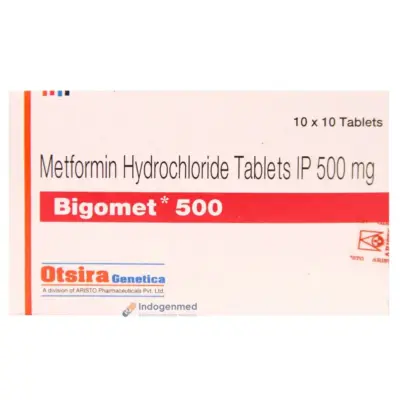
- Bigomet 500 Mg Tablets — The standard 500 mg metformin tablet in the Bigomet range, typically used for ongoing maintenance therapy once the dose is established and tolerability confirmed.
Storage Instructions
- Store below 25°C in a cool, dry place away from direct sunlight and moisture
- Keep tablets in the original blister pack until use
- Store out of reach of children and pets
- Do not use tablets after the printed expiry date
- Avoid storing in bathrooms or other high-humidity environments
Frequently Asked Questions
Q: Why start with Bigomet 250 rather than the 500 mg tablet?
A: Starting metformin at a lower dose such as 250 mg and gradually increasing the dose over several weeks significantly reduces gastrointestinal side effects — particularly nausea, diarrhoea, and stomach discomfort — which are metformin’s most common adverse effects. This gradual titration approach is recommended in many clinical guidelines to improve tolerability and treatment adherence.
Q: Can Bigomet 250 control blood sugar on its own?
A: At 250 mg per dose, Bigomet 250 will provide less glucose-lowering effect than the standard maintenance doses of 1,500–2,000 mg daily. As a starter dose, the 250 mg tablet is typically increased over time to reach an effective therapeutic dose. Your doctor will monitor your blood glucose levels and adjust your dose or add other treatments as needed to achieve your individual targets.
Q: Is Bigomet 250 safe for elderly patients?
A: Metformin can be used in elderly patients, but renal function must be monitored regularly because the kidneys are responsible for eliminating metformin from the body. Declining kidney function with age may require a reduced dose or, if renal function falls below a safe threshold (eGFR < 30 mL/min/1.73 m²), discontinuation. The lower 250 mg dose may be appropriate for older patients requiring a reduced daily metformin intake. Your doctor will determine the safe dose for you.
Q: How is Bigomet 250 different from Bigomet 500?
A: Both Bigomet 250 and Bigomet 500 contain the same active ingredient — Metformin Hydrochloride — and are manufactured by Aristo Pharmaceuticals. The only difference is the strength per tablet: 250 mg versus 500 mg. Bigomet 250 is used for gentle dose initiation or for situations requiring a lower daily metformin intake, while Bigomet 500 is the more practical tablet for established maintenance dosing.
Q: Will Bigomet 250 cause low blood sugar?
A: Metformin monotherapy does not cause hypoglycaemia because it does not stimulate insulin secretion from the pancreas. If Bigomet 250 is taken alongside insulin or sulphonylurea drugs, however, the combination can cause low blood sugar. Always follow your doctor’s advice on dose adjustments and learn to recognise the symptoms of hypoglycaemia — shakiness, sweating, confusion, and rapid heartbeat — so you can treat it promptly.
References
- NHS. Metformin. NHS.uk. Available at: https://www.nhs.uk/medicines/metformin/
- MedlinePlus. Metformin. U.S. National Library of Medicine. Available at: https://medlineplus.gov/druginfo/meds/a696005.html
- U.S. Food and Drug Administration (FDA). Glucophage (metformin hydrochloride) Prescribing Information. Available at: FDA.gov
- National Institute for Health and Care Excellence (NICE). Type 2 diabetes in adults: management. NICE Guideline NG28. Available at: https://www.nice.org.uk/guidance/ng28
- Inzucchi SE, et al. “Management of hyperglycaemia in type 2 diabetes: a patient-centered approach.” Diabetes Care. 2012;35(6):1364–1379.
Reviews
There are no reviews yet.