Description
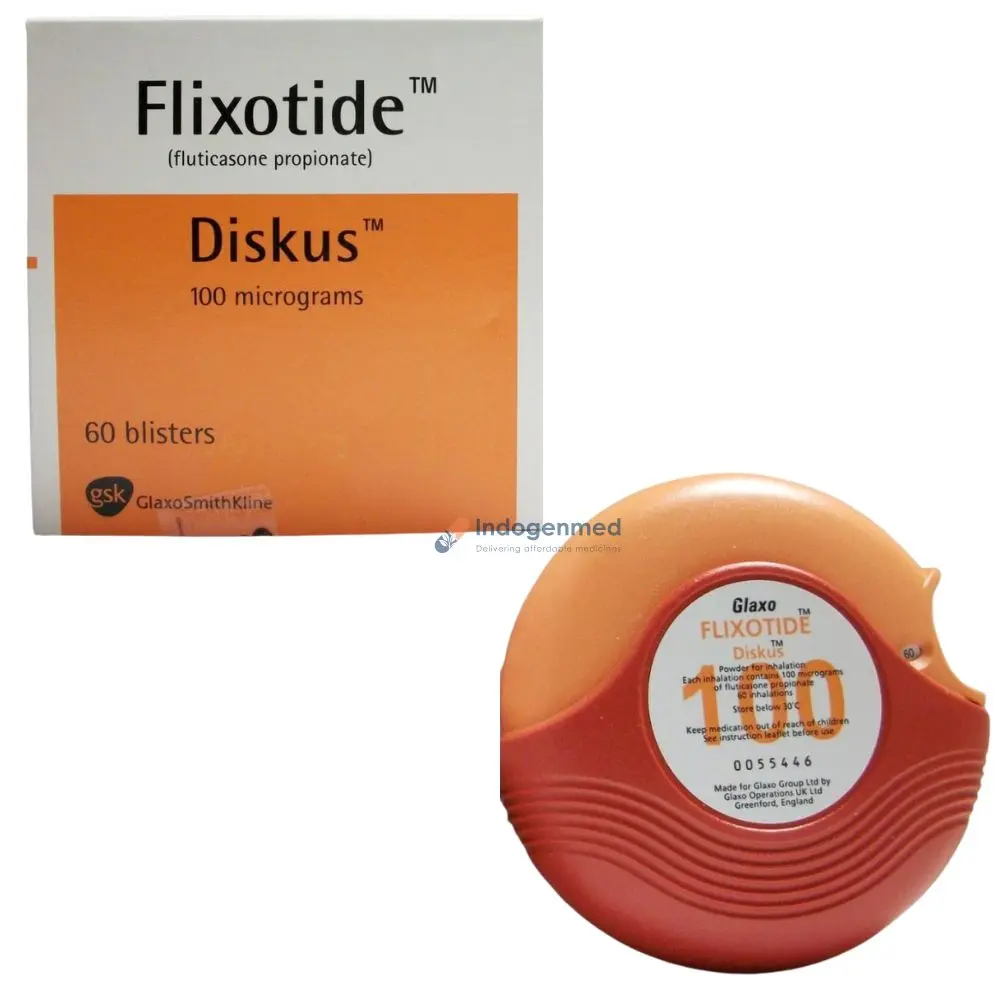
Flixotide Discus 100 Mcg Inhaler – Fluticasone Propionate Dry Powder Inhaler
Flixotide Discus 100 Mcg Inhaler contains Fluticasone Propionate 100 mcg per dose in the Accuhaler/Diskus dry powder inhaler (DPI) device. Fluticasone propionate is one of the most potent and topically selective inhaled corticosteroids (ICS) available. The 100 mcg dose is primarily used for mild-to-moderate persistent asthma as a low-dose ICS — the first-line controller medication recommended in asthma management guidelines worldwide. Regular preventive use of Flixotide Discus 100 mcg reduces airway inflammation, prevents exacerbations, and improves day-to-day symptom control. It is suitable for adults, adolescents, and children aged 4 years and over.
Composition
Each actuation of the Flixotide Discus 100 Mcg Inhaler delivers:
- Fluticasone Propionate – 100 mcg per blister dose
- Carrier: Lactose monohydrate (contains milk proteins)
The Discus device holds 60 individually foil-sealed blisters in a strip format. Each blister is broken only at the moment of inhalation, maintaining dose integrity and protecting the powder from moisture.
How Fluticasone Propionate Works
Fluticasone propionate is a synthetic trifluorinated glucocorticoid with exceptionally high binding affinity for the intracellular glucocorticoid receptor — approximately 18 times greater than dexamethasone. After inhalation, fluticasone particles deposit on the bronchial mucosa, penetrate airway cells, and bind cytoplasmic glucocorticoid receptors. The drug-receptor complex enters the cell nucleus and modulates transcription of genes encoding inflammatory and anti-inflammatory proteins.
This results in suppression of pro-inflammatory cytokines including interleukins (IL-4, IL-5, IL-13), GM-CSF, and TNF-α, as well as inhibition of phospholipase A2 via upregulation of lipocortin-1, which reduces production of prostaglandins and leukotrienes from arachidonic acid. Collectively, these effects reduce airway eosinophilic inflammation, bronchial mucosal oedema, mucus hypersecretion, and bronchial hyperresponsiveness.
With regular use, lung function indices such as FEV1 and peak expiratory flow improve, rescue bronchodilator requirements decrease, and both daytime and nocturnal asthma symptoms are controlled. Fluticasone propionate has extremely low oral bioavailability (approximately 1%) owing to poor absorption from the gastrointestinal tract and extensive first-pass hepatic metabolism, markedly reducing the risk of systemic corticosteroid effects compared with oral formulations.
Uses of Flixotide Discus 100 Mcg Inhaler
- Mild-to-moderate persistent asthma: First-line preventer therapy to control airway inflammation and reduce exacerbation frequency in patients with regular symptoms.
- Asthma step-up from SABA-only therapy: Initiating maintenance ICS therapy when short-acting bronchodilators alone are insufficient for asthma control.
- Paediatric asthma: Preferred ICS in school-age children (4–11 years) with persistent asthma at low doses (100 mcg or less per day).
- Exercise-induced bronchoconstriction: Regular ICS use reduces the frequency and severity of exercise-induced wheeze as part of overall asthma management.
- Seasonal or allergic asthma: Used throughout the year or seasonally to prevent allergen-triggered airway inflammation.
Dosage and Administration
- Adults and adolescents (12+ years): 100 to 250 mcg twice daily, depending on severity. For mild asthma, 100 mcg twice daily is an appropriate starting dose.
- Children (4–11 years): 50 to 100 mcg twice daily. Some guidelines recommend 50 mcg twice daily for mild persistent asthma in children; physician guidance is essential.
- Using the Discus device: open the case, slide the lever to click open and load a blister, exhale away from the inhaler, place the mouthpiece between the lips, inhale deeply and steadily, hold breath for approximately 10 seconds, then exhale slowly. Close the case after use.
- Rinse mouth and gargle with water after each use to minimise the risk of oral candidiasis and reduce swallowed dose absorption.
- Do not exhale into the device. Wipe the mouthpiece with a dry cloth only — do not wash with water.
- The dose counter shows remaining doses; replace the inhaler when the counter reaches zero.
Side Effects
- Oropharyngeal candidiasis: Oral thrush (white patches in the mouth or throat) is the most common local side effect; largely prevented by rinsing mouth with water after each use.
- Dysphonia: Hoarseness due to myopathy of laryngeal muscles from local steroid deposition; often resolves on dose reduction or drug holiday.
- Systemic effects (at higher doses or long-term use): Growth retardation in children, reduced bone mineral density, skin thinning, bruising, and suppression of the hypothalamic-pituitary-adrenal axis may occur at high cumulative doses; always use the lowest effective dose.
- Paradoxical bronchospasm: Rare; discontinue immediately if inhalation triggers worsening wheeze and use a rescue bronchodilator.
Precautions and Warnings
- Not a rescue medication: Flixotide Discus prevents symptoms but does not relieve acute bronchospasm. Always have a short-acting bronchodilator (e.g. salbutamol inhaler) available for acute attacks.
- Milk allergy: The lactose carrier contains milk proteins; patients with severe hypersensitivity to milk proteins should inform their doctor before use.
- Pulmonary tuberculosis: Active respiratory TB may be worsened or masked by corticosteroid therapy.
- Steroid card: Patients on high-dose ICS may benefit from carrying a steroid card or medical alert in case of emergency adrenal insufficiency.
- Child growth monitoring: Regular height measurement is recommended in children on long-term ICS therapy; use the minimum effective dose.
Drug Interactions
- Ritonavir, cobicistat, and HIV protease inhibitors: Potent CYP3A4 inhibitors that dramatically increase fluticasone plasma concentration — avoid combination if possible, as systemic corticosteroid effects (including Cushing’s syndrome) may occur.
- Ketoconazole, itraconazole: Inhibit CYP3A4-mediated metabolism of fluticasone; concomitant use should be avoided or closely monitored.
- Long-acting beta-2 agonists (salmeterol, formoterol): Frequently combined with ICS for superior asthma control; no adverse pharmacokinetic interaction.
Contraindications
- Hypersensitivity to fluticasone propionate, lactose, or milk proteins
- Use as sole rescue therapy in acute asthma or status asthmaticus
Storage Instructions
Store below 30°C. Protect from frost and direct sunlight. Keep in a dry environment. Do not pierce or burn the device even when empty. Keep out of reach of children. Do not use after the expiry date printed on the device.
Related Products
- Flixotide Discus 250 Mcg Inhaler – Fluticasone 250 mcg for moderate-to-severe asthma
- Budecort Respules 1 Mg/2 Ml – Budesonide nebulisation for children and adults
- Flohale 100 Mcg Capsules – Fluticasone 100 mcg capsules for inhalation
- Levolin 100 Mcg Capsules – Levosalbutamol bronchodilator capsules
References
- MedlinePlus. Fluticasone Oral Inhalation. U.S. National Library of Medicine. medlineplus.gov
- Mayo Clinic. Fluticasone (Inhalation Route) – Proper Use. mayoclinic.org
- electronic Medicines Compendium (eMC). Flixotide Accuhaler 100 micrograms – Summary of Product Characteristics. medicines.org.uk/emc
Reviews
There are no reviews yet.