Description
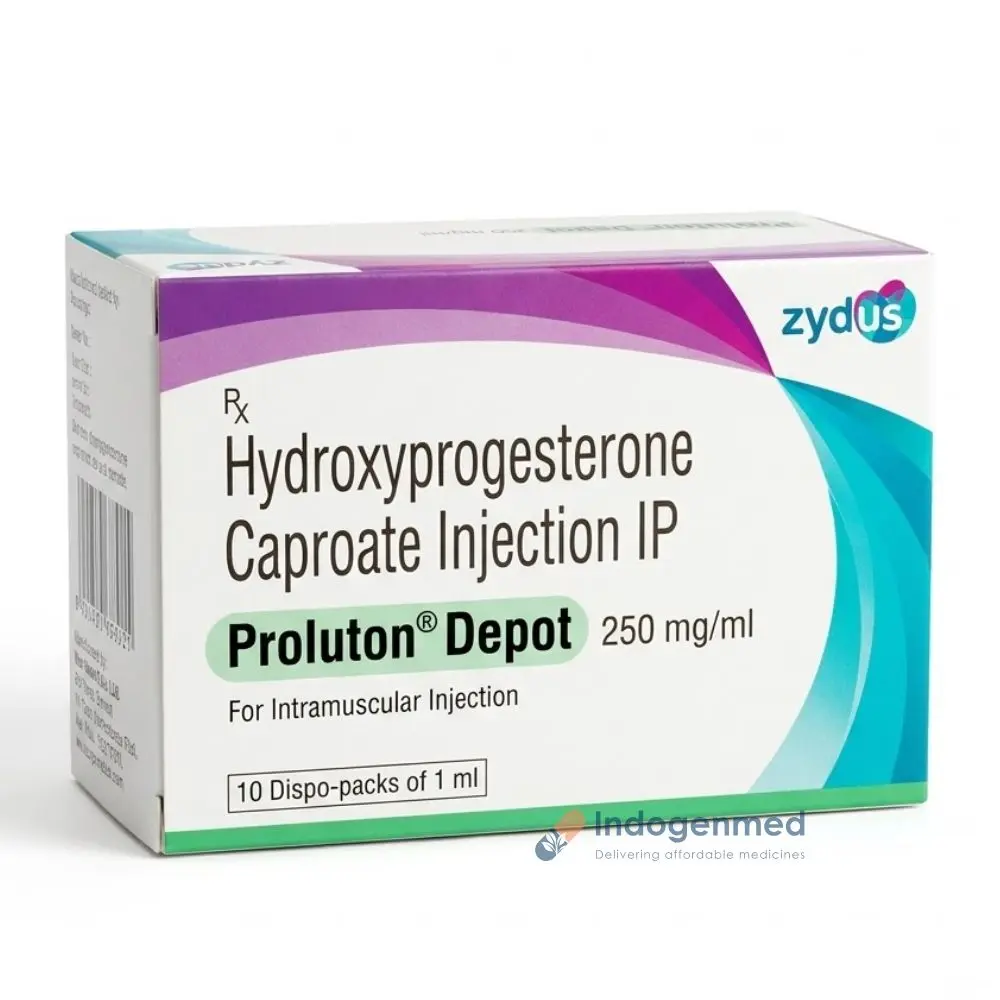
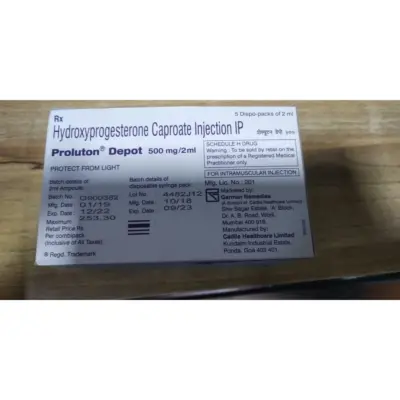
Proluton Depot 250 Mg Injection – Hydroxyprogesterone Caproate 250 mg
Proluton Depot 250 Mg Injection contains hydroxyprogesterone caproate 250 mg/mL, a long-acting synthetic progestogen formulated in an oily vehicle for deep intramuscular (IM) injection. Hydroxyprogesterone caproate (17-OHPC) is an esterified derivative of progesterone whose oily depot formulation allows slow, sustained release over 7–14 days following a single IM dose, making it suitable for weekly administration in clinical practice.
The 250 mg strength is the most extensively studied dose in clinical trials for the prevention of recurrent preterm birth, used in the landmark NICHD MFMU Network trial by Meis et al. (2003) and endorsed by ACOG and other international obstetric guidelines for singleton pregnancies with a prior spontaneous preterm birth.
Mechanism of Action
After IM injection, hydroxyprogesterone caproate is slowly released from the oily depot and hydrolysed by circulating esterases to hydroxyprogesterone, which acts on progesterone receptors (PR-A and PR-B) in uterine, cervical, and other target tissues.
Key pharmacodynamic effects include:
- Myometrial quiescence: Progesterone receptor activation suppresses uterine contractility by downregulating connexin-43 gap junctions (required for synchronised contractions), oxytocin receptors, and prostaglandin E2 and F2α receptors. This prolongs uterine quiescence and delays the onset of coordinated uterine contractions associated with preterm labour
- Anti-inflammatory effect on the cervix: Progesterone inhibits the production of pro-inflammatory cytokines (interleukin-8, interleukin-1β) and matrix metalloproteinases (MMP-1, MMP-8) that promote cervical collagen breakdown and ripening; this supports cervical integrity and delays premature cervical remodelling
- Endometrial stabilisation: Induces secretory transformation of the proliferative endometrium, stabilises endometrial stromal cells, and reduces aberrant endometrial shedding, which is relevant to its use in dysfunctional uterine bleeding and threatened miscarriage
- Immunomodulatory role: Progesterone modulates the maternal immunological environment at the decidua-trophoblast interface, promoting immune tolerance necessary for maintenance of an intrauterine pregnancy
Indications
- Prevention of recurrent preterm birth: In women with a singleton pregnancy and a previous spontaneous preterm birth (before 37 weeks), initiated at 16–20 weeks gestation and continued weekly to 36 weeks; this is the evidence-based primary indication for the 250 mg dose
- Threatened and recurrent abortion: Adjunctive progestogen support in the first and second trimester in women with a history of recurrent miscarriage, or when threatened abortion is associated with progesterone deficiency
- Dysfunctional uterine bleeding: To arrest irregular, excessive, or prolonged uterine bleeding by inducing secretory endometrial transformation
- Endometriosis: As a hormonal suppressive therapy to reduce endometrial implant activity
- Secondary amenorrhoea: To induce a withdrawal bleed and assess endometrial integrity in women with absent menstruation
- Premenstrual syndrome: Adjunctive support in selected cases linked to luteal-phase progesterone deficiency
Dosage and Administration
- Prevention of preterm birth (primary indication): 250 mg IM once weekly, beginning between 16 and 20 weeks of gestation and continuing until 36 weeks of gestation or delivery, whichever comes first
- Threatened and recurrent abortion: 250 mg IM once or twice weekly in the first trimester; adjust according to clinical response and physician guidance
- Dysfunctional uterine bleeding and endometriosis: 250 mg IM every 1–2 weeks; duration and frequency determined by the treating physician
Administration notes:
- For deep intramuscular injection only — not for intravenous or subcutaneous use
- Inject into a large muscle group (upper outer quadrant of the gluteus maximus); rotate injection sites weekly to minimise local tissue reactions
- Use a syringe and needle appropriate for viscous oily solutions; warming the vial to room temperature facilitates drawing and injection
- Administer slowly to reduce injection-site discomfort; applying a warm compress after injection may provide further relief
Pharmacokinetics
Following deep IM injection of hydroxyprogesterone caproate in an oily vehicle (typically castor oil with benzyl benzoate), drug release from the injection-site depot is prolonged over 7–14 days. Circulating hydroxyprogesterone caproate is hydrolysed to the active hydroxyprogesterone moiety by serum esterases.
Protein binding is high (greater than 99%), predominantly to albumin. Hepatic metabolism produces polar conjugated metabolites excreted primarily in the bile (~50%) and in the urine (~30%). The effective pharmacokinetic half-life after a single 250 mg IM dose is approximately 7–10 days, consistent with weekly dosing maintaining steady-state therapeutic serum progesterone levels.
Peak serum levels after the 250 mg dose are lower than after the 500 mg dose, while the weekly dosing interval provides consistent exposure. Accumulation at steady state over the first 4–6 weeks of weekly dosing is modest given the prolonged half-life.
Clinical Evidence — Preterm Birth Prevention
The clinical evidence base for hydroxyprogesterone caproate 250 mg in preterm birth prevention is well-established:
- Meis et al. (2003) — NICHD MFMU Network: The pivotal trial that established 17-OHPC 250 mg weekly as effective for reducing recurrent preterm birth. Among 310 women with prior spontaneous preterm birth, 17-OHPC reduced delivery before 37 weeks (36.3% vs 54.9% with placebo; relative risk 0.66; p<0.001), delivery before 35 weeks (20.6% vs 30.7%), and neonatal morbidity outcomes including necrotising enterocolitis, intraventricular haemorrhage, and requirement for supplemental oxygen
- Subsequent meta-analyses: Pooled data from multiple trials confirmed a statistically significant reduction in preterm birth before 34 and 37 weeks with 17-OHPC in women with a singleton pregnancy and prior preterm birth
- PROLONG trial (2020): A larger, multicentre international trial did not confirm a significant benefit in a broader, more diverse population, raising questions about which subgroups benefit most. The discrepancy between the Meis and PROLONG populations remains under investigation, and clinical guidelines continue to recommend 17-OHPC for women who match the original trial criteria
Contraindications
- Known hypersensitivity or allergy to hydroxyprogesterone caproate, any other progestogen, castor oil, benzyl benzoate, or any formulation excipient
- Current or previous thrombophlebitis, thromboembolic disorders, pulmonary embolism, or cerebrovascular disease
- Known or suspected oestrogen- or progestogen-dependent malignancies (breast cancer, uterine cancer)
- Undiagnosed abnormal vaginal bleeding
- Severe hepatic disease (impaired liver function tests)
- Missed abortion or confirmed non-viable pregnancy
- Active depression (use with caution; monitor throughout treatment)
Precautions and Warnings
- Depression and mood: Progestogens may worsen depression; use with caution and monitor patients with a history of depressive illness throughout the treatment course
- Fluid retention: As with other progestogens, fluid retention may occur; use with caution in patients with cardiac or renal disease, epilepsy, migraine, or asthma
- Diabetes mellitus: Progestogens may impair glucose tolerance; blood glucose should be monitored in patients with established diabetes or gestational diabetes
- Lipid metabolism: May affect lipid profiles in long-term use; monitor in patients with significant dyslipidaemia
- Vehicle hypersensitivity: The castor oil/benzyl benzoate vehicle may cause allergic reactions, including anaphylaxis; have resuscitation equipment available during and after administration, particularly for the first dose
- Injection-site monitoring: Rotation of injection sites is essential to prevent local fibrosis, nodule formation, and scarring with long-term weekly administration
Adverse Effects
- Very common: Injection-site reactions — pain, swelling, pruritus, bruising, and nodule formation
- Common: Urticaria, nausea, diarrhoea, breast tenderness, breakthrough bleeding or spotting, fatigue
- Uncommon: Depression, mood changes, oedema, weight changes, dizziness, headache, reduced libido
- Rare: Thromboembolic events, allergic reactions (including anaphylaxis), jaundice, significant glucose intolerance
Storage Instructions
- Store at 15–30°C (some formulations may require refrigeration at 2–8°C — check the specific product label)
- Protect from light; keep in the original outer carton until use
- Do not freeze
- Keep out of reach and sight of children
- Discard any unused solution from opened single-dose vials; multi-dose vials should be used according to product labelling instructions
Frequently Asked Questions
What is the difference between Proluton Depot 250 mg and 500 mg?
Both strengths contain hydroxyprogesterone caproate. The 250 mg dose per injection is the standard dose for preterm birth prevention as established by the pivotal clinical trial (Meis et al., 2003). The 500 mg dose provides a higher dose per injection and may be used in certain gynaecological indications. Your obstetrician will prescribe the appropriate strength for your specific clinical indication.
How long does each Proluton Depot 250 mg injection last?
Due to its oily depot formulation, each 250 mg IM injection provides sustained release over approximately 7 days, which is why weekly injections are prescribed for preterm birth prevention. The effective pharmacokinetic half-life is approximately 7–10 days after a single dose.
Can Proluton Depot 250 mg be self-administered at home?
Proluton Depot is an intramuscular injection typically administered by a healthcare professional in a clinical setting. Some patients receiving it for preterm birth prevention receive injections at their doctor’s office or maternity unit. Home self-administration may be appropriate in selected settings with proper training — discuss this option with your obstetrician.
References
- Meis PJ, et al. Prevention of recurrent preterm delivery by 17 alpha-hydroxyprogesterone caproate. N Engl J Med. 2003;348(24):2379–2385. Available at: https://www.nejm.org/doi/full/10.1056/NEJMoa035140
- Electronic Medicines Compendium (eMC). Proluton Depot 250 mg/mL solution for injection — summary of product characteristics. Available at: https://www.medicines.org.uk/emc/
- National Library of Medicine – DailyMed. Hydroxyprogesterone caproate injection. Available at: https://dailymed.nlm.nih.gov/dailymed/search.cfm?labeltype=all&query=hydroxyprogesterone+caproate
- MedlinePlus (U.S. National Library of Medicine). Hydroxyprogesterone injection. Available at: https://medlineplus.gov/druginfo/meds/a612006.html
- American College of Obstetricians and Gynecologists (ACOG). Practice Bulletin No. 234: Prediction and Prevention of Preterm Birth. Obstet Gynecol. 2021;138(2):e65–e90.


Reviews
There are no reviews yet.