Description
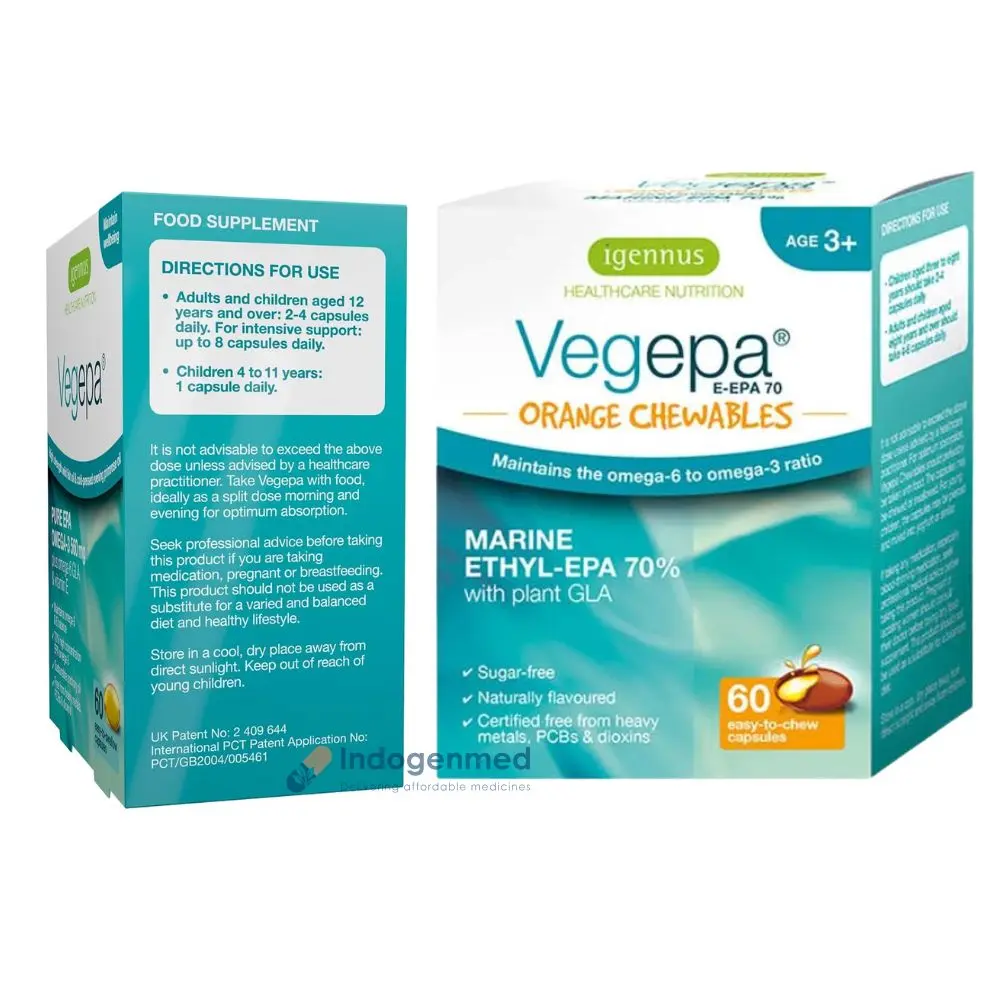
What Is Vegepa Orange Chewable Capsules?
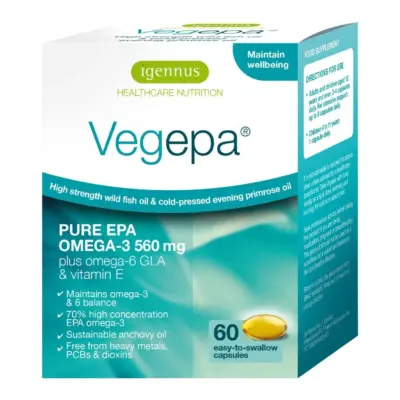
Vegepa Orange Chewable Capsules are a naturally orange-flavoured, chewable soft-gel omega-3 fatty acid supplement combining high-purity EPA (eicosapentaenoic acid) with cold-pressed evening primrose oil (providing GLA, gamma-linolenic acid). Unlike standard fish oil capsules that must be swallowed whole, the chewable format makes omega-3 supplementation accessible to children, patients who have difficulty swallowing capsules, and adults who prefer to avoid fishy aftertaste. The natural orange flavour effectively masks the fish oil taste, and the soft-gel capsule can be chewed or bitten open and the contents swallowed.
The composition mirrors that of Vegepa Omega 560 mg standard capsules — providing EPA from molecularly distilled, contaminant-tested fish oil plus GLA from evening primrose oil — in a palatability-optimised chewable format. Each capsule provides EPA and GLA in the same high-EPA-enriched ratio as Vegepa standard capsules. This formulation is particularly valued for paediatric omega-3 supplementation, where the evidence base for EPA in ADHD, learning difficulties, and neurodevelopmental support is strongest, and where swallowing standard capsules is frequently impractical.
Mechanism of Action
EPA and Neurological Membrane Function
Eicosapentaenoic acid (EPA, 20:5n-3) is a critical structural component of neuronal cell membranes. The brain is approximately 60% fat by dry weight, and polyunsaturated fatty acids (PUFAs) — particularly long-chain omega-3s — are essential for membrane fluidity, signal transduction, neurotransmitter receptor function, and myelination. EPA is incorporated into phospholipid bilayers in place of pro-inflammatory arachidonic acid (AA), shifting membrane composition towards a less inflammatory state and improving fluidity of the neuronal plasma membrane. This has downstream effects on neurotransmitter release (dopamine and serotonin transport), synaptic plasticity, and neuroinflammation.
EPA, Resolvins, and Neuroinflammation
EPA is the substrate for the synthesis of E-series resolvins — specialised pro-resolving mediators (SPMs) that actively suppress neuroinflammation, reduce microglial activation, and promote synaptic repair following neuroinflammatory episodes. Elevated neuroinflammation and microglial overactivation are implicated in ADHD, autism spectrum disorder, depression, and cognitive decline — conditions where EPA supplementation may provide benefit through direct anti-neuroinflammatory mechanisms rather than simply replacing a deficiency.
GLA and Membrane Phospholipid Support
Gamma-linolenic acid (GLA) from evening primrose oil is converted to DGLA (dihomo-gamma-linolenic acid), which modifies membrane phospholipid composition and reduces synthesis of pro-inflammatory eicosanoids derived from arachidonic acid. DGLA-derived prostaglandin E1 (PGE1) has vasodilatory, anti-aggregatory, and anti-inflammatory properties. The combination of EPA and GLA provides complementary membrane-modifying and anti-inflammatory activity — supporting both the omega-3 and omega-6 pathways of eicosanoid balance simultaneously.
Indications
Children’s Neurodevelopmental Support (ADHD, Learning, Concentration)
The chewable orange format of Vegepa is particularly suited to paediatric supplementation. EPA-enriched omega-3 supplementation has been studied in children with ADHD (attention deficit hyperactivity disorder) and other neurodevelopmental conditions. Meta-analyses demonstrate modest but statistically significant benefits of omega-3 supplementation on ADHD symptom severity — particularly inattention, hyperactivity, and reading ability — with EPA-dominant formulations (EPA ≥60% of omega-3 content) consistently outperforming DHA-dominant formulations in head-to-head comparisons. Omega-3 supplementation is used as an adjunct to, not a substitute for, evidence-based behavioural and pharmacological ADHD management.
Cardiovascular and Metabolic Support (Adults)
The chewable format provides the same EPA + GLA cardiovascular benefit as standard Vegepa capsules — triglyceride reduction, platelet anti-aggregation, anti-inflammatory arterial wall effects — in a format preferred by those who find standard capsules difficult or unpleasant. Suitable for adults managing cardiovascular risk factors alongside dietary modification and lipid-lowering therapy.
Inflammatory Skin Conditions
EPA and GLA supplementation supports inflammatory skin conditions — particularly atopic dermatitis and eczema — through combined membrane phospholipid modification and prostaglandin E1 (anti-inflammatory) enhancement. GLA supplementation has shown benefit for improving skin barrier function, reducing transepidermal water loss, and alleviating pruritus in atopic dermatitis across multiple randomised trials. For children with eczema, the chewable format facilitates consistent supplementation.
General Omega-3 and Fatty Acid Supplementation
For individuals — adults or children — with low dietary intake of omega-3 fatty acids (those who do not regularly consume oily fish), Vegepa Orange Chewable provides a convenient, palatable omega-3 supplementation option to support general health, immune function, and anti-inflammatory balance.
Dosage and Administration
Children (6–12 years): Typically 2 chewable capsules daily, taken with a meal.
Children (12–18 years) and adults: 4 chewable capsules daily (2 capsules twice daily) with meals — the same as the standard Vegepa adult dose, providing approximately 1120 mg EPA + 320 mg GLA daily.
Administration: Capsules can be chewed, bitten open, or swallowed whole. The orange flavour is designed to mask fishy taste if the capsule is chewed. Taking with or immediately after a meal reduces the risk of fishy aftertaste and nausea, and maximises absorption.
Duration: Allow 8–12 weeks before assessing full response. For neurodevelopmental support in children, trials typically run for 3–6 months. Supplementation can be continued long-term as part of ongoing nutritional support.
Under 6 years: Not recommended without medical supervision.
Contraindications
- Known allergy to fish, fish oil, or evening primrose oil.
- Known hypersensitivity to any excipient, including the natural orange flavouring or gelatine used in the capsule shell.
- Allergy to evening primrose oil or gamma-linolenic acid sources.
Warnings and Precautions
Anticoagulants and antiplatelet agents: EPA and GLA both have antiplatelet properties. At high doses (≥3 g/day EPA+DHA combined), omega-3 supplementation may prolong bleeding time — particularly relevant with concurrent warfarin, DOAC, aspirin, or clopidogrel use. The standard paediatric doses used with Vegepa Orange are unlikely to produce clinically significant anticoagulant effects, but should be mentioned to prescribers in patients on anticoagulants.
Fish allergy: This product is derived from fish oil. Patients with clinically significant fish or seafood allergy should seek medical advice before use.
Gelatine content: Standard soft-gel capsule shells contain gelatine (bovine or porcine). Vegepa Orange Chewable is not suitable for vegetarians, vegans, or those with religious dietary restrictions on gelatine unless the product labelling confirms a plant-based alternative.
Pregnancy: Omega-3 supplementation during pregnancy supports fetal neurodevelopment and is generally considered beneficial. Use pharmaceutical-grade (molecularly distilled) omega-3 preparations only during pregnancy to minimise contaminant exposure. Consult a midwife or physician before initiating supplementation in pregnancy.
Adverse Effects
- Common: Fishy taste (even with flavouring, some patients notice it, particularly if capsule contents are bitten into), mild nausea — take with food.
- Uncommon: Loose stools or diarrhoea at high doses, dyspepsia.
- Rare: Allergic reactions (urticaria, rash) in patients sensitive to fish proteins or evening primrose oil.
Drug Interactions
- Anticoagulants (warfarin, DOACs): Additive antiplatelet effect — monitor INR with high-dose omega-3 supplementation. Paediatric supplementation doses are unlikely to be clinically significant.
- Antiplatelet agents (aspirin, clopidogrel): Additive antiplatelet effect at high omega-3 doses.
- Other lipid-lowering medications: No significant pharmacokinetic interactions; clinically compatible combination.
Storage
Store below 25°C in a cool, dry place. Refrigeration is recommended after opening to preserve freshness and prevent oxidation of omega-3 fatty acids. Keep tightly closed. Keep out of reach of children. Do not use after the expiry date printed on the packaging.
Related Products
For the standard adult capsule form of the same EPA + GLA combination, see Vegepa Omega 560 mg Capsules. For standard EPA + DHA omega-3 supplementation, see Omega 620 mg Capsules. For omega-3 with added selenium, see Omega S 620 mg Capsules.
References
- National Library of Medicine MedlinePlus. Omega-3 Fatty Acids. Available at: https://medlineplus.gov/druginfo/meds/a607065.html
- Mayo Clinic. Fish Oil (Oral Route). Available at: https://www.mayoclinic.org
- Bloch MH, Qawasmi A. Omega-3 fatty acid supplementation for the treatment of children with attention-deficit/hyperactivity disorder symptomatology: systematic review and meta-analysis. J Am Acad Child Adolesc Psychiatry. 2011;50(10):991–1000. PubMed PMID: 21961774
- Gillies D, Sinn JK, Lad SS, Leach MJ, Ross MJ. Polyunsaturated fatty acids (PUFA) for attention deficit hyperactivity disorder (ADHD) in children and adolescents. Cochrane Database Syst Rev. 2012;7:CD007986. PubMed PMID: 22786509
- Skulas-Ray AC, Wilson PWF, Harris WS, et al. Omega-3 fatty acids for the management of hypertriglyceridemia: a science advisory from the American Heart Association. Circulation. 2019;140(12):e673–e691. PubMed PMID: 31422671
Reviews
There are no reviews yet.