Description
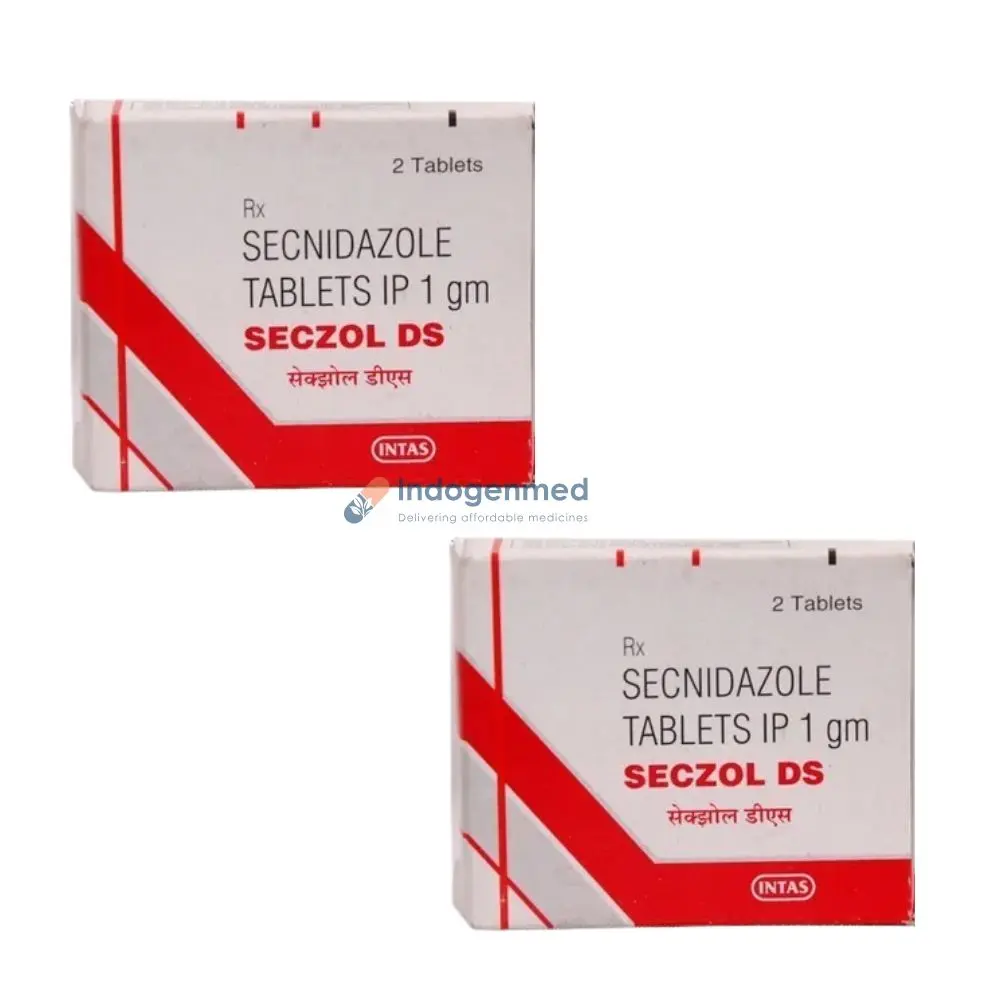
Seczol DS 1000 Mg Tablet – Secnidazole Antiprotozoal and Antibacterial
Seczol DS 1000 Mg Tablet is a prescription antiprotozoal and antibacterial medication manufactured by Intas Pharmaceuticals Ltd, one of India’s foremost pharmaceutical companies headquartered in Ahmedabad, Gujarat. It contains secnidazole 1000 mg as the active ingredient — a second-generation, long-acting member of the 5-nitroimidazole class of antimicrobials, the same chemical family as metronidazole and tinidazole.
Secnidazole is widely used in clinical practice for the treatment of a range of protozoal and anaerobic bacterial infections. Its key pharmacokinetic advantage over metronidazole is its significantly longer plasma elimination half-life of approximately 17 hours, which permits single-dose or once-daily dosing regimens for most indications — improving patient compliance and reducing the risk of incomplete treatment courses. The “DS” designation in Seczol DS refers to the double-strength 1000 mg tablet, as opposed to the standard 500 mg formulation.
Composition
Each Seczol DS tablet contains:
- Secnidazole IP: 1000 mg
Excipients include standard tablet-forming agents such as microcrystalline cellulose, starch, magnesium stearate, and a film coating. The tablets are supplied in strips of 2 tablets (1 × 2 blister pack), reflecting the typical single-dose or dual-dose regimens used for most indications.
How Seczol DS Works (Mechanism of Action)
Secnidazole is a prodrug that requires intracellular activation by susceptible microorganisms. After entering the microbial cell, the nitro group of secnidazole is reduced by bacterial and protozoal ferredoxin-linked enzymes (including nitroreductases and pyruvate:ferredoxin oxidoreductase in anaerobes) to generate highly reactive nitro radical anion intermediates. These radical species are cytotoxic: they interact with and cause strand breaks in microbial DNA, disrupting the helical structure of DNA and inhibiting further DNA synthesis and repair. This irreversible DNA damage leads to cell death.
Because this activation mechanism depends on the low-redox-potential electron transport systems found specifically in anaerobic bacteria and certain protozoa, secnidazole is selectively toxic to these organisms and does not damage aerobic human cells in the same way. This selectivity underpins its favourable therapeutic index.
Secnidazole is active against a broad range of clinically relevant pathogens including:
- Trichomonas vaginalis (trichomoniasis)
- Entamoeba histolytica (amoebiasis)
- Giardia lamblia / G. intestinalis (giardiasis)
- Anaerobic bacteria including Bacteroides fragilis, Gardnerella vaginalis, Prevotella spp., Fusobacterium spp., and others associated with bacterial vaginosis
- Clostridium spp. and other Gram-positive anaerobes
Indications and Uses
Seczol DS 1000 Mg Tablet is indicated for the treatment of the following infections:
Protozoal Infections
- Intestinal amoebiasis (amoebic dysentery) — caused by Entamoeba histolytica
- Amoebic liver abscess — extraintestinal amoebiasis
- Giardiasis — intestinal infection caused by Giardia lamblia
- Trichomoniasis — urogenital infection caused by Trichomonas vaginalis, in both women and men
Bacterial Infections
- Bacterial vaginosis — polymicrobial vaginal infection associated with overgrowth of anaerobic organisms including Gardnerella vaginalis and Prevotella spp.
- Prophylaxis and treatment of anaerobic bacterial infections in surgical settings (e.g., abdominal, colorectal, and gynaecological surgery)
- Adjunctive treatment in Helicobacter pylori eradication regimens (where nitroimidazole sensitivity is established)
Seczol DS is not effective against aerobic bacteria, fungi, or viruses. It should be used only where a susceptible protozoal or anaerobic bacterial infection is confirmed or strongly suspected.
Dosage and Administration
Always use Seczol DS 1000 Mg exactly as prescribed by your doctor. Dosage varies by indication:
Standard Adult Dosing
- Trichomoniasis: 2 g (2 × 1000 mg tablets) as a single oral dose. Sexual partners should be treated simultaneously.
- Bacterial vaginosis: 2 g (2 × 1000 mg tablets) as a single oral dose
- Giardiasis: 2 g (2 × 1000 mg tablets) as a single oral dose
- Intestinal amoebiasis: 2 g (2 × 1000 mg tablets) once daily for 3 days (total 6 g course)
- Amoebic liver abscess: 2 g (2 × 1000 mg tablets) once daily for 3–5 days, in combination with a tissue amoebicide such as diloxanide furoate
- Surgical prophylaxis (anaerobic infections): 2 g administered as a single pre-operative dose, typically 1–2 hours before the procedure
Administration Instructions
- Swallow tablets whole with a full glass of water
- May be taken with or without food; taking with food reduces the risk of gastrointestinal side effects
- Avoid alcohol during treatment and for at least 48 hours (2 days) after completing the course — see Drug Interactions
Special Populations
- Children: Paediatric dosing is weight-based (typically 30 mg/kg/day); consult a physician for specific paediatric regimens
- Elderly: No dose adjustment is specifically required; use with standard caution in patients with significant hepatic impairment
- Renal impairment: No dose adjustment required for mild to moderate renal impairment. Approximately 15% of the dose is excreted unchanged in urine
- Hepatic impairment: Secnidazole undergoes minimal hepatic metabolism (<1% via CYP450 oxidation). Use with caution in severe hepatic impairment
- Pregnancy: Not recommended in the first trimester; use with caution in the second and third trimesters only if clearly indicated (see Contraindications)
- Breastfeeding: Breastfeeding should be suspended for at least 96 hours after the last dose (see Precautions)
Pharmacokinetics
Understanding secnidazole’s pharmacokinetic profile helps explain its clinical dosing advantages:
- Absorption: Well absorbed orally; food has no clinically significant effect on bioavailability
- Peak plasma concentration (Cmax): Approximately 45 mcg/mL after a 2 g dose; reached at approximately 4 hours post-dose (Tmax)
- Volume of distribution: Approximately 42 litres — indicating good tissue penetration including into the intestinal mucosa, liver, and urogenital tract
- Protein binding: Less than 5% — predominantly unbound in plasma
- Metabolism: Minimal hepatic metabolism (<1% converted to metabolites)
- Elimination half-life: Approximately 17 hours — significantly longer than metronidazole (~8 hours) or tinidazole (~12 hours), enabling single-dose or once-daily regimens
- Excretion: Approximately 15% excreted unchanged in urine
Side Effects
Seczol DS is generally well tolerated, particularly at the single-dose and short-course regimens used for most indications.
Common (affects more than 1 in 100 users)
- Nausea
- Dysgeusia — an unpleasant or metallic taste in the mouth (a class effect of nitroimidazoles)
- Headache
- Diarrhoea
- Abdominal pain or cramping
- Vomiting
Uncommon
- Vulvovaginal candidiasis — overgrowth of Candida species following disruption of normal vaginal flora
- Dizziness or vertigo
- Vulvovaginal pruritus (itching)
- Furry tongue or dry mouth
Rare / Serious (reported with nitroimidazole class)
- Peripheral neuropathy: Numbness, tingling, or pain in the hands or feet — most commonly associated with prolonged high-dose use. Discontinue if neurological symptoms develop.
- Central nervous system effects: Seizures, encephalopathy, optic neuropathy — rare; reported with high-dose or prolonged nitroimidazole use
- Severe skin reactions: Stevens-Johnson syndrome, toxic epidermal necrolysis — very rare
- Blood dyscrasias: Leucopenia, thrombocytopenia — rare; monitor in patients with pre-existing haematological conditions
- Disulfiram-like reaction with alcohol — see Drug Interactions
If you experience unusual neurological symptoms (tingling, numbness, coordination difficulties), severe skin rashes, or signs of blood disorders (unusual bruising or bleeding, unexplained fatigue), stop the medication and seek medical advice immediately.
Precautions and Warnings
Alcohol Avoidance is Essential
Secnidazole, like all nitroimidazoles, inhibits aldehyde dehydrogenase and can cause a disulfiram-like reaction when taken with alcohol. Symptoms include severe nausea, vomiting, flushing, palpitations, headache, and abdominal cramps. Patients must avoid all alcoholic beverages, alcohol-containing medications, and products containing propylene glycol during treatment and for at least 48 hours after the last dose. For single-dose treatment, this means 48 hours of alcohol avoidance starting from the time of the dose.
Breastfeeding
Secnidazole is excreted into breast milk. Because of the drug’s long half-life (approximately 17 hours), breastfeeding should be suspended for at least 96 hours (4 days) after a single 2 g dose. Breast milk expressed during this period should be discarded. After 96 hours, breastfeeding may be resumed.
Cockayne Syndrome
Serious hepatotoxicity, including fatalities, has been reported in patients with Cockayne syndrome (a rare genetic disorder) who received metronidazole or tinidazole. The same risk is presumed to apply to secnidazole. Patients with Cockayne syndrome should not receive Seczol DS.
Carcinogenicity
Nitroimidazoles including metronidazole have demonstrated carcinogenic potential in rodent studies following chronic, high-dose administration. The clinical relevance to humans, particularly after single-dose or short-course treatment, is not established. Unnecessary or prolonged use should be avoided.
Peripheral Neuropathy
Although peripheral neuropathy is primarily associated with prolonged high-dose nitroimidazole use, any neurological symptoms — tingling, numbness, or weakness in the extremities — emerging during treatment should prompt discontinuation and medical review.
Superinfection
Use of Seczol DS may disrupt normal microbial flora and predispose patients to secondary infections, including vulvovaginal candidiasis. If symptomatic candidiasis develops, appropriate antifungal therapy should be initiated.
Hepatic Impairment
Secnidazole undergoes minimal hepatic metabolism, but caution is warranted in severe hepatic impairment. Monitor for signs of drug accumulation in patients with significant liver disease.
Drug Interactions
- Alcohol and alcohol-containing products: CONTRAINDICATED during treatment and for 48 hours after the last dose — causes disulfiram-like reaction (nausea, vomiting, flushing, tachycardia, headache)
- Disulfiram: Concurrent use is contraindicated — psychotic reactions and confusional states have been reported with the metronidazole-disulfiram combination; presume the same risk applies to secnidazole. Allow at least 2 weeks between stopping disulfiram and starting secnidazole.
- Warfarin and oral anticoagulants: Nitroimidazoles can enhance the anticoagulant effect of warfarin by inhibiting its hepatic metabolism. Monitor INR closely if co-administration is necessary; dose adjustment of warfarin may be required.
- Combined oral contraceptives (ethinyl estradiol/norethindrone): Co-administration may reduce Cmax of ethinyl estradiol by approximately 29%, without a significant change in overall exposure (AUC). No dose adjustment is required, but patients should be advised of a possible transient reduction in contraceptive efficacy; use additional contraceptive precautions during and for one cycle after treatment.
- Lithium: Nitroimidazoles may elevate lithium plasma concentrations; monitor lithium levels in patients on lithium therapy.
- Busulfan: Metronidazole (a related nitroimidazole) has been shown to increase busulfan plasma levels. Avoid concurrent use with secnidazole if possible.
- CYP450 substrates: Secnidazole undergoes minimal hepatic CYP450 metabolism and is unlikely to cause significant interactions with CYP450-metabolised drugs at single-dose therapeutic levels.
Contraindications
Seczol DS 1000 Mg must NOT be used in patients with:
- Known hypersensitivity to secnidazole, metronidazole, tinidazole, or any other nitroimidazole derivative
- Cockayne syndrome — risk of severe hepatotoxicity
- First trimester of pregnancy — insufficient safety data; theoretical teratogenic risk based on animal and in vitro genotoxicity studies
- Current use of disulfiram or within the preceding 2 weeks
- Patients who cannot abstain from alcohol for the required abstinence period
- Active central nervous system disease (epilepsy, multiple sclerosis, or other demyelinating disorders) where nitroimidazole-induced neurotoxicity risk is elevated
- Blood dyscrasias — a history of leucopenia or other haematological abnormalities is a relative contraindication; weigh risk vs. benefit
Storage Instructions
- Store below 30°C in a cool, dry place
- Protect from direct sunlight and moisture
- Keep the strip pack sealed until use
- Keep out of reach and sight of children
- Do not use after the expiry date printed on the strip
Related Products
Patients being treated for protozoal, anaerobic bacterial, or related infections may also find these IndoGenMed product pages relevant:
- Roxid 150 Tablet (Roxithromycin 150 mg) – Macrolide Antibiotic for Respiratory and Soft Tissue Infections
- Roza 30 Gm Gel (Metronidazole 0.75%) – Topical Gel for Rosacea
- Skin Lite 20 Gm Cream (Hydroquinone + Mometasone + Tretinoin) – Triple Combination for Melasma
- Nicardia CD 30 Tablet (Nifedipine 30 mg) – Extended-Release Calcium Channel Blocker
- Suminat Nasal 20 Mcg/Dose Nasal Spray (Sumatriptan) – Acute Migraine Treatment
References
- U.S. Food and Drug Administration. SOLOSEC (secnidazole) 2 g oral granules — Full Prescribing Information. Lupin Pharmaceuticals Inc.; revised June 2021. Available at: accessdata.fda.gov
- MedlinePlus (U.S. National Library of Medicine). Secnidazole. Available at: medlineplus.gov/druginfo/meds/a617052.html
- Mayo Clinic. Secnidazole (Oral Route) — Description and Brand Names. Available at: mayoclinic.org
- U.S. National Library of Medicine, DailyMed. Secnidazole drug information. Available at: dailymed.nlm.nih.gov
Reviews
There are no reviews yet.