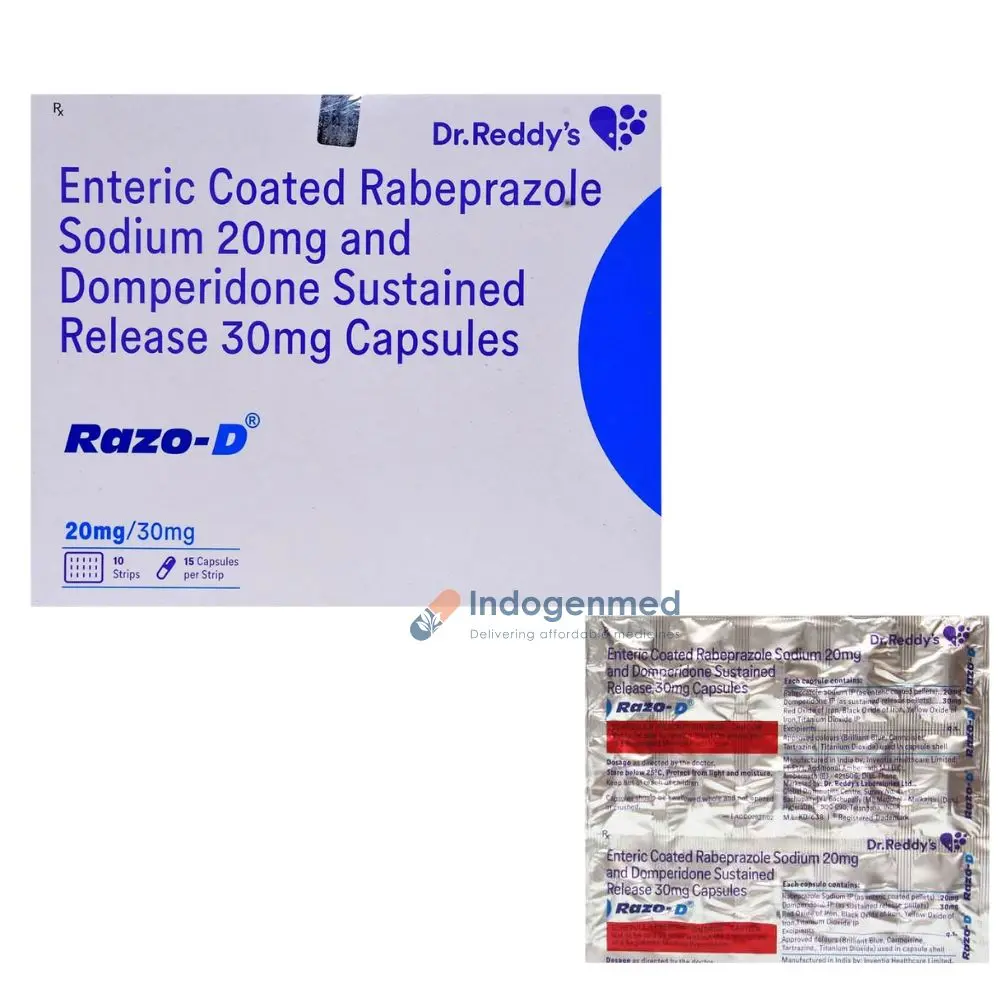
Description
What Is Razo-D 30+20 mg Tablets?
Razo-D 30+20 mg Tablets contain a fixed-dose combination of domperidone 30 mg + rabeprazole sodium 20 mg per tablet. This combination pairs a proton pump inhibitor (PPI) with a gastroprokinetic antiemetic, addressing two complementary components of acid-related upper gastrointestinal disorders: acid suppression and impaired gastric motility. Rabeprazole is a benzimidazole-class PPI that irreversibly inhibits the gastric H+/K+-ATPase proton pump. Domperidone is a selective dopamine D2/D3 receptor antagonist acting peripherally at the gastric wall and chemoreceptor trigger zone, enhancing gastric emptying and reducing nausea. The combination is widely used in India and South Asia for GERD with dysmotility, functional dyspepsia, and drug-induced nausea (such as that occurring with levodopa, diclofenac, or opioids). Razo is Dr Reddy’s Laboratories’ established brand name for rabeprazole.
Mechanism of Action
Rabeprazole Sodium (PPI — 20 mg)
Rabeprazole is a prodrug that undergoes acid-catalysed activation in the secretory canaliculi of gastric parietal cells. The activated sulphenamide form binds covalently to cysteine residues (Cys813 and Cys892) of the H+/K+-ATPase proton pump, irreversibly inhibiting the final step of gastric acid secretion. Because activation of rabeprazole occurs at a lower pH than omeprazole or lansoprazole, it may achieve slightly faster onset of acid suppression. Acid secretion recovers only when new H+/K+-ATPase molecules are synthesised, giving a prolonged duration of effect exceeding the drug’s short plasma half-life. Rabeprazole undergoes predominantly non-enzymatic metabolism, reducing the influence of CYP2C19 polymorphism on efficacy compared with omeprazole and esomeprazole.
Domperidone (Gastroprokinetic/Antiemetic — 30 mg)
Domperidone is a selective antagonist at peripheral dopamine D2 and D3 receptors. It acts at:
- Gastric and intestinal wall: Blockade of inhibitory D2 receptors in gastric smooth muscle enhances gastric peristalsis, accelerates gastric emptying, and improves antroduodenal coordination — reversing the gastroparesis and delayed gastric emptying that contribute to dysmotility symptoms (bloating, nausea, early satiety, postprandial distension)
- Lower oesophageal sphincter (LOS): Domperidone increases LOS tone, reducing gastro-oesophageal reflux
- Chemoreceptor trigger zone (CTZ): The CTZ is located in the area postrema, which lies outside the blood-brain barrier; domperidone’s poor CNS penetration allows it to act at the CTZ D2 receptors to suppress nausea and vomiting, without the central dopaminergic side effects (extrapyramidal reactions, tardive dyskinesia) seen with metoclopramide
Indications
- Gastro-oesophageal reflux disease (GERD) with dysmotility: Rabeprazole suppresses acid; domperidone improves gastric emptying and raises LOS pressure, addressing both the acid component and the motility defect that permits acid reflux
- Functional dyspepsia: Combination therapy targeting both acid hypersecretion and impaired gastric emptying in patients with dyspeptic symptoms not attributed to structural disease
- Drug-induced nausea and gastroparesis: Domperidone is the preferred prokinetic antiemetic for nausea associated with dopaminergic drugs (particularly levodopa/carbidopa in Parkinson’s disease) because it does not cross the blood-brain barrier and does not exacerbate dopamine deficiency centrally. The rabeprazole component is useful when concurrent PPI therapy is required (e.g. with diclofenac, NSAIDs)
- Peptic ulcer disease (adjunct): Razo-D may be used as part of Helicobacter pylori eradication regimens where the PPI component is required
- Post-operative nausea: Domperidone’s antiemetic properties are used perioperatively
Dosage and Administration
- Adults: One tablet of Razo-D 30+20 mg taken 30 minutes before meals, once or twice daily as directed by the prescriber
- Duration: Short-term (4–8 weeks) for GERD and peptic ulcer healing; long-term use at the lowest effective dose for maintenance of healed GERD. Duration of domperidone therapy should be minimised due to cardiac risk (see warnings)
- Children: This combination in a fixed 30/20 mg dose is not appropriate for paediatric use
- Hepatic impairment: Severe hepatic impairment — both components require caution; domperidone is contraindicated in severe hepatic disease; rabeprazole dose reduction may be needed
- Renal impairment: No rabeprazole dose adjustment required; domperidone — use with caution in renal impairment
Critical Safety Warning — Domperidone and Cardiac Risk
Domperidone carries a class warning regarding QTc interval prolongation and risk of serious ventricular arrhythmia including torsades de pointes. This risk has led to withdrawal of high-dose domperidone preparations in several countries, and regulatory restriction to the lowest effective dose for the shortest duration in others. Key precautions:
- Avoid in patients with known QTc prolongation, electrolyte disturbances (hypokalaemia, hypomagnesaemia), or significant cardiac disease
- Avoid concomitant use with other QTc-prolonging drugs or strong CYP3A4 inhibitors (which increase domperidone plasma concentration)
- The 30 mg dose in Razo-D represents a higher-than-minimum domperidone dose; use the lowest effective dose and duration
- MHRA (UK) has restricted domperidone to 10 mg three times daily maximum in adults; some markets retain higher-dose products for specific indications under specialist supervision
Contraindications
- Hypersensitivity to rabeprazole, domperidone, benzimidazoles, or any excipient
- Prolactin-secreting pituitary tumour (prolactinoma) — domperidone raises prolactin levels
- Gastrointestinal perforation, obstruction, or haemorrhage where stimulation of GI motility is dangerous
- Known cardiac disease with QTc prolongation or congenital long QT syndrome
- Concurrent use of strong CYP3A4 inhibitors that prolong QTc (e.g. azole antifungals, macrolide antibiotics, HIV protease inhibitors, amiodarone)
- Severe hepatic impairment (domperidone component)
Warnings and Precautions
- Masking of underlying serious GI disease: PPI therapy can mask symptoms of gastric carcinoma; exclude malignancy before long-term use, particularly in patients with alarm features (dysphagia, unexplained weight loss, haematemesis, iron-deficiency anaemia, persistent vomiting)
- Long-term PPI effects: Prolonged PPI use may reduce calcium, magnesium, and vitamin B12 absorption; increase risk of Clostridioides difficile infection; reduce efficacy of clopidogrel (via CYP2C19 inhibition, less relevant with rabeprazole than omeprazole)
- Hypergastrinaemia: Prolonged acid suppression elevates gastrin; monitor during extended use
- Hyperprolactinaemia: Domperidone raises prolactin; may cause galactorrhoea, amenorrhoea, gynaecomastia, and reduced libido; relevant with prolonged use
- Electrolyte monitoring: Hypokalaemia and hypomagnesaemia increase domperidone cardiac risk; monitor electrolytes in at-risk patients
Adverse Effects
- Rabeprazole: Headache; diarrhoea; nausea; abdominal pain; flatulence; insomnia; hypomagnesaemia (prolonged use); hyponatraemia; increased risk of enteric infections (C. difficile)
- Domperidone: Dry mouth; headache; hyperprolactinaemia (galactorrhoea, gynaecomastia, menstrual disturbance); QTc prolongation; extrapyramidal reactions (rare — lower risk than metoclopramide due to limited CNS penetration)
- Serious (rare): Ventricular arrhythmia (torsades de pointes); hepatotoxicity (rabeprazole); anaphylaxis; interstitial nephritis (class PPI effect)
Drug Interactions
- Strong CYP3A4 inhibitors (ketoconazole, clarithromycin, erythromycin, ritonavir, amiodarone): Markedly increase domperidone exposure and QTc prolongation risk; contraindicated with domperidone
- Atazanavir, nelfinavir: PPI reduces their absorption by raising gastric pH; avoid concurrent PPI use
- Clopidogrel: Rabeprazole has less CYP2C19 inhibition than omeprazole/esomeprazole and is preferred PPI choice in patients on clopidogrel
- Ketoconazole, posaconazole, itraconazole: Absorption depends on acidic gastric pH; reduced by PPI; separate by 2 hours or switch to a different antifungal
- QTc-prolonging drugs (antipsychotics, antiarrhythmics, fluoroquinolones): Additive QTc risk with domperidone
- Anticholinergic drugs: Antagonise domperidone’s prokinetic effects
Storage
Store Razo-D 30+20 mg Tablets below 25°C in a dry place, protected from moisture and direct sunlight. Keep in the original blister pack until use. Keep out of reach of children. Do not use after the expiry date printed on the pack.
Related Products
- Voveran GE 50 mg Tablets (diclofenac sodium 50 mg gastro-resistant — NSAID frequently requiring concurrent PPI gastroprotection; Razo-D is a natural complement)
- Syndopa 25/250 mg Tablets (carbidopa 25 mg + levodopa 250 mg — levodopa-induced nausea is best managed with domperidone, the same agent in Razo-D, rather than centrally-acting antiemetics)
- Suminat 25 mg Tablets (sumatriptan 25 mg — NSAID co-therapy with Razo-D PPI gastroprotection may be used adjunctively for migraine)
References
- DailyMed. Rabeprazole sodium delayed-release tablets — prescribing information. U.S. National Library of Medicine. Available at: https://dailymed.nlm.nih.gov/dailymed/
- Electronic Medicines Compendium (EMC). Domperidone 10 mg tablets — Summary of Product Characteristics. Available at: https://www.medicines.org.uk/emc/
- MedlinePlus. Rabeprazole. U.S. National Library of Medicine. Available at: https://medlineplus.gov/druginfo/meds/a699060.html
- MHRA Drug Safety Update. Domperidone: risks of cardiac side effects — indication restricted to nausea and vomiting, new contraindications, and reduced dose and duration. 2014. Available at: https://www.gov.uk/drug-safety-update/
- Mayo Clinic. Rabeprazole (Oral Route). Available at: https://www.mayoclinic.org/

Reviews
There are no reviews yet.