Description
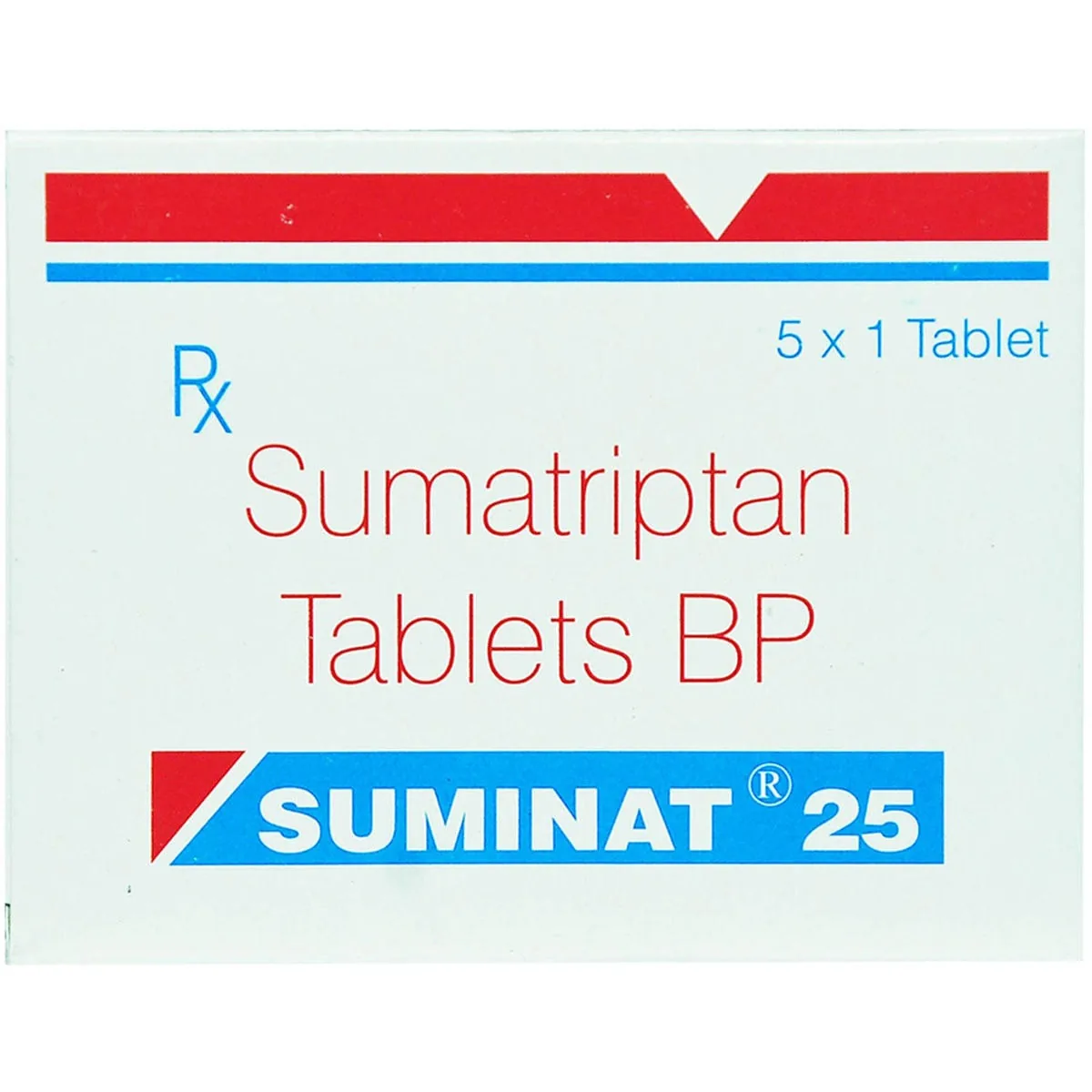
What Is Suminat 25 mg Tablets?
Suminat 25 mg Tablets contain sumatriptan succinate equivalent to sumatriptan 25 mg per tablet, formulated as an oral immediate-release tablet. Sumatriptan is a selective serotonin 5-HT1B/1D receptor agonist — the original and most widely studied member of the triptan class. It is indicated for the acute treatment of migraine attacks with or without aura in adults, and for the acute treatment of cluster headache episodes. The 25 mg dose is the lowest available oral strength and is used as a starting dose in patients who are triptan-naïve, in those with a history of adverse effects at higher doses, or in patients with significant cardiovascular risk factors where a lower dose is clinically preferred. The 50 mg and 100 mg oral doses are more commonly used. Sumatriptan does not prevent migraine — it is a rescue medication taken at the onset of an attack.
Mechanism of Action
Sumatriptan is a selective agonist at two serotonin receptor subtypes: 5-HT1B (located on intracranial blood vessels) and 5-HT1D (located on trigeminal sensory nerve terminals and in the trigeminal nucleus caudalis). Its antimigraine effects arise from three complementary mechanisms:
- Cranial vasoconstriction: Activation of 5-HT1B receptors on the smooth muscle of meningeal, dural, and cerebral arteries causes selective vasoconstriction of distended, pulsatile cranial vessels, reversing the vasodilation that contributes to the throbbing pain of migraine. Sumatriptan has minimal effect on systemic arteries at therapeutic doses, conferring selectivity for cranial vasculature
- Inhibition of neuropeptide release: Activation of presynaptic 5-HT1D receptors on trigeminal nerve terminals inhibits the release of pro-inflammatory neuropeptides — calcitonin gene-related peptide (CGRP), substance P, and neurokinin A — from perivascular trigeminal fibres. These neuropeptides mediate neurogenic inflammation in the dural vasculature, a key step in migraine pathophysiology
- Central trigeminal pain inhibition: 5-HT1D receptors in the trigeminal nucleus caudalis modulate central pain processing; activation reduces the central amplification of nociceptive signals arising from the trigeminovascular system
The net result is rapid relief of migraine headache, associated photophobia, phonophobia, and nausea by interrupting the trigeminovascular pain cascade.
Indications
- Acute treatment of migraine attacks (with or without aura): Suminat 25 mg is taken at the onset of a migraine headache phase. It may be taken during the aura phase but its efficacy is established for headache, not aura reversal. Recommended for patients who do not respond adequately to simple analgesics (aspirin, ibuprofen, paracetamol) plus antiemetics
- Cluster headache (oral formulation limitations): Sumatriptan is effective for cluster headache, but the oral route has relatively slow onset (30–90 minutes). The subcutaneous injectable form is preferred for cluster headache attacks, which are brief and extremely severe. The 25 mg oral tablet is of limited practical use for cluster headache where rapid relief is essential
Dosage and Administration
Migraine — Oral Sumatriptan
- Adults: 25 mg orally at the onset of headache. If the initial dose provides partial or no relief, a second dose may be taken after a minimum interval of 2 hours. Maximum dose in 24 hours: 300 mg (oral)
- If the first dose has no effect: A second dose for the same attack is unlikely to help; use an alternative analgesic. The second dose is intended for recurrence (return of headache after initial relief)
- Children and adolescents under 18 years: Not recommended — safety and efficacy not established for oral sumatriptan in paediatric migraine
- Elderly (>65 years): Limited experience; use with caution; cardiovascular assessment recommended before initiation
- Hepatic impairment: Maximum dose 50 mg per attack due to reduced first-pass metabolism and higher systemic exposure; use with caution in severe hepatic impairment
- Renal impairment: No dose adjustment required for mild to moderate renal impairment
When to Take It
Take Suminat 25 mg as early as possible in the headache phase of a migraine attack. Swallow the tablet whole with water; it may be taken with or without food, though absorption may be slightly delayed with food. Do not use more than 2–3 times per week to avoid medication overuse headache (MOH).
Pharmacokinetics
- Absorption: Oral bioavailability approximately 14–17% due to significant first-pass hepatic metabolism. Tmax approximately 2 hours after oral dosing; slightly delayed with food
- Distribution: Protein binding approximately 14–21%; volume of distribution approximately 170 litres
- Metabolism: Primarily MAO-A-mediated oxidative deamination to inactive indoleacetic acid metabolite. CYP450 enzymes play a minor role
- Elimination: Renal excretion of metabolites; terminal half-life approximately 2 hours
Contraindications
- Hypersensitivity to sumatriptan or any excipient
- Ischaemic heart disease (angina pectoris, previous myocardial infarction, coronary artery disease) — sumatriptan causes coronary vasoconstriction
- Peripheral vascular disease
- Previous cerebrovascular accident (stroke) or transient ischaemic attack (TIA)
- Uncontrolled hypertension
- Concurrent use of or use within 24 hours of another triptan or ergotamine/ergot alkaloid
- Concurrent use of or use within 2 weeks of a monoamine oxidase inhibitor (MAOI) — sumatriptan is metabolised by MAO-A; MAOIs increase exposure fivefold
- Hemiplegic migraine, basilar migraine, or ophthalmoplegic migraine — potential risk of stroke; not recommended
- Severe hepatic impairment
Warnings and Precautions
- Cardiovascular assessment before first use: Sumatriptan should not be given to patients with known or suspected cardiovascular disease. In women over 40 years, men over 30 years, and patients with cardiovascular risk factors (smoking, hypertension, hyperlipidaemia, obesity, diabetes, family history), a cardiovascular evaluation before prescribing is recommended
- Chest tightness/pressure: Heaviness, tightness, or pressure in the chest, throat, or jaw is reported after sumatriptan; in most cases it is not cardiac in origin but cardiac causes must be excluded before continuing therapy
- Serotonin syndrome: Risk is increased with concurrent use of SSRIs, SNRIs, MAOIs, or other serotonergic drugs. Features include agitation, confusion, hyperthermia, diaphoresis, myoclonus, and autonomic instability; discontinue and seek emergency care if suspected
- Medication overuse headache (MOH): Use of acute migraine therapy on 10 or more days per month for more than 3 months may cause MOH (also called analgesic rebound headache). Sumatriptan use should be limited to no more than 2–3 days per week. MOH requires withdrawal of the overused medication and preventive migraine treatment
- Seizures: Sumatriptan may lower seizure threshold; use with caution in patients with epilepsy or at increased seizure risk
- Allergy to sulfonamides: There is a theoretical cross-sensitivity; monitor patients with documented sulfonamide hypersensitivity
Adverse Effects
- Very common (>10%): Sensations of tingling, heat, heaviness, pressure, or tightness (not cardiac in most cases); dizziness; flushing
- Common (1–10%): Nausea; vomiting; fatigue; drowsiness; chest pain or tightness; dysphagia; myalgia
- Uncommon: Bradycardia; tachycardia; hypertension; hypotension; hypersensitivity reactions
- Rare: Coronary artery vasospasm; myocardial infarction (in patients with underlying CAD); seizures; serotonin syndrome; ischaemic colitis; Raynaud’s phenomenon; anaphylaxis/anaphylactoid reactions
Drug Interactions
- MAO-A inhibitors (phenelzine, tranylcypromine, moclobemide): Contraindicated — markedly increase sumatriptan plasma concentrations (by reducing MAO-A metabolism). Do not use sumatriptan within 2 weeks of stopping an irreversible MAOI; for reversible MAOIs (moclobemide), one day washout minimum
- Ergotamine and ergot derivatives: Additive vasoconstrictive effects; do not use within 24 hours of each other
- Other triptans: Do not combine; additive vasoconstriction risk; 24-hour separation required
- SSRIs, SNRIs, lithium, tramadol: Increased serotonin syndrome risk; use with caution; monitor for serotonergic toxicity
- St John’s Wort (Hypericum perforatum): Serotonergic interaction; additive risk; avoid concurrent use
Storage
Store Suminat 25 mg Tablets below 30°C, away from direct sunlight and moisture. Keep in the original blister pack until use. Keep out of reach of children. Do not use after the expiry date printed on the pack.
Related Products
- Suminat 100 mg Tablets (sumatriptan 100 mg — higher standard dose for migraine in patients who tolerate and require stronger treatment)
- Voveran GE 50 mg Tablets (diclofenac sodium 50 mg gastro-resistant — NSAID used for mild-to-moderate migraine attacks where triptans are not needed or not tolerated)
References
- DailyMed. Imitrex (sumatriptan succinate) tablets — prescribing information. U.S. National Library of Medicine. Available at: https://dailymed.nlm.nih.gov/dailymed/
- Electronic Medicines Compendium (EMC). Imigran 50 mg tablets (sumatriptan) — Summary of Product Characteristics. Available at: https://www.medicines.org.uk/emc/
- MedlinePlus. Sumatriptan. U.S. National Library of Medicine. Available at: https://medlineplus.gov/druginfo/meds/a601116.html
- Mayo Clinic. Sumatriptan (Oral Route) — Description and Brand Names. Available at: https://www.mayoclinic.org/
- Goadsby PJ, et al. Pathophysiology of Migraine: A Disorder of Sensory Processing. Physiological Reviews. 2017;97(2):553–622. Available at: https://pubmed.ncbi.nlm.nih.gov/28179394/



Reviews
There are no reviews yet.