Description
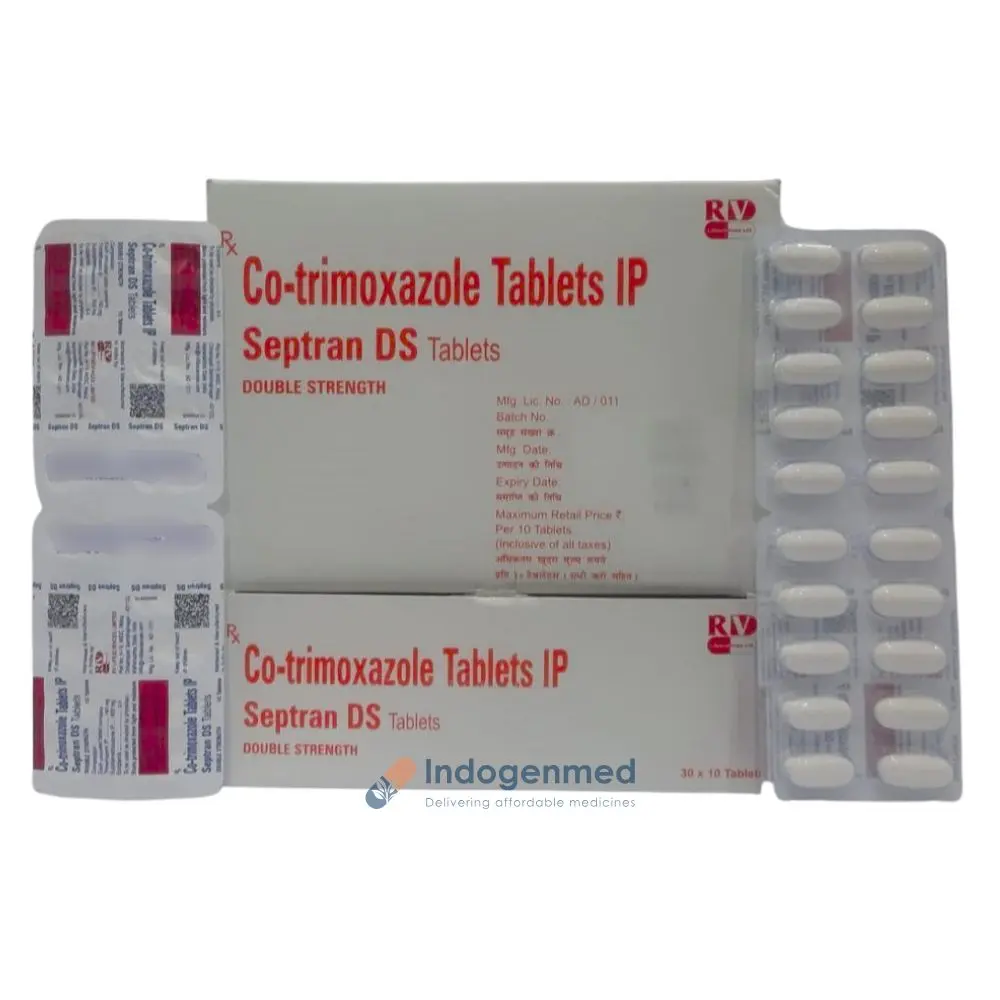
What Is Septran 400+80 mg Tablet?
Septran Tablet contains a fixed-dose combination of sulfamethoxazole 400 mg and trimethoprim 80 mg — the standard single-strength (SS) formulation of co-trimoxazole, also known as Bactrim, Septrin, or simply co-trimoxazole SS. The double-strength (DS) tablet (sulfamethoxazole 800 mg + trimethoprim 160 mg) is typically used for most adult infections, while the single-strength formulation is used in lower-dose situations, paediatric dosing (as a divisible/titration unit), and for PCP prophylaxis protocols that specify SS. Co-trimoxazole is a WHO Essential Medicine that combines sequential inhibition of bacterial folate synthesis with a potent synergistic bactericidal effect. Septran is the branded Indian generic name used in IndoGenMed’s international market.
Mechanism of Action
Co-trimoxazole exerts its antimicrobial effect through a dual sequential blockade of bacterial tetrahydrofolate synthesis — a pathway essential for nucleotide and DNA synthesis in bacteria that cannot take up exogenous folate from their environment:
- Sulfamethoxazole is a structural analogue of para-aminobenzoic acid (PABA). It competitively inhibits dihydropteroate synthase (DHPS), preventing PABA from being incorporated into dihydropteroate — blocking the first committed step of bacterial folate synthesis.
- Trimethoprim inhibits dihydrofolate reductase (DHFR), blocking the reduction of dihydrofolate to tetrahydrofolate. Trimethoprim binds bacterial DHFR with ~50,000-fold greater affinity than mammalian DHFR, conferring excellent selective toxicity in humans.
- Sequential synergy: Blocking two consecutive steps in the same pathway produces synergistic bactericidal activity. Each component is bacteriostatic alone; together they achieve bactericidal activity against many organisms at considerably lower concentrations than either drug alone — the basis for the 1:5 trimethoprim:sulfamethoxazole weight ratio in every co-trimoxazole tablet.
- Spectrum: Active against many Gram-positive and Gram-negative organisms including Staphylococcus aureus (including community-acquired MRSA), Streptococcus pneumoniae (variable — increased resistance), Escherichia coli (UTI; check local resistance), Klebsiella spp. (variable), Haemophilus influenzae, Listeria monocytogenes, Nocardia spp., Stenotrophomonas maltophilia, Pneumocystis jirovecii, Toxoplasma gondii, and Cyclospora cayetanensis.
Indications
- Urinary tract infections (UTIs): Uncomplicated cystitis (use if local E. coli resistance <20%); complicated UTI and pyelonephritis. Single-strength dose: 2 SS tablets twice daily (= 1 DS tablet twice daily). For uncomplicated cystitis: 3-day course. For pyelonephritis: 10–14 days.
- Respiratory tract infections: Acute exacerbations of chronic bronchitis (susceptible H. influenzae, S. pneumoniae). Standard adult dosing: 2 SS tablets twice daily × 10–14 days.
- Pneumocystis jirovecii pneumonia (PCP) prophylaxis: 1 SS tablet daily is an accepted alternative prophylaxis regimen to 1 DS tablet daily in HIV-positive patients with CD4 <200 cells/µL and in patients on immunosuppressive therapy (organ transplant, high-dose corticosteroids). Some clinicians prefer SS dosing for prophylaxis to reduce adverse effects.
- MRSA skin and soft-tissue infections (SSTIs): 2 SS tablets (= 1 DS tablet) twice daily for 5–10 days depending on severity.
- Traveller’s diarrhoea/shigellosis: 2 SS tablets twice daily for 5 days where co-trimoxazole is still active against Shigella.
- Nocardiosis, toxoplasmosis prophylaxis, cyclospora: As for DS formulation; doses expressed as SS tablets require doubling of SS tablet count vs DS instructions.
- Paediatric use: Children’s doses are calculated per kg (trimethoprim 8 mg/kg/day in 2 divided doses) — the SS tablet is a convenient unit for weight-based dosing in older children when liquid formulations are unavailable.
Dosage and Administration
Each Septran SS tablet contains sulfamethoxazole 400 mg + trimethoprim 80 mg. Standard adult doses require 2 SS tablets as the equivalent of 1 DS tablet.
Standard Adult Doses (expressed as SS tablets)
- UTI (uncomplicated cystitis): 2 SS tablets twice daily × 3 days
- UTI (complicated/pyelonephritis): 2 SS tablets twice daily × 10–14 days
- Respiratory tract infection: 2 SS tablets twice daily × 10–14 days
- MRSA SSTI: 2 SS tablets twice daily × 5–10 days
- PCP prophylaxis (alternative SS dosing): 1 SS tablet once daily
- PCP prophylaxis (standard DS-equivalent dosing via SS): 2 SS tablets once daily
- Take with a full glass of water; maintain adequate hydration (>1.5 L/day) to minimise crystalluria risk
Dose Adjustment
- Renal impairment: Full dose at eGFR ≥30 mL/min/1.73 m². Use with caution and reduced dose at eGFR 15–30. Avoid at eGFR <15 unless plasma level monitoring available (accumulation risk of crystalluria, hyperkalaemia, and haematotoxicity).
- Hepatic impairment: Use with caution in significant hepatic impairment.
- Elderly: Increased risk of hyperkalaemia (trimethoprim blocks renal potassium excretion), haematotoxicity, and cutaneous adverse effects; monitor potassium and renal function.
Contraindications
- Hypersensitivity to sulfonamides, trimethoprim, or any excipient — prior Stevens-Johnson syndrome or toxic epidermal necrolysis due to sulfonamide is an absolute contraindication
- Severe renal impairment (eGFR <15 mL/min/1.73 m²) — unless regular plasma concentration monitoring is performed
- Severe hepatic impairment
- Megaloblastic anaemia due to folate deficiency — co-trimoxazole further impairs folate metabolism
- Pregnancy (first trimester) — trimethoprim is a folate antagonist; sulfonamides avoided near term due to neonatal hyperbilirubinaemia risk
- Neonates and infants under 6 weeks of age — sulfonamides displace bilirubin from albumin, risking kernicterus
- Concurrent dofetilide use — contraindicated (trimethoprim markedly increases dofetilide plasma levels via renal tubular secretion inhibition, risking serious QT prolongation and torsades de pointes)
Warnings and Precautions
Serious Skin Reactions
Sulfonamides carry a risk of life-threatening cutaneous reactions including Stevens-Johnson syndrome (SJS) and toxic epidermal necrolysis (TEN), typically occurring within the first weeks of therapy. Patients should be instructed to discontinue immediately and seek urgent medical attention at the first sign of a rash. Do not rechallenge after any sulfonamide-associated skin reaction.
Hyperkalaemia
Trimethoprim acts as a potassium-sparing diuretic (via ENaC blockade in the collecting duct), raising serum potassium significantly in a clinically meaningful proportion of patients. Risk is amplified by: renal impairment, ACE inhibitors, ARBs, spironolactone, NSAIDs, diabetes, and older age. Monitor serum potassium (and creatinine/eGFR) in at-risk patients within the first 1–2 weeks of therapy and after dose changes.
Haematological Toxicity
Dose-dependent bone marrow suppression may occur — particularly with prolonged courses, in folate-deficient patients, or in those receiving concurrent antifolates (methotrexate, azathioprine). Monitor full blood count during prolonged therapy or high-dose PCP treatment courses. Leucovorin (folinic acid) can be given to prevent haematological toxicity during high-dose PCP regimens without antagonising co-trimoxazole’s antimicrobial effect (folinic acid rescues mammalian cells but bacteria cannot use exogenous folate).
Creatinine Elevation (Tubular, Not Glomerular)
Trimethoprim competitively inhibits tubular secretion of creatinine, commonly raising measured serum creatinine by 10–20% without any true reduction in GFR. This is a well-recognised artefact — it can be confused with renal deterioration but does not reflect actual nephrotoxicity. Cystatin C-based eGFR is unaffected by this mechanism and can help distinguish true from apparent renal impairment during co-trimoxazole therapy.
Adverse Effects
- Common: Nausea, vomiting, anorexia, diarrhoea, abdominal pain; skin rash; headache; raised serum creatinine (tubular artefact — does not indicate renal damage)
- Uncommon: Hyperkalaemia; hyponatraemia; elevated liver transaminases; photosensitivity; pruritus; thrombocytopenia; neutropenia
- Rare/serious: Stevens-Johnson syndrome; toxic epidermal necrolysis; agranulocytosis; aplastic anaemia; hepatic necrosis; aseptic meningitis; drug-induced fever; pulmonary infiltrates; crystalluria with impaired renal function
- HIV patients on high-dose PCP therapy: Significantly higher rates (40–80%) — rash, haematological toxicity, hepatitis, hyperkalaemia; may require dose reduction or alternative (pentamidine, clindamycin-primaquine)
Drug Interactions
- Warfarin: Co-trimoxazole markedly potentiates warfarin via CYP2C9 inhibition (sulfamethoxazole inhibits metabolism of S-warfarin) and reduced gut flora vitamin K synthesis. Monitor INR closely; warfarin dose often requires significant reduction during co-trimoxazole courses
- Methotrexate: Additive antifolate toxicity and protein-binding displacement; avoid concurrent use or monitor FBC closely
- Phenytoin: Co-trimoxazole inhibits CYP2C9-mediated phenytoin metabolism; monitor phenytoin plasma levels
- ACE inhibitors, ARBs, spironolactone, potassium supplements: Additive hyperkalaemia risk; monitor potassium — especially in elderly and renally impaired patients
- Dofetilide: Contraindicated — trimethoprim inhibits renal tubular secretion of dofetilide; risk of fatal QT prolongation
- Sulfonylureas: Co-trimoxazole may potentiate hypoglycaemia via CYP2C9 inhibition; monitor blood glucose
- Repaglinide: Trimethoprim inhibits CYP2C8 metabolism of repaglinide; risk of hypoglycaemia
- Ciclosporin: May increase nephrotoxicity; also may reduce ciclosporin levels; monitor carefully
- Azathioprine/6-mercaptopurine: Additive bone marrow suppression; avoid concurrent use where possible
- Digoxin: Trimethoprim reduces renal tubular secretion of digoxin; monitor digoxin levels in elderly patients
Use in Special Populations
Pregnancy: Category C (trimethoprim). Avoid first trimester where possible (folate antagonist — theoretical teratogenicity); supplement with folic acid; avoid sulfonamides near term (neonatal hyperbilirubinaemia risk).
Breastfeeding: Passes into breast milk. Avoid use if the infant is premature, has hyperbilirubinaemia, or G6PD deficiency. Generally acceptable for healthy term infants at standard doses.
Renal impairment: No adjustment at eGFR ≥30. Reduce dose or extend interval at eGFR 15–30. Contraindicated at eGFR <15 without monitoring.
Elderly: Increased risk of hyperkalaemia, haematotoxicity, and cutaneous reactions. Monitor renal function and potassium regularly.
G6PD deficiency: Risk of sulfonamide-induced haemolytic anaemia; use with caution and monitor for haemolysis.
Storage
Store Septran Tablets below 25°C in a dry place, away from direct light and moisture. Keep in original blister packaging until use. Store out of reach and sight of children. Do not use after the expiry date printed on the outer carton.
Related Products
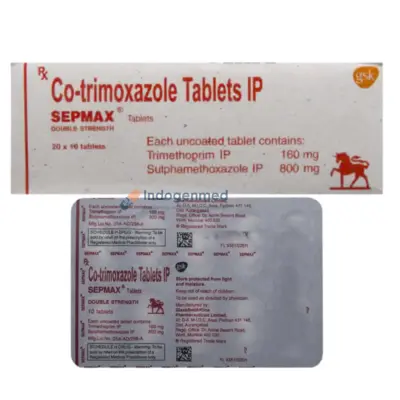
- Sepmax DS 800+160 mg Tablets (sulfamethoxazole 800 mg + trimethoprim 160 mg — double-strength co-trimoxazole, standard adult dose for most infections)
- Rosubest 20 mg Tablets (rosuvastatin 20 mg — cardiovascular risk reduction, commonly co-prescribed in patients on extended antibiotic therapy)
References
- DailyMed. Sulfamethoxazole and trimethoprim tablets — prescribing information. U.S. National Library of Medicine. Available at: https://dailymed.nlm.nih.gov/dailymed/
- MedlinePlus. Sulfamethoxazole and trimethoprim. U.S. National Library of Medicine. Available at: https://medlineplus.gov/druginfo/meds/a684026.html
- Mayo Clinic. Sulfamethoxazole And Trimethoprim (Oral Route). Available at: https://www.mayoclinic.org/
- Electronic Medicines Compendium (EMC). Septrin Tablets 480 mg — Summary of Product Characteristics. Available at: https://www.medicines.org.uk/emc/
- World Health Organization. WHO Model List of Essential Medicines — 23rd List (2023). Geneva: WHO; 2023.
Reviews
There are no reviews yet.