Description
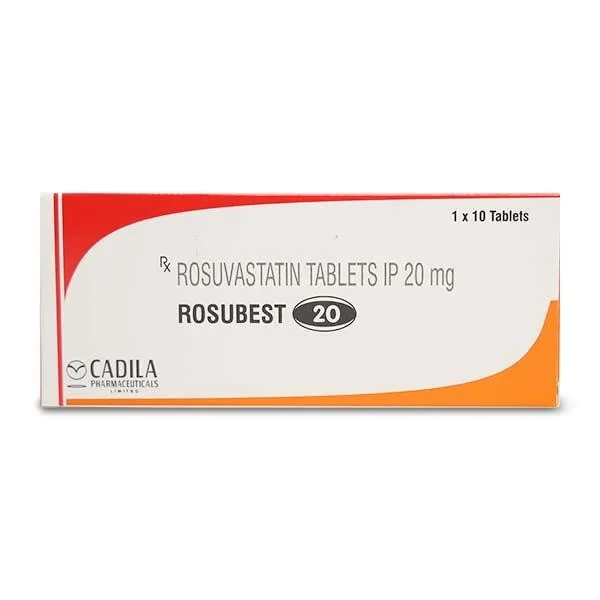
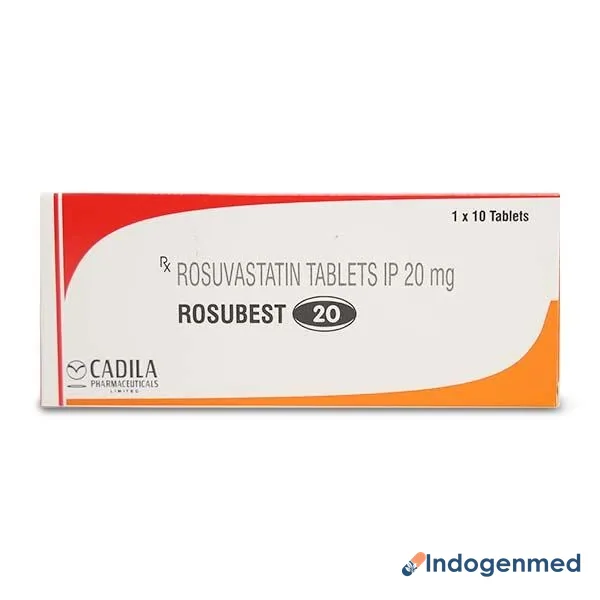
Rosubest 20 mg Tablets – Rosuvastatin 20 mg
Rosubest 20 mg Tablets contain rosuvastatin calcium equivalent to rosuvastatin 20 mg. Rosuvastatin is a fully synthetic, hydrophilic, selective inhibitor of HMG-CoA reductase used in the treatment of dyslipidaemia and for the primary and secondary prevention of atherosclerotic cardiovascular events. Rosuvastatin is the most potent statin in clinical use on a milligram-per-milligram basis. The 20 mg dose is classified as a high-intensity statin dose by the 2013 ACC/AHA Blood Cholesterol Guideline, expected to lower LDL cholesterol by approximately 46–55% from baseline. It is widely used for high-risk patients with established cardiovascular disease requiring substantial LDL-C reduction, and in patients who have not achieved LDL-C targets on lower doses of rosuvastatin or on moderate-intensity statin therapy with other agents.
Composition
Each Rosubest 20 mg film-coated tablet contains rosuvastatin calcium equivalent to rosuvastatin 20 mg. Inactive excipients typically include crospovidone, dibasic calcium phosphate, hydroxypropyl cellulose, hypromellose, lactose monohydrate, magnesium stearate, microcrystalline cellulose, red ferric oxide, and titanium dioxide in the film coat.
Mechanism of Action
Rosuvastatin is a fully synthetic statin designed to maximise selectivity for the hepatic isoform of HMG-CoA reductase. It competitively and selectively inhibits HMG-CoA reductase, the enzyme that catalyses the rate-limiting step in cholesterol biosynthesis: the conversion of HMG-CoA to mevalonate. This results in depletion of intrahepatic cholesterol, which triggers compensatory upregulation of LDL receptor expression on hepatocyte cell membranes. The increased density of LDL receptors accelerates receptor-mediated clearance of LDL particles and their precursors — IDL and VLDL — from plasma.
Rosuvastatin is structurally differentiated from lipophilic statins (simvastatin, atorvastatin) by its pronounced hydrophilicity and the presence of a polar methanesulfonamide group that forms additional hydrogen bonds with the HMG-CoA reductase catalytic site. This enhanced binding affinity for HMG-CoA reductase translates directly to greater LDL-C lowering per milligram dose compared with other statins. Rosuvastatin achieves approximately 2-fold greater LDL-C reduction than atorvastatin at equivalent doses. Rosuvastatin at 20 mg reduces LDL-C by approximately 46–55% from baseline in clinical trials. It also meaningfully reduces triglycerides and modestly raises HDL-C. Its hydrophilicity reduces passive diffusion into non-hepatic cells, potentially conferring an improved muscle safety profile compared with lipophilic statins, though myopathy remains a class-effect concern especially at higher doses.
Indications
- Primary hypercholesterolaemia and mixed dyslipidaemia as an adjunct to dietary and lifestyle measures.
- Familial hypercholesterolaemia — heterozygous in adults, adolescents, and children ≥10 years; homozygous as adjunctive therapy.
- Primary prevention of cardiovascular events in adults without established cardiovascular disease but with elevated hsCRP and cardiovascular risk factors (JUPITER trial indication in many markets).
- Secondary prevention of cardiovascular events in patients with established coronary heart disease or other atherosclerotic vascular disease; high-intensity rosuvastatin is recommended by guidelines for patients with ASCVD who require ≥50% LDL-C reduction.
- Rosuvastatin 20 mg is a standard high-intensity dose in secondary prevention and in patients with familial hypercholesterolaemia not controlled on lower doses.
Dosage and Administration
Rosuvastatin is taken once daily at any time of day, with or without food. The recommended starting dose is 5–10 mg once daily; the 20 mg dose is used when patients require high-intensity therapy or have not achieved LDL-C targets at lower doses. The 40 mg dose is the maximum recommended by most authorities and should be reserved for patients with severe dyslipidaemia with high cardiovascular risk who do not achieve LDL-C targets on 20 mg, with specialist supervision.
Special populations — reduced starting doses:
- Patients of East Asian descent (Japanese, Chinese, Korean): Starting dose 5 mg due to approximately 2-fold higher systemic exposure compared with Caucasian patients. The 20 mg dose requires careful monitoring.
- Patients receiving ciclosporin: Maximum dose 5 mg due to markedly elevated rosuvastatin exposure.
- Patients receiving gemfibrozil or regorafenib: Avoid if possible; if unavoidable, do not exceed 10 mg.
Renal impairment: Moderate renal impairment (CrCl 30–60 mL/min): starting dose 5 mg; maximum dose 20 mg. Severe renal impairment (CrCl <30 mL/min not on haemodialysis): contraindicated.
Pharmacokinetics
Rosuvastatin is absorbed orally with a bioavailability of approximately 20%; first-pass extraction is not as marked as with atorvastatin, but the drug is predominantly hepatically targeted. Peak plasma concentrations are reached in approximately 3–5 hours; food modestly reduces the rate but not the extent of absorption. Plasma protein binding is approximately 88% (lower than atorvastatin). Rosuvastatin undergoes limited hepatic metabolism: approximately 10% is metabolised by CYP2C9 to its major metabolite, N-desmethyl rosuvastatin, which retains approximately 10–20% of the HMG-CoA reductase inhibitory activity of the parent compound. Critically, rosuvastatin is not a CYP3A4 substrate, which greatly reduces its interaction potential with the many drugs that induce or inhibit CYP3A4. Hepatic uptake is mediated by OATP1B1 and OATP1B3 transporters — inhibitors of these (ciclosporin, gemfibrozil) substantially increase systemic exposure. The elimination half-life is approximately 19 hours; renal excretion of unchanged drug accounts for approximately 10% of dose, with the majority excreted in faeces as unchanged drug and metabolites. The long half-life supports once-daily dosing.
Drug Interactions
- Ciclosporin: Increases rosuvastatin AUC approximately 7-fold via OATP1B1/1B3 inhibition; maximum dose 5 mg. Avoid if possible.
- Gemfibrozil: Increases rosuvastatin AUC approximately 1.9-fold; avoid combination if possible; prefer fenofibrate if a fibrate is clinically required.
- Antacids (aluminium and magnesium hydroxide combination): Reduce rosuvastatin AUC by approximately 54%; administer antacids at least 2 hours after rosuvastatin.
- Warfarin: Modest increase in INR with initiation of rosuvastatin; monitor INR closely in warfarinised patients starting or changing dose.
- Contraceptives containing ethinyl oestradiol and norgestrel: Rosuvastatin increases ethinyl oestradiol AUC by approximately 26% and norgestrel AUC by approximately 34%; consider when selecting oral contraceptive preparations.
- Regorafenib: Increases rosuvastatin exposure approximately 3.8-fold; avoid combination or do not exceed 10 mg rosuvastatin.
- Fusidic acid (systemic): Risk of myopathy; suspend rosuvastatin during the course (typically 7 days) and restart 7 days after the last dose.
- HIV protease inhibitors: Some increase rosuvastatin exposure; consult product-specific interaction data.
Contraindications
- Active liver disease or unexplained persistent transaminase elevations >3× ULN.
- Myopathy.
- Severe renal impairment (CrCl <30 mL/min not on haemodialysis).
- Pregnancy — statins are teratogenic; rosuvastatin must be stopped as soon as pregnancy is detected. Women of childbearing age must use effective contraception.
- Breastfeeding — rosuvastatin is excreted in rat milk; human excretion is likely.
- Concomitant ciclosporin.
- Known hypersensitivity to rosuvastatin or any formulation excipient.
Adverse Effects
- Common: Headache, dizziness, constipation, nausea, abdominal pain, myalgia, increased CK, elevated transaminases.
- Serious: Myopathy — the clinically most significant adverse effect of statin therapy. Rhabdomyolysis with myoglobinuria and acute renal failure is rare but potentially fatal. Risk is dose-dependent, highest at 40 mg, and increased by concomitant use of OATP1B1 inhibitors, in patients of Asian descent, with hypothyroidism, and with pre-existing muscle disease. Patients should report unexplained muscle pain, weakness, or tenderness promptly.
- Immune-mediated necrotising myopathy (IMNM): Rare autoimmune condition; anti-HMGCR antibodies; may persist despite statin withdrawal.
- New-onset type 2 diabetes mellitus: Modest increased risk observed with statins as a class; benefit-risk strongly favours therapy in high-risk populations.
- Proteinuria and haematuria: Tubular proteinuria detected by dipstick has been observed with rosuvastatin, particularly at the 40 mg dose; in most cases it is not associated with deterioration in renal function and resolves with dose reduction.
Special Precautions
Liver function tests at baseline; discontinue if transaminase elevations persist above 3× ULN. CK measurement before and during treatment in high-risk patients; suspend rosuvastatin if unexplained muscle symptoms arise with elevated CK (>10× ULN) or if rhabdomyolysis is suspected. Hypothyroidism should be corrected before initiating statin therapy. Patients of East Asian origin require extra caution with dose escalation above 10 mg. Temporarily discontinue rosuvastatin in any patient with an acute severe illness, risk of rhabdomyolysis, or perioperative period involving significant physiological stress.
Storage
Store below 30°C, protected from moisture and light. Keep in the original packaging. Keep out of reach of children. Do not use after the expiry date.
Related Products
- Lipvas 20 mg Tablets (Atorvastatin) – Alternative high-intensity statin; atorvastatin and rosuvastatin are the two most prescribed statins for LDL reduction and cardiovascular risk
- Lipvas 40 mg Tablets (Atorvastatin) – Higher-intensity atorvastatin option when rosuvastatin is not available or not tolerated
- Lipicard 160 mg Tablets (Fenofibrate) – Combination partner; rosuvastatin + fenofibrate dual therapy for mixed dyslipidaemia with elevated triglycerides
- Lipril 10 mg Tablets (Lisinopril) – ACE inhibitor co-prescribed with rosuvastatin for comprehensive cardiovascular event prevention in high-risk patients
- Telma-H 40/12.5 mg Tablets (Telmisartan + HCTZ) – ARB-based antihypertensive paired with rosuvastatin when ACE inhibitors are not tolerated in dyslipidaemia + hypertension
References
- U.S. Food and Drug Administration. Crestor (rosuvastatin calcium) Prescribing Information. AstraZeneca. FDA.gov
- National Library of Medicine – DailyMed. Rosuvastatin Calcium Tablets Label. dailymed.nlm.nih.gov
- MedlinePlus. Rosuvastatin. U.S. National Library of Medicine. medlineplus.gov
- Ridker PM, et al. Rosuvastatin to prevent vascular events in men and women with elevated C-reactive protein (JUPITER). New England Journal of Medicine. 2008;359(21):2195–2207. PMID: 18997196.
- Mayo Clinic. Rosuvastatin (Oral Route). mayoclinic.org
Reviews
There are no reviews yet.