Description
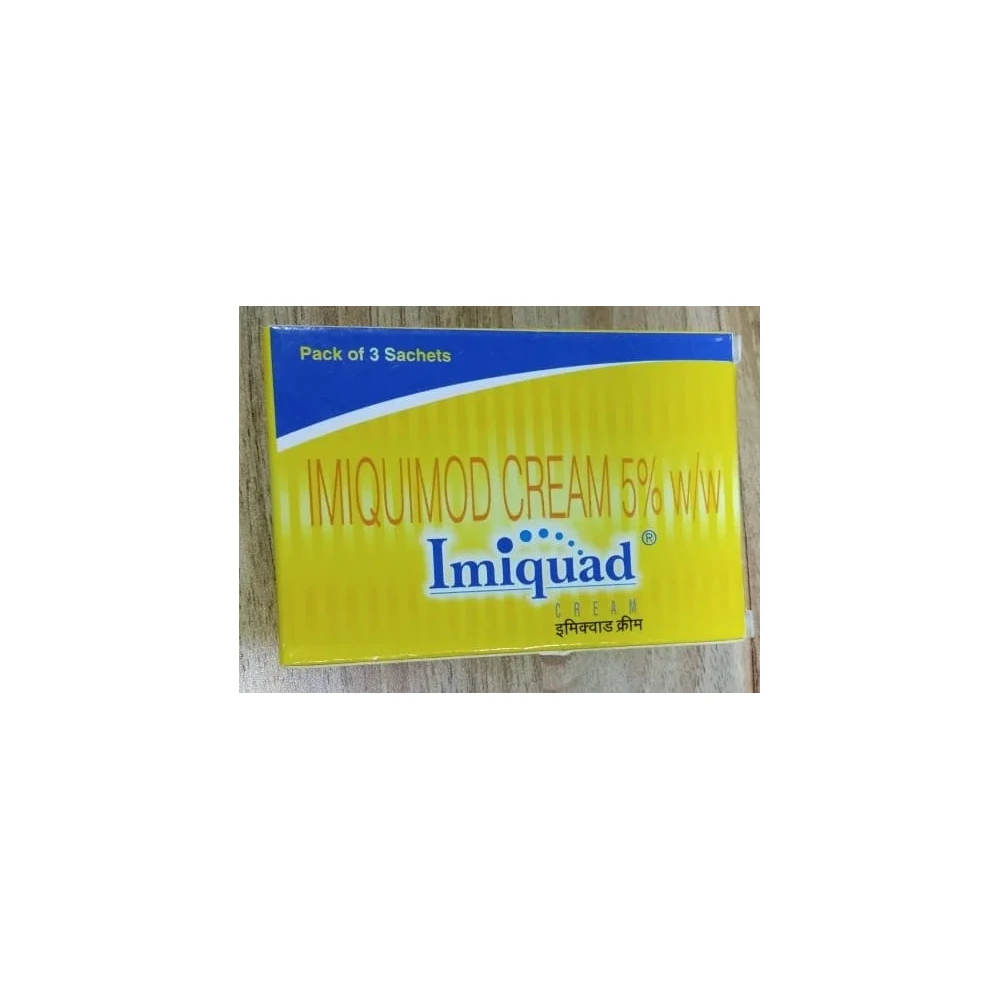
Imiquad 5% W/W Cream – Imiquimod Topical Cream
Imiquad Cream contains Imiquimod 5% w/w as the active ingredient in a white to off-white cream base for topical application. Imiquimod is a unique immune response modifier — it does not kill viruses or tumour cells directly but instead activates the innate and adaptive arms of the local immune system to target and destroy infected or abnormal cells. It is applied directly to the affected skin area and works over several weeks to clear the lesion. Imiquad 5% cream is indicated for the treatment of external genital and perianal warts (condylomata acuminata), superficial basal cell carcinoma, and actinic keratosis in immunocompetent adults. It is available as a topical cream applied only to the designated skin area and is not intended for internal use.
Composition
Each gram of cream contains:
- Imiquimod – 50 mg (5% w/w)
- Cream base excipients: isostearic acid, cetyl alcohol, stearyl alcohol, white soft paraffin, polysorbate 60, sorbitan monostearate, glycerol, methyl hydroxybenzoate, propyl hydroxybenzoate, benzyl alcohol, purified water
How Imiquimod Works
Imiquimod is a Toll-like receptor 7 (TLR7) and TLR8 agonist. When applied to the skin, it penetrates into the epidermal and dermal cells where it binds to TLR7 on innate immune cells — primarily plasmacytoid dendritic cells and macrophages. This receptor activation triggers the MyD88 intracellular signalling pathway, leading to nuclear factor kappa-B (NF-κB) activation and the production of a cascade of pro-inflammatory cytokines.
The key mediators released include interferon-alpha (IFN-α), tumour necrosis factor-alpha (TNF-α), interleukin-1 (IL-1), interleukin-6 (IL-6), and interleukin-12 (IL-12). IFN-α is particularly important as it has direct antiviral activity (upregulating antiviral proteins in neighbouring cells) and activates natural killer (NK) cells and cytotoxic T lymphocytes. This local immune activation leads to an inflammatory response that selectively destroys HPV-infected cells (in the case of warts) or abnormal neoplastic cells (in the case of actinic keratoses and basal cell carcinoma). The adaptive immune response induced — including memory T cells — may also contribute to lower recurrence rates compared to purely destructive treatments.
Uses of Imiquad 5% W/W Cream
- External genital and perianal warts (condylomata acuminata): Treatment of visible external genital and perianal warts in adults. Caused by human papillomavirus (HPV) strains 6 and 11.
- Superficial basal cell carcinoma (sBCC): Non-melanoma skin cancer restricted to the superficial dermis in immunocompetent adults where surgery is not appropriate (tumours up to 2 cm in diameter, confirmed histologically).
- Actinic keratosis (solar keratosis): Pre-cancerous skin lesions on the face and scalp caused by cumulative UV radiation exposure in immunocompetent adults.
Dosage and Administration
External genital and perianal warts:
- Apply a thin layer of cream to the wart area and surrounding 1 cm three times per week (e.g., Monday, Wednesday, Friday) at bedtime.
- Leave on for 6–10 hours, then wash off with mild soap and water.
- Continue for up to 16 weeks; treatment should be stopped when warts have cleared.
Actinic keratosis:
- Apply to the defined treatment area three times per week for 4 weeks; rest period of 4 weeks; then another 4-week treatment course if needed.
Superficial basal cell carcinoma:
- Apply five times per week (Monday to Friday) at bedtime for 6 weeks.
General application guidance:
- Apply only to the specified treatment area — avoid healthy surrounding skin, eyes, mouth, and mucous membranes.
- Wash hands before and after application.
- Do not apply under occlusive dressings.
- Avoid sexual contact while cream is on the skin; note that imiquimod may weaken condoms and diaphragms.
Side Effects
- Local skin reactions (expected and common): Erythema, erosion, flaking, scabbing, induration, vesicles — these local inflammatory reactions are a sign of immune activation and are expected during treatment.
- Severe local reactions: Intense erythema, ulceration, oedema — may require a treatment rest period of several days. Resume once the skin reaction has moderated.
- Systemic effects (rare at standard topical doses): Flu-like symptoms (fatigue, myalgia, fever) have been reported, particularly at the start of treatment or if applied to large areas.
- Pigmentation changes: Permanent changes in skin pigmentation (hypo- or hyperpigmentation) at the treatment site may occur, particularly in darker skin types.
Precautions and Warnings
- Immunocompromised patients: Imiquimod has not been studied in immunocompromised individuals and may behave unpredictably in this population; specialist guidance is required.
- Internal warts: Not indicated for intra-urethral, intra-vaginal, rectal, or cervical warts — apply to external surfaces only.
- Circumcised men: Applying to the foreskin of uncircumcised men may increase the risk of local reactions; use with caution.
- Open wounds: Do not apply to broken, irritated, or recently treated skin until fully healed.
- Sun exposure: Treated skin may be more sensitive to UV radiation; minimise sun exposure during treatment and use sun protection.
- Pregnancy and breastfeeding: Limited safety data; use only if clearly needed and under medical supervision.
Drug Interactions
No significant systemic drug interactions have been identified at standard topical doses. However, concurrent use with other immunomodulatory or immunosuppressive agents warrants caution as the local immune response could be altered. Avoid applying simultaneously with other topical creams or ointments to the same treatment area.
Contraindications
- Hypersensitivity to imiquimod or any cream excipient
- Application to internal (non-external) surfaces (intra-urethral, intra-vaginal, cervical, rectal)
Storage Instructions
Store below 25°C. Do not freeze. Keep in the original packaging. Keep out of reach of children. Do not use after the expiry date printed on the tube or carton.
Imiquimod and HPV-Related Warts
Genital warts caused by human papillomavirus (HPV) are among the most common sexually transmitted infections worldwide. HPV strains 6 and 11 account for approximately 90% of genital wart cases. Traditional destructive treatments — cryotherapy, laser therapy, electrocautery, podophyllotoxin — target visible lesion tissue but may not address the underlying viral reservoir in surrounding apparently normal skin, contributing to the high recurrence rates (25–65%) observed with purely ablative approaches.
Imiquimod’s immune-activating mechanism offers a different therapeutic strategy. By inducing a localised interferon-rich inflammatory environment, it recruits cytotoxic T lymphocytes capable of recognising and eliminating HPV-infected cells through antigen-specific pathways. Studies have demonstrated complete clearance rates of approximately 50% in treated patients, with recurrence rates lower than those seen after destructive treatments — an outcome attributed to the immune memory generated during therapy. Imiquimod is therefore particularly useful in patients with multiple, recurrent, or treatment-resistant warts.
Related Products
- Lefumide 20 Mg Tablets – Leflunomide for autoimmune conditions
- Imuran 50 Mg Tablets – Azathioprine immunosuppressant
- Lamitor 200 Mg Tablets – Lamotrigine anticonvulsant and mood stabiliser
References
- MedlinePlus. Imiquimod Topical. U.S. National Library of Medicine. medlineplus.gov
- Mayo Clinic. Imiquimod (Topical Route) – Before Using. mayoclinic.org
- electronic Medicines Compendium (eMC). Aldara 5% Cream – Summary of Product Characteristics. medicines.org.uk/emc
Reviews
There are no reviews yet.