Description
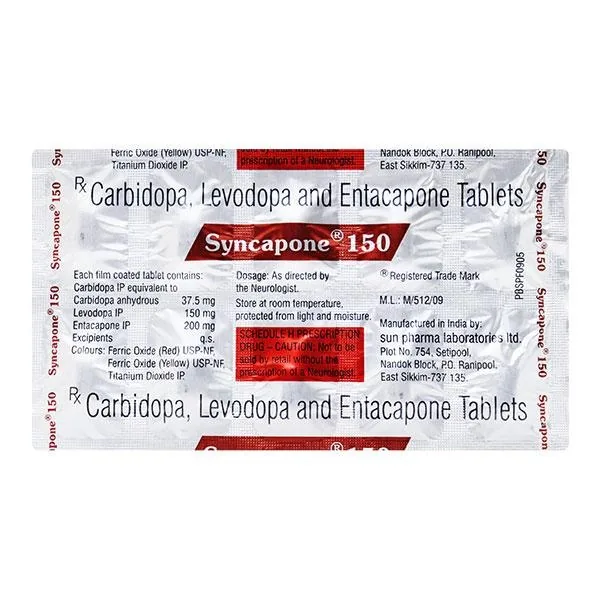
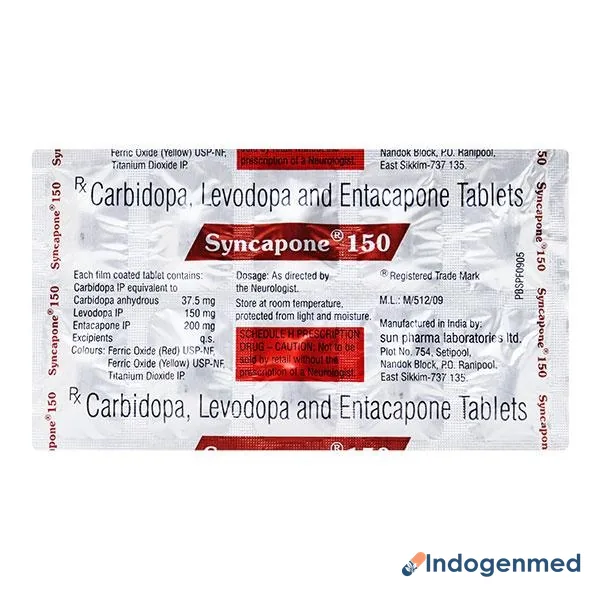
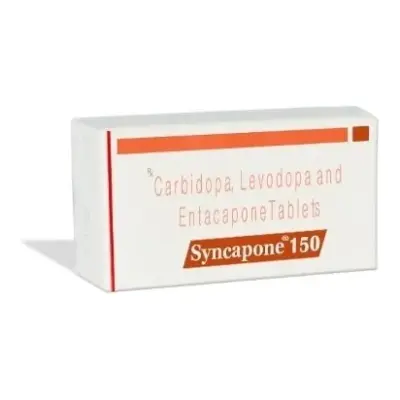
Syncapone 37.5+200+150 Mg Capsules – Levodopa, Carbidopa, and Entacapone
Syncapone Capsules contain a fixed-dose combination of levodopa 37.5 mg + carbidopa 200 mg + entacapone 150 mg in a single capsule. This is a triple-combination formulation for the treatment of Parkinson’s disease (PD), combining the classic levodopa-carbidopa dopamine precursor therapy with entacapone, a peripherally acting catechol-O-methyltransferase (COMT) inhibitor.
The rationale for combining all three components in one dosage form is to simplify the complex regimen required when entacapone is added to stabilised levodopa-carbidopa therapy. By providing all three active substances together, Syncapone reduces pill burden, improves medication adherence, and ensures that entacapone is reliably co-administered at every levodopa dose — a critical pharmacokinetic requirement for consistent dopaminergic effect.
Active Ingredients and Their Roles
Levodopa (37.5 mg)
Levodopa (L-DOPA) is the metabolic precursor to dopamine and the most effective symptomatic treatment for Parkinson’s disease. It crosses the blood-brain barrier via the large neutral amino acid transporter (LAT1), where it is decarboxylated to dopamine by aromatic L-amino acid decarboxylase (AAAD/DOPA decarboxylase). The resulting dopamine replenishes the depleted striatal dopamine stores, correcting the nigrostriatal deficiency that underlies Parkinson’s motor symptoms.
Carbidopa (200 mg)
Carbidopa is a selective inhibitor of peripheral DOPA decarboxylase (DDC), the enzyme that converts levodopa to dopamine outside the CNS. Because carbidopa does not cross the blood-brain barrier, it prevents the peripheral conversion of levodopa to dopamine, thereby:
- Reducing peripheral dopamine-related side effects (nausea, vomiting, cardiovascular effects)
- Significantly increasing the fraction of ingested levodopa available to reach the brain — typically allowing a 75–80% reduction in levodopa dose compared to levodopa monotherapy
- Extending the duration of effective levodopa-derived brain dopamine levels
Note: In Syncapone, carbidopa 200 mg is present in a dose disproportionate to conventional levodopa-carbidopa ratios. This should be verified on the specific product label before dispensing.
Entacapone (150 mg)
Entacapone inhibits catechol-O-methyltransferase (COMT), the enzyme that methylates levodopa in the periphery to 3-O-methyldopa (3-OMD), an inactive metabolite that competes with levodopa for CNS entry via LAT1. By blocking peripheral COMT, entacapone:
- Increases the bioavailability of levodopa reaching the CNS by approximately 35%
- Prolongs and stabilises plasma levodopa levels, smoothing out the peak-trough fluctuations that cause motor fluctuations (wearing-off)
- Extends the duration of “on” time per dose and reduces daily “off” time in patients with motor fluctuations
Mechanism of Action — Combined Effect
The triple combination produces a synergistic pharmacokinetic effect. Carbidopa blocks peripheral DDC-mediated conversion of levodopa to peripheral dopamine, increasing CNS delivery. Entacapone simultaneously blocks peripheral COMT-mediated methylation of levodopa to 3-OMD, further increasing the proportion of levodopa reaching the brain and extending the effective plasma levodopa half-life from approximately 90 minutes (levodopa-carbidopa alone) to approximately 2.5–3 hours.
The result is a more stable and prolonged dopaminergic effect per dose, reducing the peak-trough variation in brain dopamine levels that causes motor fluctuations, particularly end-of-dose wearing off — the most common form of motor fluctuation in patients on long-term levodopa therapy.
Indications
- Parkinson’s disease with motor fluctuations (wearing off): Syncapone is indicated in adult patients with PD who experience end-of-dose deterioration (wearing-off phenomenon) that cannot be stabilised with levodopa-carbidopa therapy alone. The addition of entacapone extends “on” time and reduces daily “off” time
- Simplification of stable levodopa-carbidopa plus entacapone regimen: In patients already stabilised on separate levodopa-carbidopa and entacapone tablets, Syncapone provides the same active ingredients in a single capsule, reducing daily pill count and simplifying the medication schedule
Dosage and Administration
Syncapone should be initiated and adjusted by a neurologist experienced in the management of Parkinson’s disease. It is not suitable for first-line initiation of levodopa therapy.
- One capsule taken orally with each levodopa-carbidopa dose, typically 3–6 times daily depending on the established levodopa-carbidopa schedule
- The number of daily doses is determined by the patient’s pre-existing levodopa dosing frequency and total daily levodopa requirement
- Doses should be spaced evenly throughout the waking day
- Swallow capsules whole; do not crush, open, or chew
- Can be taken with or without food; however, high-protein meals can reduce levodopa absorption via competition at the LAT1 transporter — patients may benefit from taking doses 30 minutes before meals
Conversion from levodopa-carbidopa plus separate entacapone: When switching from separate tablets to Syncapone, the same total daily levodopa and entacapone doses should be maintained; adjust subsequent doses based on clinical response and tolerability.
Pharmacokinetics
The pharmacokinetic properties of Syncapone reflect the combined effects of its three components in a single capsule formulation:
- Levodopa: Rapidly absorbed in the proximal small intestine via active transport; food delays absorption. Plasma half-life of approximately 1.5 hours (without entacapone) extended to 2.5–3 hours with entacapone co-administration. Brain entry via LAT1
- Carbidopa: Rapidly absorbed; does not cross the blood-brain barrier; plasma protein binding ~36%; excreted mainly by renal route
- Entacapone: Rapidly absorbed with Tmax approximately 1 hour; plasma protein binding ~98%; extensively metabolised by glucuronidation; plasma half-life approximately 2–3 hours; excreted mainly in bile/faeces (~90%)
Contraindications
- Narrow-angle glaucoma (entacapone may worsen this)
- Phaeochromocytoma, paraganglioma, or other catecholamine-secreting tumours (risk of hypertensive crisis)
- Concomitant use of non-selective monoamine oxidase inhibitors (MAO-A and MAO-B inhibitors together) — selective MAO-B inhibitors such as selegiline or rasagiline may be used with caution at standard doses
- History of neuroleptic malignant syndrome (NMS) or non-traumatic rhabdomyolysis
- Severe hepatic impairment (entacapone pharmacokinetics are significantly altered)
- Known hypersensitivity to levodopa, carbidopa, entacapone, or any formulation excipient
Precautions and Warnings
- Dyskinesias: Entacapone increases levodopa exposure and may intensify or prolong existing dyskinesias; a dose reduction in levodopa is often required when entacapone is introduced
- Hallucinations and psychosis: As with levodopa, hallucinations, confusion, and other dopaminergic neuropsychiatric effects may occur or worsen
- Impulse control disorders: Dopaminergic therapy (including levodopa) has been associated with pathological gambling, hypersexuality, compulsive shopping, and binge eating; monitor for these behaviours
- Orthostatic hypotension: May occur, particularly early in treatment; advise patients to rise slowly from sitting or lying positions
- Urine discolouration: Entacapone metabolites may colour urine reddish-brown; this is harmless but should be communicated to patients to avoid alarm
- Hepatic impairment: Use with caution in mild to moderate hepatic impairment; entacapone glucuronidation is impaired; avoid in severe hepatic disease
- Melanoma: Epidemiological data suggest an increased risk of melanoma in PD patients; the relationship to levodopa is unclear; skin should be monitored regularly
- Abrupt withdrawal: Sudden discontinuation of levodopa can precipitate akinetic crisis or neuroleptic malignant syndrome-like syndrome; always taper under medical supervision
Adverse Effects
- Very common: Dyskinesia (involuntary movements), nausea, diarrhoea, urine discolouration (reddish-brown)
- Common: Vomiting, dizziness, orthostatic hypotension, constipation, dry mouth, headache, hallucinations, confusion, insomnia, abnormal dreams
- Uncommon: Cardiac arrhythmias, hypertension, impulse control disorder, somnolence, falls
- Rare: Rhabdomyolysis, neuroleptic malignant syndrome (on abrupt withdrawal), hepatotoxicity (rare with entacapone)
Drug Interactions
- MAO inhibitors: Non-selective MAO inhibitors are contraindicated; can cause hypertensive crisis. Selective MAO-B inhibitors (selegiline, rasagiline) may be used at standard doses with caution
- Dopamine antagonists (antipsychotics, metoclopramide): May reduce the efficacy of levodopa by blocking dopamine receptors; avoid where possible
- Iron salts: Chelate levodopa and reduce its absorption; separate doses by at least 2 hours
- High-protein diet: Large neutral amino acids compete with levodopa for intestinal and BBB transport; protein-redistribution diets may help in patients with severe wearing-off
- Antihypertensive agents: Additive hypotensive effects, particularly orthostatic; monitor blood pressure
Storage Instructions
- Store below 30°C in a dry place, protected from light
- Keep in the original packaging to protect from moisture
- Keep out of reach and sight of children
- Do not use after the expiry date printed on the label
Frequently Asked Questions
What is wearing-off in Parkinson’s disease, and how does Syncapone help?
Wearing-off (end-of-dose deterioration) is the most common motor complication of long-term levodopa therapy. As PD progresses, dopamine storage capacity in surviving neurons decreases, making the brain more dependent on the moment-to-moment availability of circulating levodopa. When plasma levodopa levels fall toward the end of a dosing interval, motor symptoms return — the patient “wears off” before the next dose. Syncapone’s entacapone component extends the plasma half-life of levodopa by blocking peripheral COMT, smoothing out the troughs and extending the duration of each “on” period.
Can Syncapone be used as first-line levodopa therapy in Parkinson’s disease?
No. Syncapone is not for first-line initiation. It is intended for patients already stabilised on levodopa-carbidopa who require entacapone (because of wearing-off) or for those being transitioned from separate levodopa-carbidopa plus entacapone tablets to a simplified single-capsule regimen.
References
- Electronic Medicines Compendium (eMC). Stalevo film-coated tablets (levodopa/carbidopa/entacapone) — summary of product characteristics. Available at: https://www.medicines.org.uk/emc/
- National Library of Medicine – DailyMed. Levodopa, carbidopa, and entacapone tablets. Available at: https://dailymed.nlm.nih.gov/dailymed/search.cfm?labeltype=all&query=levodopa+carbidopa+entacapone
- MedlinePlus (U.S. National Library of Medicine). Levodopa, carbidopa, and entacapone. Available at: https://medlineplus.gov/druginfo/meds/a606013.html
- Mayo Clinic. Carbidopa, Entacapone and Levodopa (Oral Route). Available at: https://www.mayoclinic.org/drugs-supplements/carbidopa-entacapone-and-levodopa-oral-route/description/drg-20062722
- Parkinson’s Foundation. Medications for Parkinson’s Disease. Available at: https://www.parkinson.org/understanding-parkinsons/treatments/medications



Reviews
There are no reviews yet.