Description
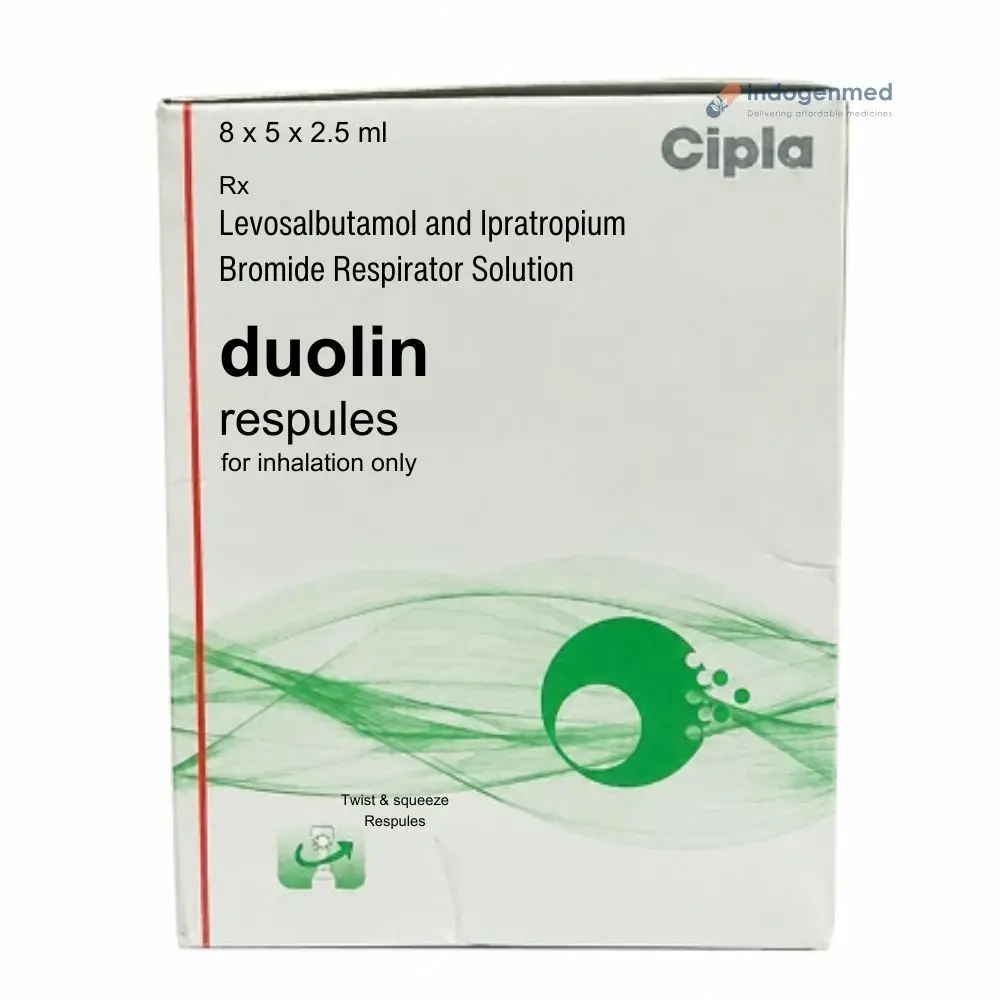
What Is Duolin Respules 1.25 mg + 500 mcg?
Duolin Respules 1.25 mg + 500 mcg is a fixed-dose bronchodilator combination for nebulisation, containing levosalbutamol 1.25 mg (the R-enantiomer of salbutamol) and ipratropium bromide 500 mcg per 2.5 mL unit-dose respule. It is manufactured by Cipla Ltd. and supplied in packs of 5 sterile respules. This combination is used in the management of acute and chronic bronchospasm in obstructive airway diseases including chronic obstructive pulmonary disease (COPD) and acute severe asthma, delivering dual bronchodilation through two mechanistically distinct pathways — beta-2 adrenoceptor stimulation (levosalbutamol) and muscarinic receptor blockade (ipratropium bromide).
Obstructive airway disease is characterised by reversible or partially reversible airflow limitation caused by bronchospasm, mucus hypersecretion, and airway inflammation. In COPD, airflow limitation results from a combination of small airway disease (obstructive bronchiolitis) and parenchymal destruction (emphysema). Bronchodilators are the cornerstone of symptomatic management, with both beta-2 agonists and anticholinergics demonstrating additive bronchodilatory effects when combined, as they act on distinct pathways of airway smooth muscle contraction. The combination of a short-acting beta-2 agonist with ipratropium provides broader and more sustained bronchodilation than either agent alone, particularly in COPD where cholinergic tone is a major contributor to airflow obstruction.
Mechanism of Action
Levosalbutamol — Selective Beta-2 Adrenoceptor Agonism
Levosalbutamol (also known as levalbuterol) is the pharmacologically active R(−)-enantiomer of racemic salbutamol (albuterol). It binds selectively to beta-2 adrenergic receptors on airway smooth muscle, activating adenylate cyclase and increasing intracellular cyclic AMP (cAMP). Elevated cAMP activates protein kinase A, which phosphorylates and inactivates myosin light-chain kinase and reduces intracellular calcium, resulting in smooth muscle relaxation and bronchodilation. Levosalbutamol also inhibits mast cell degranulation and reduces microvascular permeability in the airway mucosa, contributing to anti-inflammatory effects.
Compared to racemic salbutamol, levosalbutamol delivers equivalent bronchodilation at half the total dose, reducing the beta-2-mediated side effects (tachycardia, tremor, hypokalaemia) attributed to the inactive S(+)-enantiomer. Onset of action is within 5 minutes of nebulisation, with peak effect at 15–30 minutes and duration of 4–6 hours.
Ipratropium Bromide — Muscarinic Receptor Antagonism
Ipratropium bromide is a quaternary ammonium anticholinergic agent that competitively blocks muscarinic acetylcholine receptors (predominantly M3) on airway smooth muscle, submucosal glands, and vascular smooth muscle in the bronchi. By blocking cholinergic bronchoconstriction — the dominant bronchomotor tone in COPD — ipratropium causes bronchial smooth muscle relaxation, reduces mucus hypersecretion from submucosal glands, and decreases airway secretions. As a quaternary ammonium compound, ipratropium is poorly absorbed across biological membranes including the blood–brain barrier, minimising systemic anticholinergic side effects (dry mouth and increased heart rate are the most common, but central nervous system effects such as confusion or urinary retention are rare at inhaled doses). Onset is within 15 minutes; peak effect at 1–2 hours; duration 4–6 hours.
Indications
COPD — Acute Exacerbation and Maintenance Nebulisation
Duolin Respules are indicated for bronchodilation in patients with COPD who require nebulised therapy due to severe disease, inability to use metered-dose inhalers, or acute exacerbation requiring high-dose bronchodilator delivery. The combination provides additive bronchodilation superior to either component alone in COPD.
Acute Severe and Moderate Asthma
In acute asthma, the combination of a nebulised beta-2 agonist with ipratropium bromide is recommended in moderate-to-severe exacerbations to maximise bronchodilation. Multiple doses in the first hour of an acute attack improve lung function and reduce hospitalisation rates compared with beta-2 agonist monotherapy.
Bronchospasm in Other Obstructive Airways Disease
Symptomatic relief of reversible bronchospasm associated with chronic bronchitis, emphysema, and other obstructive airway conditions.
Dosage and Administration
Administer one respule (2.5 mL) via jet nebuliser 3–4 times daily, or as directed by a physician. In acute severe asthma, up to 3 consecutive doses may be administered in the first hour under medical supervision, then reassessed. Each respule is for single use only; discard any unused portion. Do not mix with other nebuliser medications unless specifically directed. Use only with a properly functioning jet nebuliser connected to an air compressor; ultrasonic nebulisers are not recommended. Rinse mouth with water after each nebulisation to reduce throat irritation. If using a mouthpiece nebuliser mask in patients with glaucoma risk, ensure the mist does not contact the eyes.
Contraindications
- Known hypersensitivity to levosalbutamol, salbutamol, ipratropium bromide, atropine or related compounds, or any excipient.
- Hypertrophic obstructive cardiomyopathy or tachyarrhythmias — caution: beta-2 agonists cause dose-dependent tachycardia and may worsen outflow tract obstruction or precipitate arrhythmias.
Warnings and Precautions
Paradoxical bronchospasm: Rarely, nebulised bronchodilators can precipitate immediate bronchospasm. If this occurs, the medication should be discontinued and an alternative treatment initiated immediately.
Cardiovascular effects: Levosalbutamol causes dose-dependent heart rate increase, blood pressure changes, and hypokalaemia (via shift of potassium into cells). Use with caution in patients with ischaemic heart disease, arrhythmias, hypertension, or hyperthyroidism. Hypokalaemia risk is potentiated by co-administered xanthines, diuretics, or corticosteroids.
Acute angle-closure glaucoma: Nebulised ipratropium has precipitated acute angle-closure glaucoma when mist contacts the eye, particularly with face mask nebulisers. Use a mouthpiece nebuliser where possible; protect the eyes from mist when using a mask.
Urinary retention: Ipratropium may precipitate urinary retention in men with prostatic hypertrophy or bladder neck obstruction; use with caution.
Diabetes: Beta-2 agonists can cause hyperglycaemia, particularly at high doses; monitor blood glucose in diabetic patients.
Adverse Effects
- Common (≥1/100): Throat dryness or irritation, dry mouth, mild tremor (hands), tachycardia, headache, dizziness, cough.
- Uncommon (≥1/1000): Palpitations, hypokalaemia (especially with high-dose or frequent use), nausea, hypertension, bronchospasm.
- Rare (≥1/10,000): Paradoxical bronchospasm, acute angle-closure glaucoma (eye contact), urinary retention, hypersensitivity reactions (urticaria, angioedema).
Drug Interactions
- Other beta-2 agonists (e.g. formoterol, salmeterol): Additive adrenergic effects — increased risk of tachycardia, hypokalaemia, and arrhythmia; avoid concomitant use of multiple short-acting beta-2 agonists.
- Beta-blockers (non-selective, e.g. propranolol): Antagonise bronchodilator effect of levosalbutamol; may precipitate severe bronchospasm in asthmatic patients. Avoid non-selective beta-blockers; use cardioselective beta-blockers with caution.
- Xanthines (theophylline, aminophylline): Additive hypokalaemia risk with high-dose beta-2 agonists; monitor potassium.
- Loop and thiazide diuretics: Hypokalaemia risk potentiated by combination with high-dose beta-2 agonists; monitor electrolytes.
- MAO inhibitors and tricyclic antidepressants: Potentiate cardiovascular effects of levosalbutamol (tachycardia, hypertension); use with caution or avoid.
- Other anticholinergic agents: Additive anticholinergic effects (dry mouth, urinary retention, constipation, elevated intraocular pressure) with ipratropium; caution when combining with antihistamines, tricyclics, or antipsychotics with anticholinergic properties.
Storage
Store below 25°C in a cool, dry place away from direct sunlight. Keep in the original foil pouch until use. Do not freeze. Each respule is for single use only — discard after use. Keep out of reach of children. Do not use after the expiry date printed on the pack.
Related Products
For patients requiring long-acting dual bronchodilation for maintenance COPD therapy, Duova 18+12 mcg Capsules (tiotropium + formoterol) provides once-daily LAMA/LABA combination therapy for patients who have stabilised beyond the acute phase. For patients with acute bronchospasm requiring nebulisation with ipratropium alone, Ipravent Respules 2 mL (ipratropium bromide) is available as a monotherapy nebuliser solution. For respiratory infections complicating COPD exacerbations, Roxid Kidtab 50 mg (roxithromycin) provides macrolide antibiotic coverage commonly used in community-acquired respiratory pathogens.
References
- U.S. Food and Drug Administration / DailyMed. Ipratropium Bromide and Albuterol Sulfate Inhalation Solution — Prescribing Information. National Library of Medicine. Available at: https://dailymed.nlm.nih.gov
- National Library of Medicine MedlinePlus. Ipratropium Oral Inhalation. Available at: https://medlineplus.gov/druginfo/meds/a601063.html
- National Library of Medicine MedlinePlus. Levalbuterol Oral Inhalation. Available at: https://medlineplus.gov/druginfo/meds/a603025.html
- Mayo Clinic. Ipratropium and Albuterol (Inhalation Route) — Description. Available at: https://www.mayoclinic.org
- Electronic Medicines Compendium (EMC). Combivent UDVs Nebuliser Solution (Ipratropium + Salbutamol) — Summary of Product Characteristics. Available at: https://www.medicines.org.uk/emc
- Rodrigo GJ, Rodrigo C. The role of ipratropium bromide in acute asthma treatment: an evidence-based evaluation. Chest. 2002;121(6):1977–1987. PubMed PMID: 12065360
Reviews
There are no reviews yet.