Description
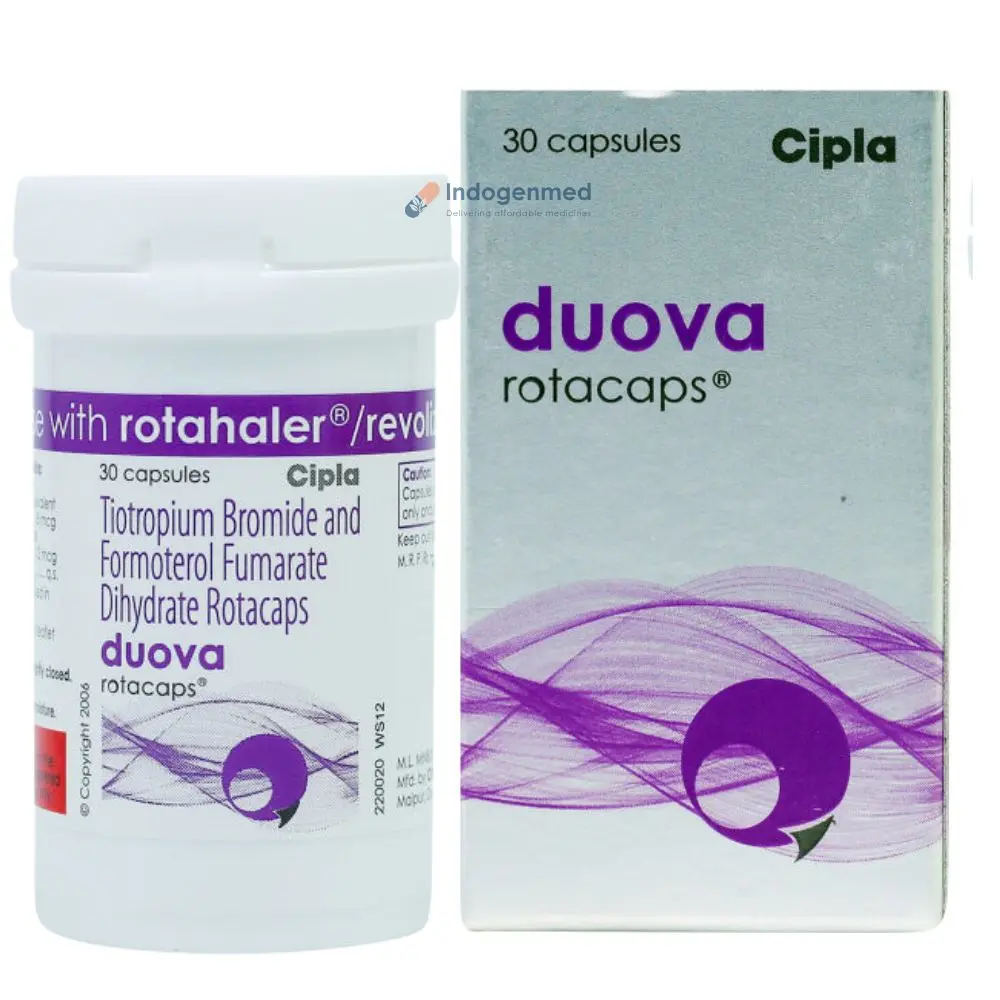
What Is Duova 18+12 mcg Capsules?
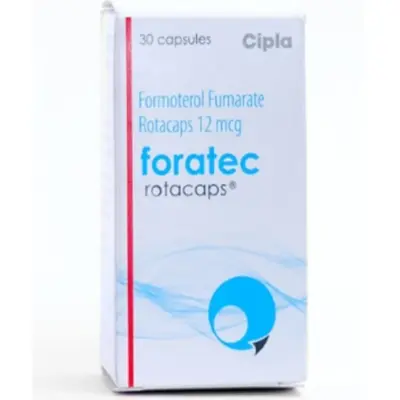
Duova 18+12 mcg Capsules is a fixed-dose long-acting dual bronchodilator combination for inhalation, containing tiotropium bromide 18 mcg and formoterol fumarate 12 mcg per capsule, manufactured by Cipla Ltd. Each strip pack contains 10 capsules intended for use with a compatible dry powder inhaler (DPI) device such as a Rotahaler or Handihaler. This combination pairs a long-acting muscarinic antagonist (LAMA) with a long-acting beta-2 agonist (LABA) in a single inhalation device, providing 24-hour dual bronchodilation for the maintenance treatment of chronic obstructive pulmonary disease (COPD).
The LAMA/LABA combination strategy is supported by the Global Initiative for Chronic Obstructive Lung Disease (GOLD) guidelines as preferred maintenance therapy for group B, C, and D COPD patients — those with significant symptoms, frequent exacerbations, or both. Combining a LAMA (anticholinergic) with a LABA (beta-2 agonist) produces additive bronchodilation because the two agents act on independent receptors along distinct pathways of airway smooth muscle contraction. Clinical studies consistently demonstrate that LAMA/LABA combinations achieve greater improvements in FEV₁, dyspnoea scores, exercise tolerance, and health-related quality of life than either component alone, and reduce the frequency of COPD exacerbations.
Mechanism of Action
Tiotropium Bromide — Long-Acting Muscarinic Antagonism
Tiotropium bromide is a quaternary ammonium LAMA that competitively and kinetically selectively antagonises muscarinic receptors in airway smooth muscle, submucosal glands, and mucous cells. It has high affinity for all five muscarinic receptor subtypes (M1–M5) but its bronchodilatory effect is mediated primarily through M3 receptor blockade on bronchial smooth muscle and submucosal glands. The key pharmacokinetic feature of tiotropium is its very slow dissociation from M1 and M3 receptors (kinetic selectivity) compared to M2 receptors, translating into a bronchodilatory effect lasting approximately 24 hours after a single dose. This allows once-daily dosing. By blocking cholinergic bronchoconstriction — the dominant mechanism of airway narrowing in COPD — tiotropium reduces resting bronchomotor tone and decreases mucus hypersecretion, improving FEV₁ and reducing dynamic lung hyperinflation on exertion.
Formoterol Fumarate — Long-Acting Beta-2 Adrenoceptor Agonism
Formoterol is a long-acting, selective beta-2 adrenoceptor partial agonist with an onset of action of approximately 1–3 minutes (faster than salmeterol, making it suitable for both rescue and maintenance use in some contexts) and a duration of 12 hours. It activates beta-2 receptors on airway smooth muscle, increasing intracellular cyclic AMP through adenylate cyclase stimulation, leading to protein kinase A activation, myosin light-chain kinase inactivation, reduced intracellular calcium, and bronchial smooth muscle relaxation. Formoterol also stabilises mast cells, reduces vascular permeability in airway mucosa, and inhibits the release of bronchoconstricting mediators. In combination with tiotropium, formoterol provides bronchodilation through an additive and complementary mechanism — the LAMA reduces cholinergically-mediated tone while the LABA provides beta-adrenergic smooth muscle relaxation — without mechanistic overlap.
Indications
Chronic Obstructive Pulmonary Disease (COPD) — Maintenance Therapy
Duova 18+12 mcg is indicated as a maintenance bronchodilator for adult patients with COPD (chronic bronchitis, emphysema, or both) to reduce symptoms of dyspnoea, improve exercise tolerance, reduce frequency of acute exacerbations, and improve health-related quality of life. It is particularly indicated in symptomatic patients classified as GOLD group B or higher who have not achieved adequate symptom control on a single bronchodilator.
Dosage and Administration
Inhale the contents of one capsule once daily using the compatible dry powder inhaler (DPI) device. Place the capsule in the inhaler chamber, pierce it by pressing the side button, exhale completely, seal lips around the mouthpiece, and inhale forcefully and deeply to draw the powder into the lungs. Hold breath for 5–10 seconds after inhalation. If the capsule rattles during inhalation and the device does not whistle, inhalation technique needs correcting. Rinse mouth with water after use (reduces hoarseness and oropharyngeal candidiasis risk from residual formoterol). Capsules must NOT be swallowed. Store capsules in the original blister pack and load only immediately before use.
Duova is for maintenance use only — it is not intended for the relief of acute bronchospasm. Patients should have a separate short-acting bronchodilator (e.g. salbutamol) for acute symptom relief.
Contraindications
- Known hypersensitivity to tiotropium, ipratropium, formoterol, or any excipient (including lactose — the carrier powder in DPI capsules).
- Patients with severe hypersensitivity to atropine or atropine derivatives (tiotropium is an atropine analogue).
- Asthma as sole indication — Duova is not indicated for asthma; LABA monotherapy without inhaled corticosteroid (ICS) increases asthma-related hospitalisation risk. Use of LABA in asthma must always be in combination with ICS.
- Acute bronchospasm — not for acute use; use a short-acting bronchodilator.
Warnings and Precautions
Not for acute episodes: Both tiotropium and formoterol have an onset too slow and are not indicated for the treatment of acute bronchospasm. Patients must be instructed to use a short-acting reliever (salbutamol/levosalbutamol) for acute attacks and not to increase the dose of Duova.
Cardiovascular effects: Formoterol causes dose-related QTc prolongation, tachycardia, and hypokalaemia. Use with caution in patients with known QT prolongation, ischaemic heart disease, hypertrophic cardiomyopathy, or severe arrhythmias, and in patients receiving other drugs known to prolong QTc.
Anticholinergic effects: Tiotropium may cause dry mouth, constipation, urinary difficulty, and blurred vision (narrow-angle glaucoma). Use with caution in patients with prostatic hyperplasia, bladder neck obstruction, or narrow-angle glaucoma.
Renal impairment: Tiotropium is predominantly renally eliminated; plasma concentrations are higher in patients with moderate-to-severe renal impairment (CrCl <50 mL/min). Monitor for anticholinergic adverse effects and consider alternative bronchodilators if renal function is severely compromised.
Adverse Effects
- Common (≥1/100): Dry mouth (tiotropium), upper respiratory tract infection, sinusitis, cough, headache, constipation, throat irritation.
- Uncommon (≥1/1000): Tachycardia, palpitations, tremor, dizziness, insomnia, blurred vision, urinary retention, hypokalaemia, oral candidiasis.
- Rare (≥1/10,000): Atrial fibrillation, QTc prolongation (formoterol), paradoxical bronchospasm, hypersensitivity reactions (rash, angioedema, anaphylaxis), glaucoma exacerbation.
Drug Interactions
- Other anticholinergic agents: Additive anticholinergic effects (dry mouth, constipation, urinary retention, blurred vision) with concurrent use; avoid routine combination with other anticholinergics.
- Other beta-2 agonists: Additive adrenergic side effects (tachycardia, hypokalaemia, tremor); avoid concomitant use of a second LABA.
- QTc-prolonging drugs (antiarrhythmics, antipsychotics, macrolides, fluoroquinolones): Additive QTc prolongation with formoterol; use with caution and monitor ECG.
- Non-selective beta-blockers: Antagonise bronchodilator effect of formoterol; may precipitate severe bronchospasm; avoid use in COPD patients unless cardioselective.
- Xanthines, corticosteroids, loop diuretics: Potentiate hypokalaemia risk with formoterol; monitor serum potassium.
Storage
Store below 25°C in a cool, dry place away from sunlight and moisture. Keep capsules in the original blister pack until immediately before use. Do not store capsules in the inhaler device. Keep out of reach of children. Do not use after the expiry date printed on the pack.
Related Products
For acute bronchospasm or COPD exacerbations requiring immediate nebulised bronchodilation, Duolin Respules 1.25 mg + 500 mcg (levosalbutamol + ipratropium) provides short-acting dual bronchodilation via nebuliser for rapid symptom relief. For patients who require LABA/ICS maintenance combination therapy rather than dual bronchodilation, Foracort 6/400 mcg Inhaler (formoterol + budesonide) combines an inhaled corticosteroid with LABA for asthma or eosinophilic COPD. For anticholinergic monotherapy with ipratropium, Ipravent Respules 2 mL is available for patients who require ipratropium alone.
References
- U.S. Food and Drug Administration / DailyMed. Tiotropium Bromide Inhalation Powder (Spiriva HandiHaler) — Prescribing Information. National Library of Medicine. Available at: https://dailymed.nlm.nih.gov
- U.S. Food and Drug Administration / DailyMed. Formoterol Fumarate Inhalation Solution — Prescribing Information. National Library of Medicine. Available at: https://dailymed.nlm.nih.gov
- National Library of Medicine MedlinePlus. Tiotropium Oral Inhalation. Available at: https://medlineplus.gov/druginfo/meds/a604018.html
- National Library of Medicine MedlinePlus. Formoterol Oral Inhalation. Available at: https://medlineplus.gov/druginfo/meds/a603025.html
- Electronic Medicines Compendium (EMC). Spiriva 18 micrograms inhalation powder — Summary of Product Characteristics. Available at: https://www.medicines.org.uk/emc
- Tashkin DP, et al. A 4-year trial of tiotropium in chronic obstructive pulmonary disease. N Engl J Med. 2008;359(15):1543–1554. PubMed PMID: 18836213
Reviews
There are no reviews yet.