Description
What Is Ipravent Respules 2 ml?
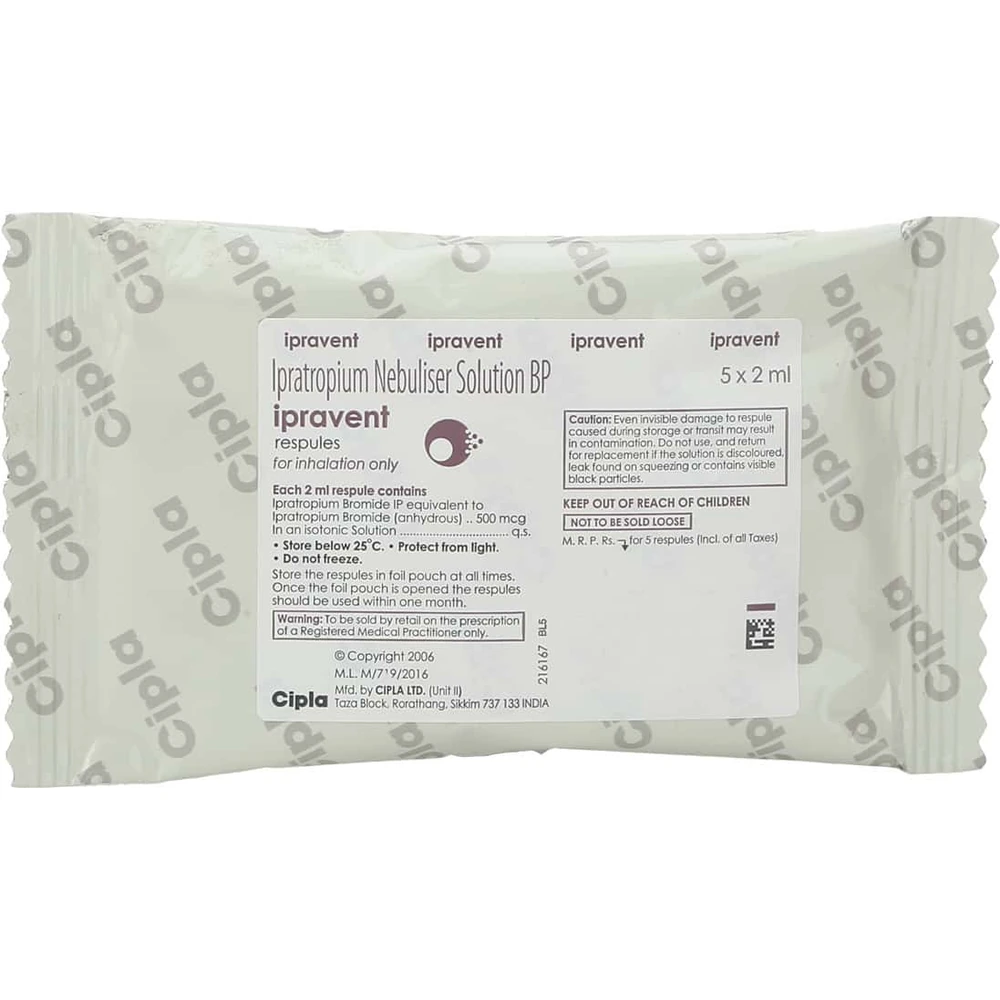
Ipravent Respules 2 ml contain ipratropium bromide 0.025% w/v solution for nebulisation, providing 500 mcg of ipratropium bromide per 2 ml unit-dose vial (respule). Ipratropium bromide is a short-acting muscarinic antagonist (SAMA) — the prototype anticholinergic bronchodilator — delivered here via nebuliser for maximum bronchodilator effect in patients who cannot use handheld inhalers or who require high-dose bronchodilator therapy. Nebulised ipratropium is particularly important in acute severe and life-threatening asthma exacerbations and in COPD exacerbations, where it is used alongside nebulised short-acting beta-2 agonists (SABAs) such as salbutamol for additive bronchodilation. Ipratropium bromide is on the WHO List of Essential Medicines. The respule (unit-dose ampoule/vial) format is designed for direct loading into a nebuliser, ensuring accurate dosing and minimising contamination.
Mechanism of Action
Ipratropium bromide is a quaternary ammonium compound derived from atropine. It acts as a competitive antagonist at muscarinic acetylcholine receptors (M1, M2, M3) in bronchial smooth muscle and submucosal glands. The key therapeutic effects arise from M3 receptor antagonism:
- Bronchodilation: Normally, acetylcholine released from parasympathetic (vagal) nerve endings activates M3 receptors on bronchial smooth muscle, promoting bronchoconstriction. Ipratropium blocks this cholinergic bronchoconstriction, allowing the smooth muscle to relax and the airways to dilate. The bronchodilatory effect is greatest in the central (proximal) airways, where cholinergic tone is highest, making ipratropium particularly effective for large airway obstruction
- Reduced mucus hypersecretion: M3 antagonism in submucosal glands reduces cholinergic-driven mucus hypersecretion — a component of COPD and acute exacerbations
The quaternary ammonium structure of ipratropium gives it poor lipid solubility and limited gastrointestinal absorption after nebulisation. Systemic absorption from the lung is negligible. This means virtually no systemic anticholinergic effects (urinary retention, constipation, blurred vision, tachycardia) at therapeutic inhaled doses — a significant advantage over systemic anticholinergic drugs. Onset of bronchodilation occurs within 15–30 minutes; peak effect at 60–90 minutes; duration approximately 4–6 hours.
Indications
- Acute severe and life-threatening asthma (emergency/hospital use): BTS/SIGN, GINA, and NAEPP guidelines all recommend the addition of ipratropium bromide to nebulised salbutamol in moderate-to-severe acute asthma attacks. Multiple doses of combined ipratropium + salbutamol nebulisation produce greater bronchodilation than salbutamol alone, reduce hospitalisation rates, and decrease the need for systemic corticosteroids. It is particularly important in patients with inadequate response to initial SABA therapy
- Acute COPD exacerbations: Nebulised ipratropium is a mainstay of acute COPD exacerbation management, used in combination with salbutamol when patients cannot use dry powder or MDI devices effectively
- Chronic COPD maintenance bronchodilation: In patients who cannot use dry powder inhalers or MDIs, nebulised ipratropium provides maintenance bronchodilation. Long-acting muscarinic antagonists (LAMAs) such as tiotropium are preferred for COPD maintenance where available, but ipratropium respules remain important when nebuliser therapy is required (e.g. in elderly patients, those with severe dyspnoea, those in institutional care)
- Perennial and exercise-induced rhinorrhoea (off-label): Intranasal anticholinergics are established for rhinorrhoea; the nebulised preparation is not standard for this indication
Dosage and Administration
Nebulised Dosing
- Acute severe asthma (adults): 500 mcg (one 2 ml respule of 0.025%) every 20–30 minutes for the first 1–2 hours alongside nebulised salbutamol 2.5–5 mg; then every 4–6 hours as response permits
- Acute COPD exacerbation (adults): 500 mcg every 4–6 hours; may be combined with salbutamol 2.5–5 mg in the same nebuliser (physically compatible)
- Children ≥12 years: 250–500 mcg per dose as above; for acute severe asthma, same frequency as adults
- Children 5–12 years: 250 mcg (half a 2 ml respule, or use paediatric 1 ml formulation where available) per dose, every 20–30 minutes in acute asthma; every 4–6 hours for maintenance
- Children under 5 years: 125–250 mcg per dose under specialist supervision
- COPD chronic maintenance (nebuliser-dependent patients): 500 mcg three to four times daily
Nebuliser Technique
- Open the respule and squeeze the entire contents (2 ml) into the nebuliser chamber; for lower doses in children, discard the unused portion after the treatment session
- Connect the nebuliser to the oxygen or air flow source (6–8 L/min for most jet nebulisers); use a mouthpiece or tight-fitting face mask
- Breathe normally through the mouthpiece throughout the nebulisation session (approximately 10–15 minutes)
- Use a mouthpiece rather than a face mask where possible, to minimise periorbital deposition and risk of acute angle-closure glaucoma
- Discard any residual solution after the treatment session; do not reuse opened respules
- Clean the nebuliser chamber after each use according to the manufacturer’s instructions
Pharmacokinetics
- Absorption: Systemic absorption from inhaled ipratropium is minimal (<1% of inhaled dose reaches systemic circulation from lung); swallowed fraction also poorly absorbed due to quaternary ammonium structure
- Distribution: Does not cross the blood-brain barrier; minimal placental transfer
- Metabolism: Partially metabolised by ester hydrolysis to inactive metabolites
- Elimination: Excreted in urine (unchanged drug and metabolites) and faeces; terminal half-life approximately 2 hours
Contraindications
- Hypersensitivity to ipratropium bromide, atropine, or any anticholinergic drug, or to any excipient in the respule (benzalkonium chloride in some formulations)
- Some formulations contain benzalkonium chloride as a preservative — this may cause paradoxical bronchoconstriction in sensitive patients; preservative-free formulations preferred where bronchospasm is a concern
Warnings and Precautions
- Acute angle-closure glaucoma: Ipratropium mist reaching the eyes can precipitate acute angle-closure glaucoma in predisposed patients (narrow anterior chamber angle). Use a mouthpiece rather than a face mask whenever possible; if a face mask is required, ensure a tight seal to prevent nebuliser mist escaping around the eyes. If eye pain, blurred vision, or visual haloes develop, seek urgent ophthalmological assessment
- Urinary retention: Although systemic absorption is minimal, caution is required in patients with prostatic hypertrophy or bladder neck obstruction; rare cases of urinary retention have been reported
- Paradoxical bronchospasm: Some patients experience worsening bronchoconstriction after ipratropium inhalation, particularly with benzalkonium chloride-containing formulations; discontinue and use an alternative bronchodilator
- Not for acute rescue monotherapy: Ipratropium has a slower onset (15–30 min) than salbutamol (3–5 min); in acute severe bronchospasm requiring immediate relief, salbutamol should be given first or simultaneously
- Pregnancy: Limited data; use only if benefit outweighs risk
Adverse Effects
- Common (1–10%): Dry mouth; headache; throat irritation; cough; nausea; urinary hesitancy; constipation
- Uncommon: Tachycardia; palpitations; blurred vision; urinary retention; paradoxical bronchospasm; ocular hypertension
- Rare: Acute angle-closure glaucoma (from eye exposure); anaphylaxis; hypersensitivity reactions; ocular pain
Drug Interactions
- Other anticholinergic drugs (tiotropium, hyoscine, oxybutynin, tricyclic antidepressants): Additive anticholinergic effects; additive risk of urinary retention, dry mouth, constipation, and cognitive effects in the elderly
- Salbutamol (and other SABAs): Additive bronchodilation — the combination is intentional and recommended in acute severe asthma and COPD exacerbations. Physically compatible in the same nebuliser chamber
- Nebulised cromoglicate: Reports of physical incompatibility when mixed; administer separately
Storage
Store Ipravent Respules below 25°C in a dry place, protected from direct sunlight. Keep in the original foil pouch until use — the foil protects the solution from light degradation. Once a respule is opened, use immediately and discard any remaining solution. Keep out of reach of children. Do not use after the expiry date printed on the foil and outer carton.
Related Products
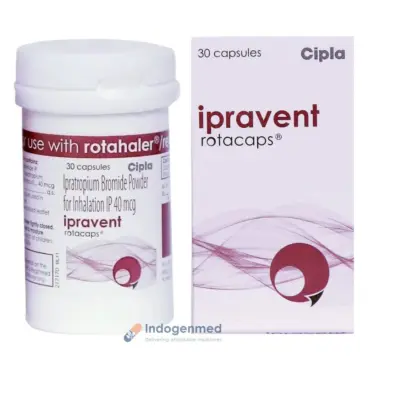
- Ipravent 40 mcg Capsules (ipratropium bromide 40 mcg Rotacap — same molecule in dry powder format for maintenance bronchodilation in patients able to use a Rotahaler)
- Seroflo 50+500 mcg Capsules (salmeterol 50 mcg + fluticasone 500 mcg Rotacap — ICS/LABA combination; ipratropium is often added when ICS/LABA is insufficient in severe COPD)
- Serobid 25 mcg Inhaler (salmeterol 25 mcg MDI — LABA bronchodilator; complementary mechanism to ipratropium SAMA for COPD maintenance)
References
- DailyMed. Atrovent (ipratropium bromide) inhalation solution — prescribing information. U.S. National Library of Medicine. Available at: https://dailymed.nlm.nih.gov/dailymed/
- Electronic Medicines Compendium (EMC). Atrovent Nebuliser Solution (ipratropium bromide) — Summary of Product Characteristics. Available at: https://www.medicines.org.uk/emc/
- MedlinePlus. Ipratropium Oral Inhalation. U.S. National Library of Medicine. Available at: https://medlineplus.gov/druginfo/meds/a601063.html
- Global Initiative for Asthma (GINA). Global Strategy for Asthma Management and Prevention — 2024 Report: Management of Acute Asthma. Available at: https://ginasthma.org/gina-reports/
- British Thoracic Society / SIGN. British Guideline on the Management of Asthma 2019 (updated 2023). Available at: https://www.brit-thoracic.org.uk/
Reviews
There are no reviews yet.