Description
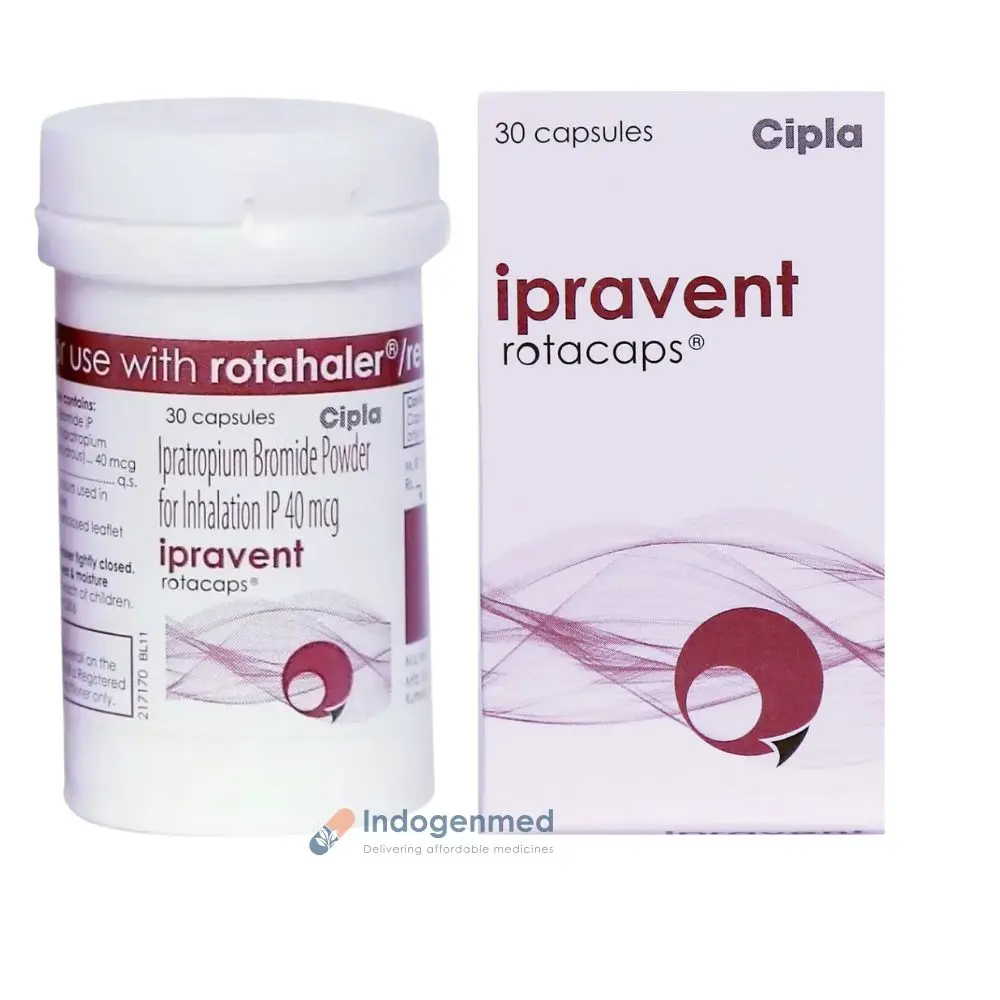
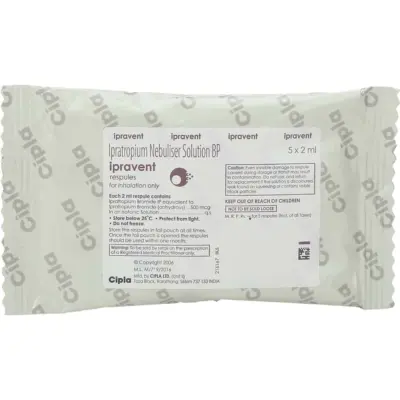
Ipravent 40 mcg Capsules – Ipratropium Bromide for Inhalation
Ipravent 40 mcg Capsules contain ipratropium bromide 40 mcg per capsule, formulated for use in a dry powder inhaler (DPI) device or via inhalation. Ipratropium bromide is a quaternary ammonium anticholinergic bronchodilator that acts by blocking muscarinic receptors in the airways, reducing bronchoconstriction and airway secretions. It is an established treatment for chronic obstructive pulmonary disease (COPD), including chronic bronchitis and emphysema, and may be used as a component of combination therapy in asthma management.
Composition
Each Ipravent 40 mcg capsule contains ipratropium bromide equivalent to 40 mcg for inhalation use. The capsule formulation is intended for use with an appropriate inhaler device; the capsule itself is not for swallowing. The dry powder or solution within is delivered directly to the airways upon actuation, ensuring local bronchodilatory effect with minimal systemic absorption.
Mechanism of Action
Ipratropium bromide is a competitive antagonist at muscarinic acetylcholine receptors in bronchial smooth muscle and the tracheobronchial tree. In the airways, acetylcholine released from parasympathetic (vagal) nerve endings stimulates M3 muscarinic receptors on smooth muscle, causing bronchoconstriction and increased secretion from airway glands. Ipratropium blocks this pathway, leading to bronchial smooth muscle relaxation, airway dilation, and a reduction in mucus hypersecretion.
Unlike atropine, ipratropium is a quaternary ammonium compound, which means it carries a permanent positive charge and is poorly absorbed across biological membranes including the blood-brain barrier and the gastrointestinal mucosa. This physicochemical property confines its pharmacological activity largely to the airways after inhalation, minimising systemic anticholinergic side effects such as tachycardia, urinary retention, and cognitive effects that occur with systemically absorbed anticholinergics.
Ipratropium blocks all muscarinic receptor subtypes (M1, M2, M3) in the lung without selectivity. While M3 blockade in airway smooth muscle drives bronchodilation, M2 blockade on presynaptic parasympathetic nerve endings can theoretically increase acetylcholine release, partially limiting M3-mediated bronchodilation. Despite this, the net effect in vivo is consistent, clinically meaningful bronchodilation in patients with airflow obstruction due to COPD.
Indications
Ipravent 40 mcg Capsules are indicated for:
- COPD (chronic obstructive pulmonary disease): Maintenance treatment of bronchoconstriction in COPD including chronic bronchitis and emphysema. Ipratropium is a cornerstone of COPD pharmacotherapy, as the dominant mechanism of airflow obstruction in COPD is cholinergic-mediated bronchoconstriction rather than the inflammatory eosinophilic mechanism typical of asthma. This makes anticholinergics particularly effective as bronchodilators in COPD.
- Asthma: As an adjunct to beta-2 agonist therapy for acute asthma or in patients who cannot tolerate or have insufficient response to beta-2 agonists alone. It is not a first-line treatment for chronic asthma but provides additive bronchodilation when combined with salbutamol in acute severe asthma.
- Rhinorrhoea associated with the common cold or allergic rhinitis: Some formulations of ipratropium (nasal spray) are used for rhinorrhoea, though the inhaled capsule form targets lower airway indications.
Dosage and Administration
Ipravent 40 mcg Capsules are for inhalation use only. Each capsule must be placed in the designated inhaler device and punctured before inhalation; the capsule should never be swallowed. The recommended dose for COPD maintenance is typically one to two capsules (40–80 mcg) three to four times daily, with a maximum of 12 capsules (480 mcg) per 24 hours. The dosing schedule should be maintained consistently, as ipratropium’s bronchodilatory effect in COPD is primarily maintenance-oriented rather than rescue-oriented.
In acute asthma exacerbations, ipratropium is typically combined with a short-acting beta-2 agonist (SABA) such as salbutamol for additive bronchodilation. Patients should be instructed to exhale fully before inhalation, place the mouthpiece in the mouth, and inhale forcefully to draw the powder into the airways. Breath-holding for 5–10 seconds after inhalation maximises airway deposition.
Pharmacokinetics
After inhalation, approximately 10–30% of the inhaled dose is deposited in the lower airways; the remainder is deposited in the oropharynx and swallowed. Systemic absorption from both the lung and gastrointestinal tract is minimal due to ipratropium’s quaternary ammonium structure. Plasma protein binding is approximately 0% (essentially unbound), with an elimination half-life of approximately 1.6–2.0 hours. The onset of bronchodilatory action occurs within 15 minutes of inhalation, with peak effect at 1–2 hours and duration of action of approximately 3–6 hours, supporting three-to-four times daily dosing in COPD maintenance.
Approximately 50–60% of the systemically absorbed fraction is excreted unchanged in the urine. Because systemic absorption is low, ipratropium has minimal impact on heart rate, intraocular pressure, urinary function, or gastrointestinal motility at standard inhaled doses. This safety profile is particularly advantageous in elderly COPD patients who often have comorbid cardiovascular disease, benign prostatic hyperplasia, or glaucoma.
Drug Interactions
Clinically significant interactions with ipratropium include:
- Anticholinergic drugs (e.g., tiotropium, glycopyrrolate, oxybutynin, tricyclic antidepressants): Additive anticholinergic effects, increasing the risk of urinary retention, constipation, dry mouth, and—importantly—angle-closure glaucoma if the aerosol contacts the eye.
- Beta-2 agonists (salbutamol, formoterol): Pharmacologically complementary. Combination provides additive bronchodilation and is widely used in COPD and acute asthma. Fixed-dose combination inhalers containing both ipratropium and salbutamol are available specifically for this reason.
- Xanthines (theophylline, aminophylline): No direct pharmacokinetic interaction, but additive bronchodilatory effects occur through different mechanisms.
Contraindications and Precautions
Ipravent 40 mcg Capsules are contraindicated in patients with hypersensitivity to ipratropium bromide, atropine, or other anticholinergic compounds, or to any excipient. Use with caution in patients with narrow-angle glaucoma (avoid getting aerosol or solution in the eyes), benign prostatic hyperplasia, or bladder neck obstruction. Although inhalation routes significantly limit systemic exposure, eyes should be protected during inhalation, particularly when using nebulised formulations, to avoid precipitation of acute angle-closure glaucoma.
Ipratropium has not been associated with the life-threatening paradoxical bronchospasm reported occasionally with beta-2 agonist inhalers, but rare paradoxical bronchoconstriction can occur and should prompt discontinuation. It should be used as maintenance therapy, not as an acute rescue inhaler; patients should have a SABA available for breakthrough symptoms.
Adverse Effects
The most common adverse effects of inhaled ipratropium are those of local deposition in the upper airway: dry mouth (most common, affecting up to 10% of users), throat irritation, and cough. Systemic anticholinergic effects are uncommon at standard inhaled doses but can include urinary hesitancy (in susceptible patients with BPH), constipation, and blurred vision if drug contacts the eyes. Paradoxical bronchospasm and hypersensitivity reactions are rare but should be considered if symptoms worsen after administration. No clinically significant cardiovascular effects are observed at standard doses.
Use in Special Populations
Elderly: COPD primarily affects elderly patients. The poor systemic absorption profile of ipratropium makes it relatively safe in older adults with cardiovascular comorbidities. Monitoring for urinary symptoms in male patients with prostatic hypertrophy is prudent.
Renal and hepatic impairment: No dose adjustments are required, given minimal systemic exposure.
Pregnancy and lactation: Although systemic absorption is minimal, use during pregnancy should be based on careful benefit-risk assessment, particularly in the first trimester.
Comparison with Long-Acting Anticholinergics
While ipratropium remains an effective and well-established bronchodilator, long-acting muscarinic antagonists (LAMAs) such as tiotropium (once daily), glycopyrrolate, and umeclidinium have largely superseded it as preferred maintenance agents in COPD according to current GOLD guidelines. LAMAs offer superior 24-hour bronchodilation, greater improvements in hyperinflation and exercise capacity, and reduced exacerbation rates with once-daily convenience. Ipratropium retains a role where longer-acting options are not tolerated, in combination therapy with beta-2 agonists, and in certain acute exacerbation settings.
Storage
Store at 25°C (77°F) or below, with excursions permitted to 15–30°C. Protect from moisture and light. Keep capsules in the original blister packaging until immediately before use. Keep out of reach of children.
Related Products
- Lan 30 mg Tablets (Lansoprazole) – Proton pump inhibitor commonly co-prescribed in COPD patients on inhaled or systemic corticosteroids to protect the gastric mucosa
- Kenacort 1 mL Injection (Triamcinolone) – Corticosteroid for severe asthma or COPD exacerbations unresponsive to inhaled therapy; often used alongside bronchodilators
- Lipril 10 mg Tablets (Lisinopril) – Cardiovascular risk management; note ACE inhibitor-induced cough can mimic or worsen respiratory symptoms in COPD patients
References
- U.S. Food and Drug Administration. Atrovent (ipratropium bromide) Inhalation Solution Prescribing Information. Boehringer Ingelheim. Available at: FDA.gov
- National Library of Medicine – DailyMed. Ipratropium Bromide Inhalation Solution Label. dailymed.nlm.nih.gov
- MedlinePlus. Ipratropium Oral Inhalation. U.S. National Library of Medicine. medlineplus.gov
- Global Initiative for Chronic Obstructive Lung Disease (GOLD). Global Strategy for the Diagnosis, Management and Prevention of COPD. 2024 Report. goldcopd.org
Reviews
There are no reviews yet.