Description
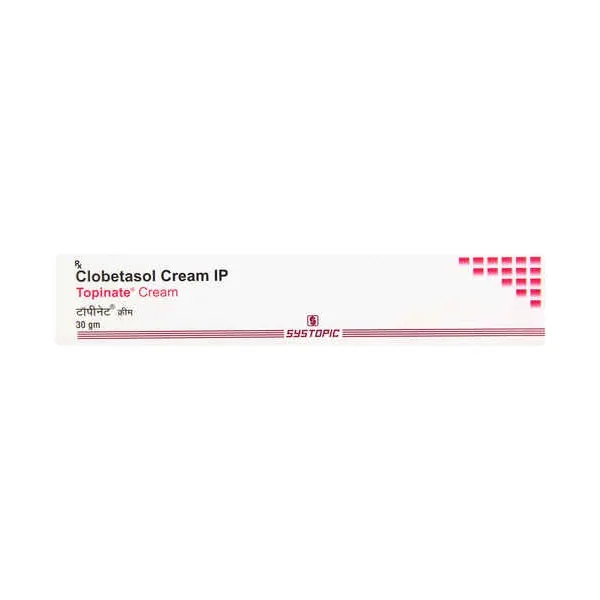
What Is Topinate 30 gm 0.05% Cream?
Topinate 30 gm 0.05% Cream contains clobetasol propionate 0.05% — a Class I (US) / Group IV (UK) superpotent topical corticosteroid, the highest potency category of topical steroids available. Clobetasol propionate at 0.05% is approximately 1800 times more potent than hydrocortisone on a weight basis and delivers the strongest anti-inflammatory, anti-pruritic, and vasoconstrictive effects of any topical corticosteroid formulation used in routine clinical practice. It is reserved for severe, recalcitrant inflammatory dermatoses unresponsive to lower-potency topical steroids, and is used in short, defined courses with careful attention to total dose, treated body surface area, and duration of use.
The cream formulation of clobetasol propionate 0.05% is suitable for moist, weeping, or acute inflammatory lesions and for use on the trunk and limbs; ointment formulations are preferred for dry, hyperkeratotic, or plaque-type lesions and have higher occlusive effect. The 30 g tube provides a quantity for a standard short treatment course for localised disease. Clobetasol propionate is never appropriate for routine long-term maintenance therapy due to its high risk of local and systemic side effects with prolonged use.
Mechanism of Action
Glucocorticoid Receptor Activation
Clobetasol propionate diffuses across the keratinocyte cell membrane and binds with high affinity to the intracellular glucocorticoid receptor (GR). The clobetasol–GR complex translocates to the nucleus and acts as a transcription factor, binding to glucocorticoid response elements (GREs) in DNA. This modulates the expression of multiple genes, producing the following key effects: induction of annexin-1 (lipocortin-1), which inhibits phospholipase A2 and thereby blocks the release of arachidonic acid — the precursor for both prostaglandins and leukotrienes; inhibition of pro-inflammatory cytokine transcription (IL-1, IL-6, TNF-α, IL-8); and reduction in the expression of adhesion molecules that recruit inflammatory cells to the skin.
Vasoconstriction and Anti-Oedema Effects
Topical corticosteroids, particularly superpotent agents like clobetasol, produce marked cutaneous vasoconstriction by reducing endothelial permeability and suppressing the release of vasodilatory mediators. This reduces the erythema, oedema, and weeping associated with acute inflammatory dermatoses. The vasoconstriction assay (McKenzie-Stoughton blanching test) is the standard pharmacodynamic method used to rank corticosteroid potency — clobetasol 0.05% consistently achieves maximum vasoconstriction at the shortest exposure time.
Anti-Proliferative Effects
Clobetasol suppresses epidermal keratinocyte proliferation, reducing the epidermal thickening (acanthosis) seen in conditions such as psoriasis and lichen simplex chronicus. This anti-proliferative effect also underlies the risk of skin atrophy with prolonged use: corticosteroid-induced inhibition of fibroblast collagen synthesis and reduction in dermal glycosaminoglycans produce clinically visible thinning of the skin, telangiectasia, and striae with chronic exposure.
Indications
Severe Plaque Psoriasis
Topinate 0.05% Cream is a first-line option for severe, recalcitrant plaque psoriasis of the trunk and limbs — where thick, well-demarcated, erythematous plaques with heavy scale have failed to respond adequately to moderate-potency corticosteroids. For scalp psoriasis, clobetasol propionate scalp solution or foam formulations are used. Clobetasol should not be used on the face, flexures, or genital skin for psoriasis — lower-potency agents or calcineurin inhibitors (tacrolimus, pimecrolimus) are preferred for these sites.
Severe Eczema/Atopic Dermatitis (Adults)
For severe flares of atopic dermatitis in adults — particularly lichenified (thick, leathery) eczema of the limbs and trunk — clobetasol propionate provides rapid, potent anti-inflammatory and anti-itch relief when lower-potency steroids have been inadequate. Treatment should be limited to short courses (maximum 2 weeks continuous); proactive maintenance with moderate-potency steroids or tacrolimus is preferable for long-term management.
Discoid Lupus Erythematosus and Lichen Planus
Clobetasol propionate 0.05% is a standard treatment for discoid lupus erythematosus (DLE) — chronic scarring plaques that, if untreated, lead to permanent skin atrophy and pigmentary change. It is also used for hypertrophic lichen planus — a particularly treatment-resistant variant of lichen planus causing thick, pruritic plaques on the limbs.
Lichen Sclerosus
Clobetasol propionate 0.05% is the gold-standard first-line treatment for lichen sclerosus — a chronic inflammatory dermatosis causing atrophy, whitening, and scarring of the anogenital skin, with significant impact on quality of life and risk of squamous cell carcinoma at the affected site. Standard induction regimens involve twice-daily application for 4 weeks, reducing to once daily for 4 weeks, then every other day — under specialist supervision.
Other Severe Inflammatory Dermatoses
Clobetasol is used in severe allergic contact dermatitis (after the trigger is identified and removed), severe seborrhoeic dermatitis on the scalp (using solution formulations), alopecia areata, and in acute exacerbations of other inflammatory dermatoses unresponsive to lower-potency treatments.
Dosage and Administration
General: Apply a thin layer of Topinate 0.05% Cream to the affected area twice daily (morning and evening) until the flare is controlled — typically no more than 2 consecutive weeks, then reassess. Do not use more than 50 g per week in adults.
Maximum duration: Short courses only — 2 weeks for most conditions, up to 4 weeks under specialist supervision for specific indications (lichen sclerosus, hypertrophic lichen planus). Prolonged continuous use is not appropriate due to risk of skin atrophy, HPA axis suppression, and systemic effects.
Restricted areas: Do not apply to the face, groin, axillae, or genital skin (except under specialist supervision for specific indications such as lichen sclerosus). Do not apply under occlusive dressings unless specifically instructed — occlusion greatly increases absorption and systemic risk.
Children: Avoid in children under 12 years except under specialist supervision. Children have a higher surface-area-to-body-weight ratio and are at greater risk of systemic absorption and HPA axis suppression.
Application: Apply sparingly with clean fingertips. Rub in gently. Avoid contact with eyes. Wash hands after application.
Contraindications
- Known hypersensitivity to clobetasol propionate, other corticosteroids, or any excipient.
- Rosacea, perioral dermatitis — corticosteroids worsen both conditions.
- Primary cutaneous infections (bacterial, fungal, viral) — treat the infection first; clobetasol immunosuppression may allow uncontrolled infection spread.
- Acne vulgaris — corticosteroids worsen steroid acne.
- Perianal and genital pruritus caused by candidiasis — use antifungal treatment.
- Application to the face, except under specialist direction.
- Children under 1 year of age.
Warnings and Precautions
HPA axis suppression and systemic effects: Clobetasol propionate 0.05% can suppress the hypothalamic–pituitary–adrenal (HPA) axis — particularly with large amounts, long treatment duration, or use under occlusion. Systemic effects including Cushing’s syndrome, hyperglycaemia, and growth retardation in children may occur. Use the minimum effective amount for the shortest possible duration.
Skin atrophy: Prolonged use causes irreversible skin thinning, telangiectasia, striae, and bruising — particularly at the face, flexures, and genital skin. These sites must not be treated with clobetasol unless under specialist supervision for a specific indication.
Rebound: Abrupt discontinuation after prolonged use may cause rebound flare of the underlying condition — taper by reducing frequency or switching to a lower-potency agent rather than stopping abruptly.
Steroid acne and perioral dermatitis: Clobetasol applied to the face causes steroid rosacea and perioral dermatitis — apply to the face only when specifically indicated and supervised by a specialist.
Secondary infection: Prolonged topical corticosteroid use predisposes to secondary bacterial and fungal superinfection. If skin infection occurs, discontinue clobetasol and treat the infection.
Adverse Effects
- Very common: Local burning, stinging, and pruritus at the application site (especially at initiation).
- Common: Skin atrophy, striae, telangiectasia, skin dryness, folliculitis.
- Uncommon: Steroid acne, perioral dermatitis, hypertrichosis, skin discolouration.
- Rare: HPA axis suppression, Cushingoid features (moon face, buffalo hump, striae), hyperglycaemia — with excessive use or large body surface area application.
- Very rare: Glaucoma (from periorbital or eyelid application or from hand-to-eye transfer), allergic contact dermatitis to clobetasol or vehicle excipients.
Drug Interactions
- Other topical corticosteroids: Avoid concurrent use — additive adrenal suppression risk and no therapeutic benefit from combining corticosteroids of different potencies.
- CYP3A4 inhibitors (itraconazole, ritonavir): May reduce clobetasol metabolism if significant systemic absorption occurs, increasing systemic corticosteroid exposure — monitor for signs of corticosteroid excess with these combinations.
- Live vaccines: Significant systemic absorption of clobetasol (high dose, prolonged course, large area) produces immunosuppression — avoid live attenuated vaccines during such courses.
Storage
Store below 25°C. Do not freeze. Keep tube tightly closed. Keep out of reach of children. Protect from light. Do not use after the expiry date printed on the tube.
Related Products
For retinoid-based treatment of psoriasis and acne to combine with or use as maintenance after clobetasol, see Tazret 0.05% 20 gm Gel (tazarotene). For calcineurin inhibitor maintenance therapy of atopic dermatitis on sensitive skin areas, see Tacroz 0.1% 10 gm Ointment (tacrolimus). For antibiotic management of infected eczema or impetigo, see T-Bact 7.5 gm Cream (mupirocin 2%).
References
- Electronic Medicines Compendium (EMC). Dermovate 0.05% Cream — Summary of Product Characteristics. Available at: https://www.medicines.org.uk/emc
- National Library of Medicine MedlinePlus. Clobetasol Topical. Available at: https://medlineplus.gov/druginfo/meds/a603013.html
- Mayo Clinic. Clobetasol (Topical Route). Available at: https://www.mayoclinic.org
- Mason AR, Mason J, Cork M, et al. Topical treatments for chronic plaque psoriasis. Cochrane Database Syst Rev. 2013;3:CD005028. PubMed PMID: 23543539
- Funaro D, Lovett A, Leroux N, Powell J. A double-blind, randomized prospective study evaluating topical clobetasol propionate 0.05% versus topical tacrolimus 0.1% in patients with vulvar lichen sclerosus. J Am Acad Dermatol. 2014;71(1):84–91. PubMed PMID: 24709272
Reviews
There are no reviews yet.