Description
What are Cifran OD 1000 Mg Tablets?
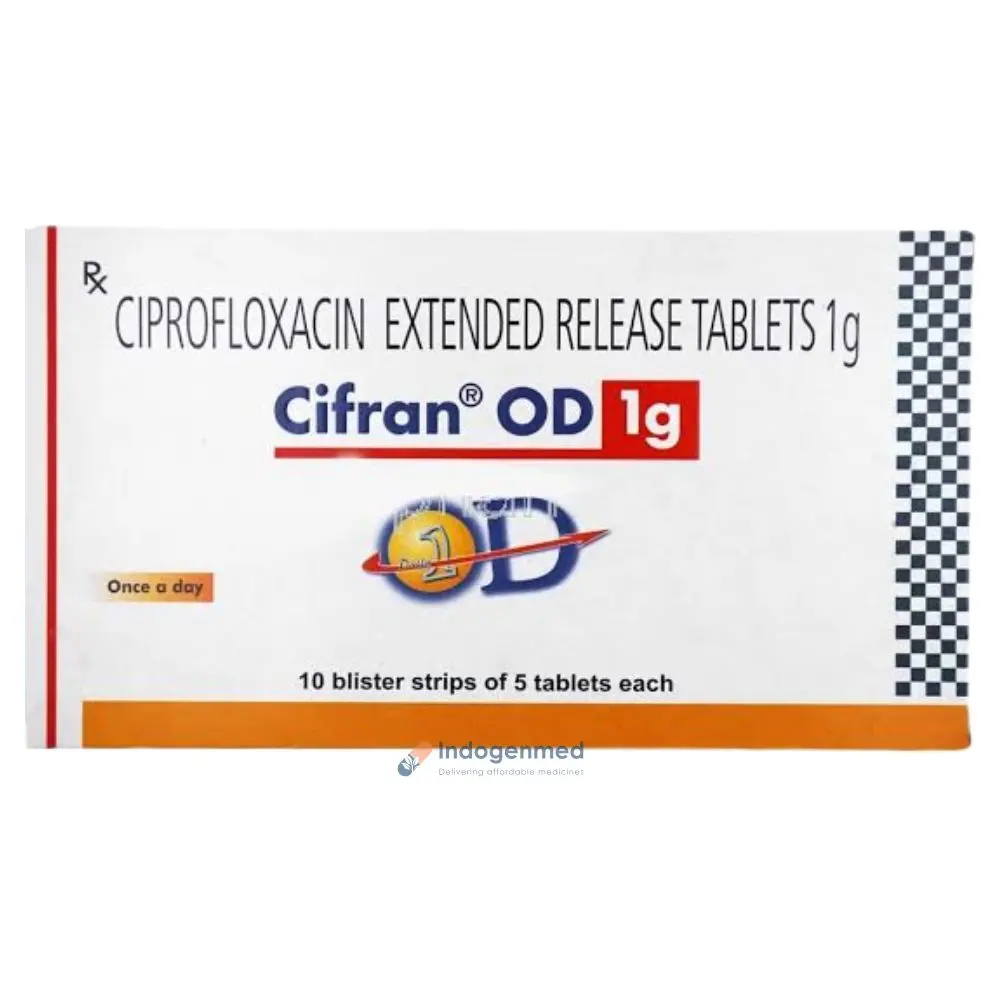
Cifran OD 1000 Mg Tablets contain Ciprofloxacin 1000 mg in an extended-release (XR) formulation, designed to be taken once daily (OD). Ciprofloxacin is a fluoroquinolone antibiotic with broad-spectrum activity against a wide range of bacterial infections. The extended-release tablet delivers ciprofloxacin over an extended period, maintaining therapeutic blood and tissue levels with a single daily dose — clinically equivalent to the conventional 500 mg twice-daily tablet for approved indications.
Cifran OD 1000 Mg Tablets are manufactured by Sun Pharmaceutical Industries Ltd., one of India’s largest and internationally recognised pharmaceutical companies. Each strip contains 10 tablets.
Prescription only (Rx). Use Cifran OD only as prescribed by a doctor. Do not use leftover antibiotics or self-prescribe. Complete the full course as directed.
Composition
| Component | Detail |
|---|---|
| Active ingredient | Ciprofloxacin 1000 mg (as extended-release tablet) |
| Drug class | Fluoroquinolone antibiotic (second generation) |
| Formulation type | Extended-release (XR) oral tablet — once daily (OD) |
| Pack size | 10 tablets per strip |
| Manufacturer | Sun Pharmaceutical Industries Ltd., India |
| Medicine type | Generic (Rx — prescription required) |
About Sun Pharmaceutical Industries Ltd.
Sun Pharmaceutical Industries Ltd. is India’s largest pharmaceutical company by market capitalisation and one of the top five specialty generic pharmaceutical companies globally. Founded in 1983 in Mumbai and listed on the BSE and NSE, Sun Pharma operates manufacturing facilities approved by the US FDA, the UK MHRA, and regulatory authorities in over 100 countries, supplying medicines to hospitals, clinics, and pharmacies worldwide.
How Ciprofloxacin Works
Ciprofloxacin is a bactericidal fluoroquinolone antibiotic — it kills bacteria rather than merely inhibiting their growth. It works by inhibiting two essential bacterial enzymes:
- DNA gyrase (topoisomerase II): An enzyme that relieves tension in bacterial DNA ahead of the replication fork. Ciprofloxacin traps the enzyme-DNA complex in a broken state, preventing DNA strand re-ligation and halting DNA replication.
- Topoisomerase IV: Required for the segregation of replicated chromosomes into daughter cells. Inhibition prevents bacteria from completing cell division.
By simultaneously disrupting both enzymes, ciprofloxacin causes lethal double-strand DNA breaks in the bacterial cell, leading to rapid bacterial death. Because these enzymes are structurally distinct from the equivalent enzymes in human cells, ciprofloxacin has selective toxicity against bacteria.
Spectrum of Activity
Ciprofloxacin has broad-spectrum activity, covering:
- Gram-negative bacteria: Escherichia coli, Klebsiella pneumoniae, Proteus mirabilis, Pseudomonas aeruginosa, Salmonella typhi, Haemophilus influenzae, Neisseria gonorrhoeae
- Gram-positive bacteria (moderate activity): Staphylococcus aureus (including some MRSA), Streptococcus pneumoniae (variable)
- Atypical organisms: Mycoplasma, Chlamydia, Legionella
- Anthrax: Bacillus anthracis (approved for post-exposure prophylaxis)
Ciprofloxacin is not effective against anaerobic bacteria. Streptococcal and Enterococcal infections are better treated with other antibiotics.
Why the Extended-Release (OD) Formulation?
Conventional ciprofloxacin tablets (250 mg or 500 mg) require dosing two or three times daily to maintain therapeutic levels. The extended-release formulation delivers both an immediate and a delayed-release component in one tablet, sustaining ciprofloxacin plasma concentrations throughout the day with a single dose. This improves patient adherence, reduces peak-to-trough fluctuations, and minimises the burden of twice-daily dosing — particularly relevant for courses lasting 3–28 days.
Indications: When Is Cifran OD 1000 Mg Prescribed?
Ciprofloxacin XR 1000 mg once daily is approved for the following bacterial infections (culture and sensitivity testing should guide treatment wherever possible):
- Complicated urinary tract infections (cUTI): Infections involving the upper urinary tract or caused by pathogens resistant to simpler antibiotics, or occurring in patients with structural urinary abnormalities, catheterisation, or immunocompromise. Typical course: 7–14 days.
- Uncomplicated urinary tract infections / acute cystitis: Community-acquired bladder infections (primarily caused by E. coli) in adult women. The 1000 mg OD formulation offers a convenient 3-day treatment course. This indication is reserved for situations where no other suitable antibiotic is appropriate — fluoroquinolones are not recommended as first-line for uncomplicated UTIs due to antibiotic stewardship concerns.
- Acute uncomplicated pyelonephritis (kidney infection): Bacterial infection of the kidney causing fever, flank pain, and systemic symptoms. Ciprofloxacin achieves high renal parenchymal concentrations and is effective against the gram-negative pathogens most commonly responsible. Course: 7–14 days (OD formulation).
- Chronic bacterial prostatitis: E. coli and other Enterobacteriaceae are the main causative organisms. Ciprofloxacin penetrates prostate tissue well, making it one of the recommended agents for this difficult-to-treat condition. Course: typically 28 days.
- Anthrax — inhalational post-exposure prophylaxis: Following confirmed or suspected exposure to Bacillus anthracis spores. Ciprofloxacin is one of the recommended agents for prophylaxis and treatment. 60-day course.
Ciprofloxacin should only be used for infections caused by, or strongly suspected to be caused by, susceptible bacteria. Inappropriate use promotes antibiotic resistance.
Dosage and Administration
Cifran OD 1000 Mg tablets are taken once daily, with or without food. Swallow the tablet whole — do not crush, split, or chew the extended-release tablet, as this would disrupt the controlled-release mechanism and lead to an overdose-equivalent peak concentration. Take at the same time each day. Maintain adequate fluid intake throughout treatment.
| Indication | Dose | Duration |
|---|---|---|
| Uncomplicated UTI (acute cystitis) | 1000 mg once daily | 3 days |
| Complicated UTI | 1000 mg once daily | 7–14 days |
| Acute pyelonephritis | 1000 mg once daily | 7–14 days |
| Chronic bacterial prostatitis | 1000 mg once daily | 28 days |
| Anthrax (post-exposure prophylaxis) | 500 mg twice daily (conventional tablet — specialist use) | 60 days |
All doses and durations are subject to your doctor’s assessment of the infection type, severity, culture and sensitivity results, and your renal function. Do not stop the course early, even if you feel better — stopping early risks bacterial relapse and promotes resistance.
Important: Do not crush or chew the Cifran OD tablet. Swallow whole. Crushing releases the entire dose at once.
Special Populations
Renal Impairment
Ciprofloxacin is primarily renally eliminated (approximately 40–50% of the dose excreted unchanged in urine). Dose reduction is necessary in moderate-to-severe renal impairment (creatinine clearance <30 mL/min). The extended-release tablet should generally not be used in severe renal impairment (CrCl <30 mL/min); the conventional immediate-release tablet at a reduced dose is preferred in such patients. Haemodialysis patients require specific dose adjustments. Your doctor will adjust the dose based on your eGFR/creatinine clearance results.
Hepatic (Liver) Impairment
Mild-to-moderate hepatic impairment does not significantly alter ciprofloxacin pharmacokinetics, as it is primarily renally eliminated. Caution is advised in severe hepatic impairment; no specific dose adjustment is established, so use under specialist guidance.
Elderly Patients
Elderly patients are at higher risk of ciprofloxacin-associated tendinitis and tendon rupture, particularly if also taking corticosteroids or with a history of tendon disorders. The risk–benefit should be carefully assessed. Renal function declines with age; dose adjustments based on actual renal function are important. Falls risk from CNS effects (dizziness, confusion) should be assessed.
Pregnancy
Ciprofloxacin is classified Pregnancy Category C. Animal studies have shown that fluoroquinolones cause arthropathy (joint damage) in developing animals. While no adequate controlled human studies exist, ciprofloxacin should be avoided during pregnancy unless there is no safe alternative and the benefit clearly outweighs the risk. If you are pregnant or planning to become pregnant, tell your doctor before taking Cifran OD.
Breastfeeding
Ciprofloxacin passes into breast milk. Use during breastfeeding is generally not recommended because of the theoretical risk of arthropathy in the infant. Discuss with your doctor whether to pause breastfeeding during treatment or use an alternative antibiotic.
Paediatric Use
Ciprofloxacin is not generally recommended in children and adolescents under 18 years (due to arthropathy risk in growing joints), except for specific indications such as complicated UTIs, anthrax prophylaxis, and certain other infections where no safer alternative exists. Paediatric use requires specialist supervision.
Important Safety Warnings
Tendinitis and Tendon Rupture
Fluoroquinolones including ciprofloxacin have been associated with an increased risk of tendinitis and tendon rupture, most commonly affecting the Achilles tendon. Rupture can occur during or up to several months after completing treatment. Risk is higher in patients over 60, those taking corticosteroids, and those with kidney, heart, or lung transplants. Discontinue Cifran OD immediately and rest the affected limb if you experience pain, swelling, or inflammation in a tendon. Contact your doctor promptly.
Peripheral Neuropathy
Ciprofloxacin can cause peripheral neuropathy — nerve damage manifesting as pain, burning, tingling, numbness, or weakness, typically in the hands and feet. This can occur rapidly after starting treatment and may persist for months or years, or be permanent. Discontinue immediately and contact your doctor if these symptoms develop.
Central Nervous System Effects
CNS side effects including dizziness, agitation, insomnia, anxiety, confusion, tremors, and, rarely, hallucinations and seizures can occur. Use with caution in patients with a history of seizures, CNS disorders, or cerebrovascular disease. Avoid driving or operating machinery if affected.
QT Interval Prolongation
Ciprofloxacin can prolong the cardiac QT interval, potentially triggering serious ventricular arrhythmias including torsades de pointes. Avoid use in patients with known QT prolongation, uncorrected hypokalaemia, or those taking other QT-prolonging medicines (including certain antiarrhythmics, antipsychotics, and antimalarials). An ECG may be appropriate in high-risk patients.
Clostridioides difficile (C. diff) Associated Diarrhoea
Antibiotic-associated colitis due to Clostridioides difficile can occur during or after fluoroquinolone treatment. If you develop severe or persistent diarrhoea (which may be watery or bloody) during or after taking Cifran OD, stop the antibiotic and contact your doctor promptly. Do not use antidiarrhoeal agents, as they may delay diagnosis.
Myasthenia Gravis
Ciprofloxacin can exacerbate muscle weakness in patients with myasthenia gravis and has caused life-threatening respiratory failure in such patients. Cifran OD must not be used in patients with known myasthenia gravis.
Precautions
- Antacids, calcium, iron, zinc: Products containing aluminium, magnesium, calcium, iron, or zinc (antacids, dairy products, multivitamins, sucralfate) significantly reduce ciprofloxacin absorption by chelation. Take Cifran OD at least 2 hours before or 6 hours after these products. Dairy products and calcium-enriched juices should not be taken simultaneously.
- Glucose-6-phosphate dehydrogenase (G6PD) deficiency: Ciprofloxacin can cause haemolytic anaemia in patients with G6PD deficiency. Use with caution and monitor haematological status.
- Crystalluria: Ciprofloxacin can form crystals in the urine if the patient is dehydrated. Maintain adequate fluid intake (at least 1.5–2 litres per day) throughout treatment to prevent crystalluria.
- Photosensitivity: Ciprofloxacin may increase sensitivity to ultraviolet (UV) light, causing exaggerated sunburn reactions. Avoid prolonged sun exposure, use broad-spectrum high-SPF sunscreen, and wear protective clothing. Avoid tanning beds.
- Diabetes: Ciprofloxacin can cause both hypoglycaemia and hyperglycaemia, particularly in patients with diabetes taking insulin or oral antidiabetic agents. Monitor blood glucose during treatment.
- Antibiotic resistance and stewardship: Fluoroquinolones are a critically important antibiotic class. They should not be used for mild infections (e.g., uncomplicated UTI) if an equally effective first-line antibiotic is available, or for viral infections (colds, flu). Always complete the prescribed course.
Contraindications
Cifran OD 1000 Mg Tablets must not be used in patients with:
- Known hypersensitivity to ciprofloxacin, other fluoroquinolones, or any tablet excipient
- Concomitant use with tizanidine (severe hypotension and sedation risk — CYP1A2 inhibition)
- Known QT prolongation or history of serious ventricular arrhythmias (relative — use with extreme caution)
- Myasthenia gravis (may exacerbate muscle weakness; life-threatening respiratory failure reported)
- Previous ciprofloxacin-associated tendon damage
- Pregnancy (relative — avoid unless absolutely necessary)
- Children under 18 (relative — except specific specialist-supervised indications)
- Severe renal impairment (CrCl <30 mL/min) — switch to immediate-release ciprofloxacin at adjusted dose
Side Effects
Like all antibiotics, Cifran OD can cause side effects, though not all people experience them.
Common Side Effects (may affect up to 1 in 10 people)
- Nausea
- Diarrhoea
- Vomiting or stomach discomfort
- Dizziness or headache
- Elevated liver enzymes (AST/ALT) on blood tests — usually asymptomatic and reversible
- Rash or skin irritation
Less Common Side Effects (may affect up to 1 in 100 people)
- Insomnia, restlessness, or agitation
- Taste disturbance
- Joint pain or stiffness
- Photosensitivity reactions
- Elevated creatinine (mild renal function change)
- Yeast/fungal infections (oral or vaginal thrush) due to disruption of normal flora
- Blood glucose disturbances (hypoglycaemia or hyperglycaemia)
Rare but Serious — Seek Immediate Medical Help
- Tendinitis or tendon rupture (especially Achilles tendon) — stop and rest immediately; call doctor
- Peripheral neuropathy — pain, numbness, or weakness in hands/feet; stop and contact doctor
- Severe skin reactions — Stevens-Johnson syndrome (SJS), toxic epidermal necrolysis (TEN)
- Anaphylaxis or severe allergic reaction
- Severe or bloody diarrhoea — possible C. difficile colitis
- Seizures, hallucinations, or psychosis
- Hepatitis or jaundice (rare; stop immediately)
- QT prolongation or arrhythmia
- Haemolytic anaemia (particularly in G6PD deficiency)
- Exacerbation of myasthenia gravis
Report any unexpected or worsening symptoms to your doctor promptly. If you develop difficulty breathing, facial swelling, or severe skin blistering, seek emergency medical attention immediately.
Drug Interactions
Always tell your doctor and pharmacist about all medicines, supplements, herbal products, and vitamins you are taking before starting Cifran OD. Important interactions include:
- Tizanidine (muscle relaxant): Contraindicated. Ciprofloxacin is a potent inhibitor of CYP1A2, the enzyme that metabolises tizanidine. Co-administration causes a dramatic rise in tizanidine plasma levels, leading to severe hypotension and sedation.
- Theophylline (for asthma/COPD): Ciprofloxacin inhibits CYP1A2, increasing theophylline levels significantly. Theophylline toxicity (nausea, vomiting, seizures, arrhythmias) can occur. Monitor theophylline levels and reduce the dose if necessary; avoid the combination if possible.
- Antacids, sucralfate, dairy, iron, zinc, multivitamins: Products containing aluminium, magnesium, calcium, iron, or zinc chelate ciprofloxacin in the gut and reduce oral absorption by up to 90%. Take Cifran OD at least 2 hours before or 6 hours after such products.
- Warfarin and other anticoagulants: Ciprofloxacin can increase the anticoagulant effect of warfarin, raising the INR and the risk of bleeding. Monitor INR closely when starting, stopping, or changing the ciprofloxacin dose; adjust the warfarin dose as needed.
- NSAIDs (ibuprofen, naproxen): Combined use with ciprofloxacin may increase the risk of CNS stimulation and seizures. Use with caution.
- Antidiabetic medicines (insulin, sulphonylureas): Ciprofloxacin can cause symptomatic hypoglycaemia or hyperglycaemia in patients taking these agents. Monitor blood glucose closely; adjust doses as needed.
- QT-prolonging medicines: Avoid combining ciprofloxacin with other QT-prolonging agents (certain antiarrhythmics such as amiodarone, sotalol; antipsychotics; antimalarials such as hydroxychloroquine). The additive QT effect can trigger dangerous arrhythmias.
- Methotrexate: Ciprofloxacin can inhibit renal tubular secretion of methotrexate, increasing methotrexate levels and toxicity. Use with caution and monitor methotrexate levels.
- Probenecid: Inhibits renal tubular secretion of ciprofloxacin, raising ciprofloxacin plasma levels by approximately 50%. No dose adjustment is typically required unless adverse effects occur.
- Clozapine and other CYP1A2 substrates: Ciprofloxacin inhibits CYP1A2 and may increase plasma levels of other CYP1A2 substrates (clozapine, duloxetine, ropinirole). Monitor for toxicity and reduce the dose of the co-administered drug if necessary.
- Live vaccines: Ciprofloxacin may reduce the immunological response to live bacterial vaccines (e.g., live oral typhoid vaccine). Avoid vaccination with live bacterial vaccines during and for 3 days after completing ciprofloxacin treatment.
Storage Instructions
- Store below 30°C (86°F) in a cool, dry place away from heat and humidity.
- Protect from light. Do not store in a bathroom or near a kitchen sink.
- Keep in the original strip until use.
- Keep out of the sight and reach of children.
- Do not use after the expiry date printed on the strip or carton.
- Dispose of unused antibiotics safely — do not discard in household waste or flush down the drain. Ask your pharmacist about safe antibiotic disposal.
Related Products
Patients seeking related antibiotics or medicines for associated conditions may find the following products relevant:
- Cefoprox 200 Mg Tablets (Cefpodoxime) — a third-generation oral cephalosporin antibiotic used for respiratory tract, urinary tract, and ear infections; often considered as an alternative to fluoroquinolones for uncomplicated UTI in antibiotic stewardship programmes.
- Cefadur DT 250 Mg Tablets (Cefadroxil) — a first-generation cephalosporin used for skin and soft tissue infections and uncomplicated UTIs; dispersible tablet formulation.
- Cipril H 5+12.5 Mg Tablets (Lisinopril + Hydrochlorothiazide) — a combination antihypertensive that includes a thiazide diuretic, which increases susceptibility to urinary tract infections through altered urinary flow dynamics; relevant to patients managing both hypertension and recurrent UTIs.
Frequently Asked Questions (FAQs)
1. What does “OD” mean in Cifran OD — why is it different from regular Cipro?
“OD” stands for once daily, meaning Cifran OD is an extended-release formulation designed to be taken just once a day. Conventional ciprofloxacin tablets (e.g., 250 mg or 500 mg) need to be taken twice or three times a day. Cifran OD 1000 mg incorporates both immediate- and extended-release layers in a single tablet, providing sustained drug levels with the convenience of a single daily dose. The two formulations are clinically equivalent for approved indications, but they are not interchangeable — the 1000 mg OD tablet should not be swapped for two 500 mg immediate-release tablets without medical advice, and vice versa. The extended-release tablet must not be crushed or chewed.
2. Can I stop Cifran OD early if my symptoms have improved?
No — you must complete the full course prescribed by your doctor, even if you feel better before it is finished. Stopping antibiotics early is one of the most common causes of antibiotic treatment failure: the bacteria may not be fully eliminated, and the surviving bacteria are often more resistant. A partially treated infection can relapse quickly, sometimes requiring a longer or more intensive course. For prostatitis, incomplete treatment is a particularly common cause of chronic or recurrent infection.
3. I took Cifran OD with a glass of milk. Will this affect the medicine?
Yes — dairy products (milk, yogurt, cheese) and calcium-enriched juices can significantly reduce the absorption of ciprofloxacin by forming poorly absorbed chelate complexes in the gut. This can reduce ciprofloxacin’s blood levels and effectiveness. For future doses, take Cifran OD on an empty stomach or at least 2 hours before or 6 hours after dairy products. The same applies to antacids, iron supplements, zinc, and multivitamins containing these minerals.
4. I am taking ciprofloxacin for a UTI and have developed Achilles tendon pain. What should I do?
Stop taking Cifran OD, rest the affected limb, and contact your doctor immediately. Achilles tendon pain, swelling, or stiffness is a recognised warning sign of ciprofloxacin-associated tendinopathy, which can progress to tendon rupture. This is a known serious adverse effect of all fluoroquinolone antibiotics. Do not bear weight through a painful tendon. Your doctor will assess the tendon, prescribe an alternative antibiotic if needed, and advise on whether specialist orthopaedic or physiotherapy review is appropriate.
5. Is ciprofloxacin the right antibiotic for a simple UTI?
Not necessarily as a first choice. While ciprofloxacin is effective for UTIs, fluoroquinolones are a critically important antibiotic class that health guidelines in many countries recommend reserving for infections where simpler antibiotics have failed or are not suitable — this is part of global efforts to slow the development of antibiotic resistance. For an uncomplicated cystitis (simple bladder infection) in an otherwise healthy adult woman, your doctor may first consider trimethoprim, nitrofurantoin, or fosfomycin, depending on local resistance patterns. Cifran OD 1000 mg is more appropriate for complicated UTIs, pyelonephritis, or prostatitis. Always follow your doctor’s prescribing decision.
References
- National Health Service (NHS). Ciprofloxacin. Available at: https://www.nhs.uk/medicines/ciprofloxacin/ [Accessed November 2026].
- MedlinePlus (US National Library of Medicine). Ciprofloxacin. Available at: https://medlineplus.gov/druginfo/meds/a688016.html [Accessed November 2026].
- US Food and Drug Administration (FDA). Ciprofloxacin Extended-Release Tablets — Prescribing Information (Cipro XR). Available at: FDA Prescribing Information — Ciprofloxacin XR [Accessed November 2026].
- European Medicines Agency (EMA). Ciprofloxacin — Summary of Product Characteristics. Available at: https://www.ema.europa.eu/ [Accessed November 2026].
- World Health Organization (WHO). Critically Important Antimicrobials for Human Medicine — 6th revision. WHO, 2019. Available at: https://www.who.int/ [Accessed November 2026].
Disclaimer: This information is provided for educational purposes only. It does not replace professional medical advice, diagnosis, or treatment. Always consult your doctor or pharmacist before starting, stopping, or changing any medicine. If you experience a medical emergency or severe allergic reaction, seek immediate emergency care.





Reviews
There are no reviews yet.